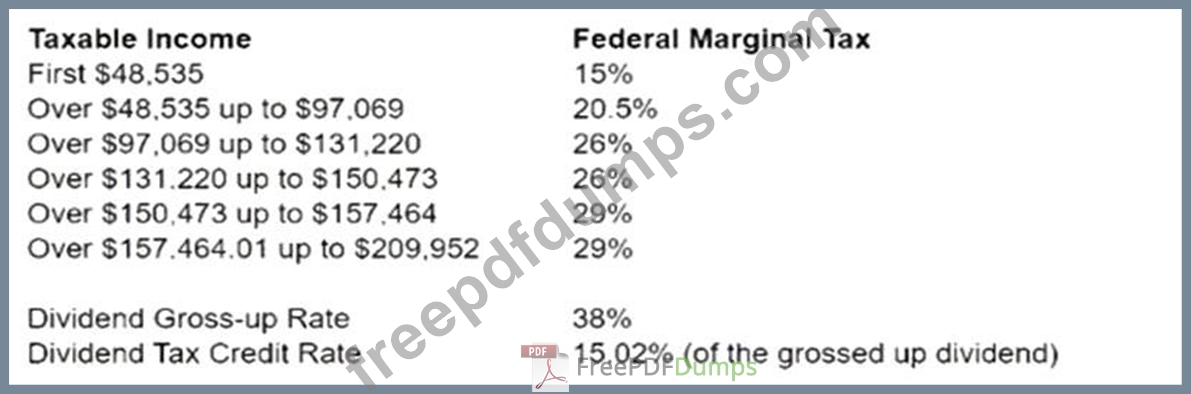
Last year Peter's earned income from employment was $50,000. Last year, after receiving a $2 per share in dividends from 500 shares in ABC Inc., a publicly-traded Canadian corporation, he sold his shares. The sale resulted in a capital gain of $15,000. Based on the tax rates mentioned above, what is Peter's net federal tax liability for the year? (Round to 2 decimal places).
Correct Answer: B
To calculate Peter's net federal tax liability for the year, we need to follow these steps: * Step 1: Calculate Peter's taxable income. This is the amount of income that is subject to federal income tax. It is equal to his earned income from employment plus his net capital gain plus his grossed-up dividend income. A net capital gain is 50% of the capital gain realized from selling an asset. A grossed- up dividend income is the actual dividend received plus a percentage of the dividend that reflects the corporate tax paid by the issuer. According to the image, the dividend gross-up rate is 15.02%. Therefore, Peter's taxable income is: 50000+0.5×15000+(500×2)×(1+0.1502)=68251.00 * Step 2: Apply the federal tax rates to Peter's taxable income according to the tax brackets shown in the image. The federal tax rates are progressive, meaning that higher income is taxed at higher rates. Therefore, Peter's federal tax before credits is: 0.15×(48535#0)+0.205×(68251#48535)=11293.69 * Step 3: Subtract the federal tax credits from Peter's federal tax before credits. A tax credit is an amount that reduces the tax payable by a taxpayer. There are two types of federal tax credits: non-refundable and refundable. Non-refundable tax credits can only reduce the tax payable to zero, but not below zero. Refundable tax credits can reduce the tax payable below zero, resulting in a refund to the taxpayer. In this question, we assume that Peter only has two non-refundable tax credits: the basic personal amount and the dividend tax credit. The basic personal amount is a fixed amount that every taxpayer can claim to reduce their taxable income. According tothis site, the basic personal amount for 2021 is $13,808. The dividend tax credit is a percentage of the grossed-up dividend income that reflects the corporate tax paid by the issuer and avoids double taxation. According tothis site, the federal dividend tax credit rate for eligible dividends in 2021 is 15.0198%.Therefore, Peter's federal tax credits are: 0.15×13808+0.150198×(500×2)×0.1502=2100 * Step 4: Subtract Peter's federal tax credits from his federal tax before credits to get his net federal tax liability. This is the amount of federal income tax that Peter has to pay or has overpaid for the year. Therefore, Peter's net federal tax liability is: 11293.69#2100=9193.69 Hence, option B is correct. References:Federal Income Tax Rates for Canada - TurboTax Canada Tips, Capital Gains Tax in Canada | Wealthsimple, Dividend Tax Credit | TurboTax Canada Tips, Basic Personal Amount (BPA)
IFC Exam Question 97
Your soon-to-be-retired client has accumulated $700,000 in a mutual fund investment. He has consulted with you with respect to systematic withdrawal plans. His other sources of income in retirement are uncertain. He is not interested in leaving a legacy at his death. Which plan would best suit his needs?
Correct Answer: A
Comprehensive and Detailed Explanation From Exact Extract: An annuity provides a steady income stream until the client's death, suitable for someone with uncertain income sources and no interest in leaving a legacy. The feedback from the document states: "The client needs a steady source of income from his investment. This rules out a ratio withdrawal plan and a life withdrawal plan. With a fixed-dollar withdrawal plan his capital could be exhausted before he dies. He should choose an annuity that will pay a fixed amount every year until his death. If he lives beyond the guaranteed term, the annuity will cease with his death, but this fact is not important as he does not wish to leave a legacy." Reference:Chapter 16 - Mutual Fund Fees and ServicesLearning Domain:Evaluating and Selecting Mutual Funds
IFC Exam Question 98
Thomas, a resident of Ontario, is a full-time university student. He does food delivery to supplement his income. During the school year, he works on weekends and works full-time during his summer break. Thomas' pensionable earnings were $16,000 for the year. How much must Thomas contribute to CPP when CPP contribution rate is 5.95%?
Correct Answer: B
Thomas must contribute to CPP based on his pensionable earnings, which are his income from employment or self-employment that are subject to CPP. However, he can deduct a basic exemption amount from his pensionable earnings, which is $3,500 for the year. Therefore, his contributory earnings are: 16,000#3,500=12,500 The CPP contribution rate is 5.95% for employees and self-employed workers. Therefore, Thomas must contribute: 12,500×5.95%=743.75 : Canadian Investment Funds Course (CIFC) Study Guide, Chapter 6: Registered Plans, Section 6.3: Canada Pension Plan (CPP), page 6-101 Canada Pension Plan - How much could you receive - Canada.ca2
IFC Exam Question 99
What role do investment dealers play in the Canadian and global financial markets?
Correct Answer: C
Investment dealers are people or firms who buy and sell securities for their own account, whether through a broker or otherwise. They play an important role in the Canadian and global financial markets because they are market makers, create liquidity, and help promote long-term growth in the market. They also provide investment services to investors, such as underwriting securities, raising capital, and offering advice. By assisting with the exchange of capital for a financial instrument, they facilitate the flow of funds between savers and borrowers, and between different sectors and countries. The other options are not accurate descriptions of the role of investment dealers. References: Dealers: Definition in Trading, Meaning and Comparison to Brokers, Investment Dealers Definition
IFC Exam Question 100
Which of the following statements about global equity funds is TRUE?
Correct Answer: A
Global equity funds are a type of investment fund that invests in equity securities of companies from different countries around the world, including the investment fund manager's home country. Global equity funds aim to provide diversification and growth potential by taking advantage of the opportunities and risks in various markets and regions. Global equity funds may have different geographic, sectoral, or thematic focuses, depending on their investment objectives and strategies. Global equity funds are different from international equity funds, which invest only in countries outside of the investment fund manager's home country. Global equity funds are also different from regional or country-specific equity funds, which specialize in one or a few countries or regions. Global equity funds may have higher risk than domestic equity funds, as they are exposed to currency risk, foreign market risk, political risk, and regulatory risk. Canadian Investment Funds Course, Chapter 4: Types of Investments1