In a FlexConnect deployment, which role does the site tag play?
Correct Answer: D
In the Cisco Catalyst 9800 IOS XE WLC configuration framework, the site tag serves as the primary organizational and functional grouping element for FlexConnect APs at a given physical location. The site tag defines the FlexConnect site - a logical boundary within which APs can perform local switching and local inter-AP roaming without requiring CAPWAP tunnel traversal to the WLC for every client handoff. Within a FlexConnect site defined by the site tag, APs can exchange client roaming context information directly with each other (peer-to-peer), enabling fast Layer 2 roaming for clients moving between APs that share the same site tag - effectively defining the roaming domain for FlexConnect APs at that site. The site tag also references the flex profile (which defines VLAN mappings, local auth settings, and split tunneling parameters) and the AP join profile. Switch port configuration (Option A) is performed on the infrastructure switches, not through the WLC site tag. IP address assignment (Option B) is a DHCP function. Firewall policies (Option C) are applied through ACLs and policy tags, not site tags. Reference: WLSD Study Guide - Catalyst 9800 Tag Architecture, FlexConnect Site Tag Role, Local Roaming in FlexConnect Deployments.
300-110 Exam Question 37
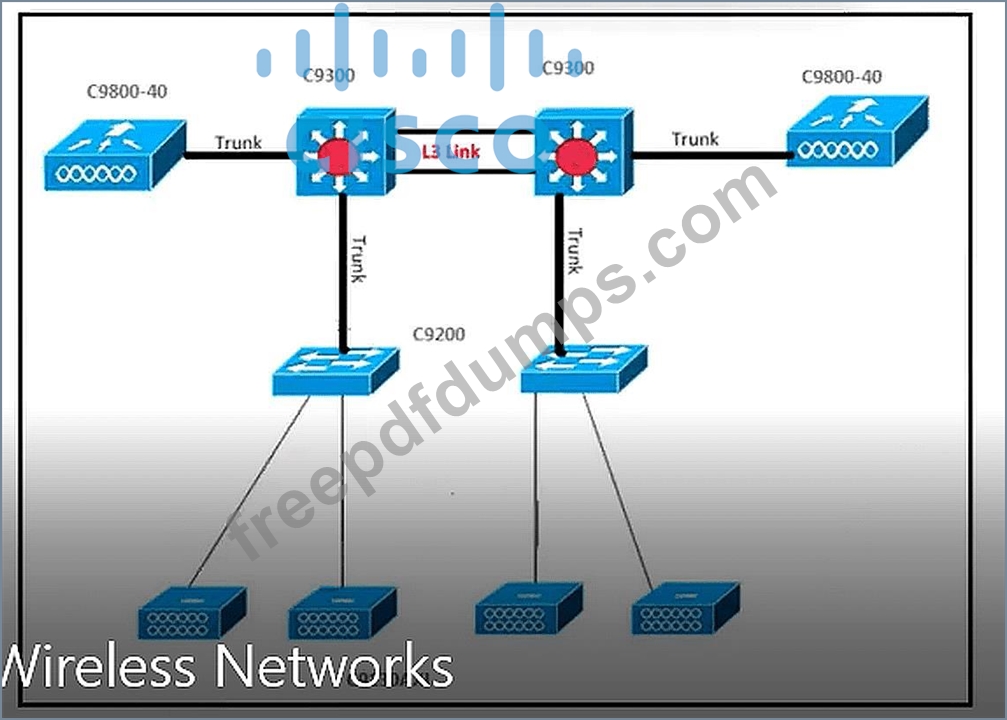
Refer to the exhibit. A network engineer is designing a high availability SSO on a Cisco Catalyst 9800-40 WLC with multi-LAG network redundancy on two Catalyst 9300 switches. The LAG requirements are: * Each LAG must be connected to a single switch. * Different VLANs must be assigned to different LAGs. * The controller must learn the identity of partners that can support LAG capabilities in each port. * When any active LAG ports fail, a standby LAG port must provide redundancy. Which protocol must be used for the port channel on the interface to meet the design requirements?
Correct Answer: A
The design requirements specify a multi-LAG configuration where each LAG connects to a single switch, different VLANs are assigned to different LAGs, the controller must dynamically learn partner LAG capabilities per port, and standby ports provide redundancy upon active port failure. These requirements collectively point to IEEE 802.3ad LACP (Link Aggregation Control Protocol) as the correct protocol. LACP is the industry-standard IEEE protocol that enables dynamic negotiation of LAG membership between endpoints - the WLC and each Catalyst 9300 switch exchange LACP PDUs (LACPDUs) to discover port capabilities, negotiate bundle membership, and monitor link status. LACP supports active and passive port states where active ports initiate negotiation and passive ports respond, and it provides the standby port mechanism through its hot-standby capability for link redundancy within the bundle. The requirement to ' learn the identity of partners that can support LAG capabilities ' is the defining characteristic of LACP ' s standardized PDU exchange mechanism. PAgP (Option C) is a Cisco proprietary port aggregation protocol that, while functionally similar, is not the IEEE standard and is incompatible with non-Cisco equipment in mixed environments. OSPF (Option B) and BGP (Option D) are Layer 3 routing protocols entirely unrelated to port channel negotiation. Reference: WLSD Study Guide - Catalyst 9800 LAG Configuration, LACP IEEE 802.3ad, Multi-LAG High Availability Design.
300-110 Exam Question 38
An enterprise is using wireless as the main network connectivity for clients. To ensure wireless network availability, two standalone controllers are installed in the head office. APs are connected to the controllers using a round-robin approach to load balance the traffic. After a power cut, the wireless clients disconnect while roaming. An engineer tried eping from the controller but fails. Which protocol needs to be allowed between the networks that the controllers are installed?
Correct Answer: D
When eping (EoIP ping) fails between two Cisco Wireless LAN Controllers, it indicates that the data path of the mobility tunnel is blocked. In Cisco AireOS wireless networks, the mobility data path uses IP Protocol 97 (EtherIP - Ethernet-over-IP encapsulation) for tunneling client traffic between the anchor and foreign controllers. This is distinct from the control path, which uses UDP port 16666. When the mobility data path (IP Protocol 97) is blocked by a firewall or ACL between the two controllers ' networks, eping will fail because eping specifically tests the EoIP data encapsulation path. After a power cut, when clients disconnect and attempt to roam between APs on different controllers, the mobility tunnel must be operational for session continuity. If IP Protocol 97 is blocked, the mobility data plane cannot function, causing client disconnections during inter-controller roaming events. The other IP protocols listed (67, 77, 87) are not used for Cisco WLC mobility tunneling. Reference: WLSD Study Guide - Mobility Tunnel Data Path, IP Protocol 97 (EtherIP), eping Command and Troubleshooting.
300-110 Exam Question 39
An engineer is using Ekahau Site Survey to create a WLAN plan for a warehouse. The plan is to use patch antennas. Which setting is adjusted when simulated APs are placed on the map?
Correct Answer: C
In Ekahau Site Survey, when planning a warehouse deployment using patch (directional) antennas, the antenna downtilt setting is the critical adjustment made when placing simulated APs on the floor plan map. Patch antennas have a defined radiation pattern with a main lobe that must be aimed precisely at the intended coverage zone. In a warehouse environment, APs with patch antennas are typically wall-mounted and aimed down aisles. The downtilt angle determines the vertical component of the antenna ' s aim - adjusting the downtilt in Ekahau tilts the simulated antenna ' s main radiation lobe downward toward the warehouse floor and the working zone of RF scanner devices, rather than projecting RF energy horizontally at an ineffective angle. Ekahau allows engineers to specify the horizontal and vertical orientation of the antenna in three dimensions, and the downtilt value directly controls how the software models the antenna ' s coverage pattern in the vertical plane. AP channel (Option A) is set during channel planning, not during AP placement. Wi-Fi technology (Option B) determines the modulation and protocol standard but is set as an AP property. AP transmission power (Option D) controls cell radius but is set separately from antenna orientation. Reference: WLSD Study Guide - Ekahau Predictive Survey, Directional Antenna Configuration, Warehouse RF Design and Antenna Orientation.
300-110 Exam Question 40
An engineer configured the optimized client roaming on Cisco WLC with an RSSI threshold of -72 dBm. Clients report frequent disconnections. What must be configured for the AP to guide the client to a better AP?
Correct Answer: A
The scenario presents a critical distinction in where Cisco WLC features are configured. Optimized roaming on Cisco WLC is a radio-level feature that monitors connected client RSSI and, when a client ' s signal falls below the configured threshold (-72 dBm), triggers a disassociation to force the client to reconnect to a stronger AP. However, without a mechanism to guide the client proactively before reaching the threshold, clients that disassociate simply reconnect to whatever AP their device selects, potentially causing the reported frequent disconnections. BSS Transition Management (802.11v) is configured at the SSID level and provides the complementary mechanism: before the client reaches the RSSI threshold, the AP sends a BSS Transition Management Request pointing the client toward a specific target AP with stronger signal. The correct architecture requires: optimized roaming configured at the radio level (triggering disconnection when RSSI falls too low) combined with BSS transition enabled at the SSID level (guiding the client to a better AP before forced disconnection). Options C and D incorrectly reverse the configuration levels for these features. Disabling coverage hole detection (Option B) addresses a different problem and would not resolve the disconnection issue. Reference: WLSD Study Guide - Optimized Roaming Configuration, BSS Transition Management (802.11v), Client Roaming Architecture on Cisco WLC.
Newest 300-110 Exam PDF Dumps shared by Actual4test.com for Helping Passing 300-110 Exam! Actual4test.com now offer the updated 300-110 exam dumps, the Actual4test.com 300-110 exam questions have been updated and answers have been corrected get the latest Actual4test.com 300-110 pdf dumps with Exam Engine here: