An organization has a requirement to collect full metadata information about the traffic going through their AWS cloud services They want to use this information for behavior analytics and statistics Which two actions must be taken to implement this requirement? (Choose two.)
Correct Answer: B,C
350-701 Exam Question 337
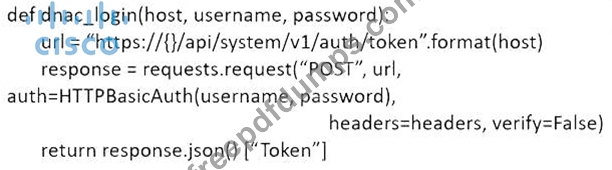
Refer to the exhibit. What is the result of the Python script?
Correct Answer: A
350-701 Exam Question 338
What is a characteristic of Cisco ASA Netflow v9 Secure Event Logging?
Correct Answer: A
The ASA and ASASM implementations of NetFlow Secure Event Logging (NSEL) provide a stateful, IP flow tracking method that exports only those records that indicate significant events in a flow. The significant events that are tracked include flow-create, flow-teardown, and flow-denied (excluding those flows that are denied by EtherType ACLs). Reference: https://www.cisco.com/c/en/us/td/docs/security/asa/asa92/configuration/general/asa-general-cli/ monitor-nsel.html The significant events that are tracked include flow-create, flow-teardown, and flow-denied (excluding those flows that are denied by EtherType ACLs). The ASA and ASASM implementations of NetFlow Secure Event Logging (NSEL) provide a stateful, IP flow tracking method that exports only those records that indicate significant events in a flow. The significant events that are tracked include flow-create, flow-teardown, and flow-denied (excluding those flows that are denied by EtherType ACLs). Reference: https://www.cisco.com/c/en/us/td/docs/security/asa/asa92/configuration/general/asa-general-cli/ monitor-nsel.html
350-701 Exam Question 339
Which benefit does endpoint security provide the overall security posture of an organization?
Correct Answer: A
350-701 Exam Question 340
Which two conditions are prerequisites for stateful failover for IPsec? (Choose two)
Correct Answer: C,E
Stateful failover for IP Security (IPsec) enables a router to continue processing and forwarding IPsec packets after a planned or unplanned outage occurs. Customers employ a backup (secondary) router that automatically takes over the tasks of the active (primary) router if the active router loses connectivity for any reason. This failover process is transparent to users and does not require adjustment or reconfiguration of any remote peer. Stateful failover for IPsec requires that your network contains two identical routers that are available to be either the primary or secondary device. Both routers should be the same type of device, have the same CPU and memory, and have either no encryption accelerator or identical encryption accelerators. Prerequisites for Stateful Failover for IPsec Complete, Duplicate IPsec and IKE Configuration on the Active and Standby Devices This document assumes that you have a complete IKE and IPsec configuration. The IKE and IPsec configuration that is set up on the active device must be duplicated on the standby device. That is, the crypto configuration must be identical with respect to Internet Security Association and Key Management Protocol (ISAKMP) policy, ISAKMP keys (preshared), IPsec profiles, IPsec transform sets, all crypto map sets that are used for stateful failover, all access control lists (ACLs) that are used in match address statements on crypto map sets, all AAA configurations used for crypto, client configuration groups, IP local pools used for crypto, and ISAKMP profiles. Reference: Although the prerequisites only stated that "Both routers should be the same type of device" but in the "Restrictions for Stateful Failover for IPsec" section of the link above, it requires "Both the active and standby devices must run the identical version of the Cisco IOS software" so answer E is better than answer B.