

CAS-004 Exam Question 146
Which of the following allows computation and analysis of data within a ciphertext without knowledge of the plaintext?
CAS-004 Exam Question 147
A product development team has submitted code snippets for review prior to release.
INSTRUCTIONS
Analyze the code snippets, and then select one vulnerability, and one fix for each code snippet.
Code Snippet 1

Code Snippet 2
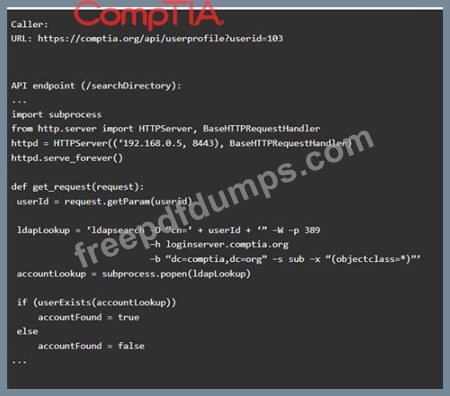
Vulnerability 1:
SQL injection
Cross-site request forgery
Server-side request forgery
Indirect object reference
Cross-site scripting
Fix 1:
Perform input sanitization of the userid field.
Perform output encoding of queryResponse,
Ensure usex:ia belongs to logged-in user.
Inspect URLS and disallow arbitrary requests.
Implement anti-forgery tokens.
Vulnerability 2
1) Denial of service
2) Command injection
3) SQL injection
4) Authorization bypass
5) Credentials passed via GET
Fix 2
A) Implement prepared statements and bind
variables.
B) Remove the serve_forever instruction.
C) Prevent the "authenticated" value from being overridden by a GET parameter.
D) HTTP POST should be used for sensitive parameters.
E) Perform input sanitization of the userid field.
INSTRUCTIONS
Analyze the code snippets, and then select one vulnerability, and one fix for each code snippet.
Code Snippet 1
Code Snippet 2
Vulnerability 1:
SQL injection
Cross-site request forgery
Server-side request forgery
Indirect object reference
Cross-site scripting
Fix 1:
Perform input sanitization of the userid field.
Perform output encoding of queryResponse,
Ensure usex:ia belongs to logged-in user.
Inspect URLS and disallow arbitrary requests.
Implement anti-forgery tokens.
Vulnerability 2
1) Denial of service
2) Command injection
3) SQL injection
4) Authorization bypass
5) Credentials passed via GET
Fix 2
A) Implement prepared statements and bind
variables.
B) Remove the serve_forever instruction.
C) Prevent the "authenticated" value from being overridden by a GET parameter.
D) HTTP POST should be used for sensitive parameters.
E) Perform input sanitization of the userid field.
CAS-004 Exam Question 148
A security architect needs to implement a CASB solution for an organization with a highly distributed remote workforce. One Of the requirements for the implementation includes the capability to discover SaaS applications and block access to those that are unapproved or identified as risky. Which of the following would BEST achieve this objective?
CAS-004 Exam Question 149
Which of the following BEST describes a common use case for homomorphic encryption ?
CAS-004 Exam Question 150
A user from the sales department opened a suspicious file attachment. The sales department then contacted the SOC to investigate a number of unresponsive systems, and the team successfully identified the file and the origin of the attack.
Which of the following is the NEXT step of the incident response plan?
Which of the following is the NEXT step of the incident response plan?