An organization has the following requirements that need to be met when implementing cloud services: SSO to cloud infrastructure On-premises directory service RBAC for IT staff Which of the following cloud models would meet these requirements?
Correct Answer: C
Explanation A hybrid cloud is a type of cloud deployment model that combines two or more different types of clouds, such as public, private, or community clouds, into a single integrated environment. A hybrid cloud can meet the requirements for implementing cloud services with SSO to cloud infrastructure, on-premises directory service, and RBAC for IT staff, as it can provide flexibility, scalability, and security for cloud-based and on-premises resources. A hybrid cloud can also enable seamless and secure access to cloud infrastructure using SSO with directory service federation, as well as granular and consistent control over IT staff permissions using RBAC across different cloud environments. References: CompTIA Cloud+ Certification Exam Objectives, page 8, section 1.2
CV0-003 Exam Question 2
A VDI administrator has received reports of poor application performance. Which of the following should the administrator troubleshoot FIRST?
Correct Answer: A
Explanation The network environment is the set of network devices, connections, protocols, and configurations that enable communication and data transfer between different systems and applications. The network environment can affect the performance of a virtual desktop infrastructure (VDI) by influencing factors such as bandwidth, latency, jitter, packet loss, and congestion. Poor network performance can result in slow or unreliable application delivery, degraded user experience, and reduced productivity. Therefore, troubleshooting the network environment should be the first step for a VDI administrator who receives reports of poor application performance. References: CompTIA Cloud+ Certification Exam Objectives, page 17, section 3.4
CV0-003 Exam Question 3
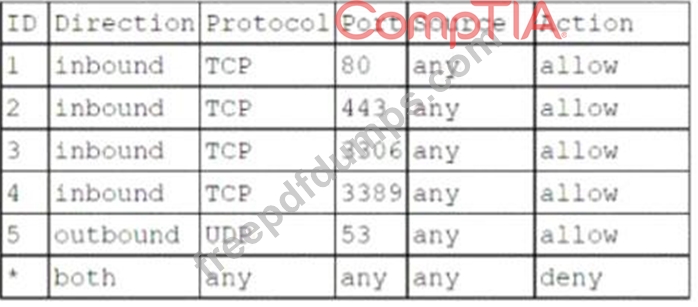
A cloud security analyst needs to ensure the web servers in the public subnet allow only secure communications and must remediate any possible issue. The stateful configuration for the public web servers is as follows: Which Of the following actions Should the analyst take to accomplish the Objective?
Correct Answer: B
Explanation The correct answer is B. Remove rules 1, 3, and 4. The objective is to ensure the web servers in the public subnet allow only secure communications. This means that only HTTPS traffic should be allowed on port 443, which is the standard port for secure web connections. HTTPS traffic uses the TCP protocol and encrypts the data between the client and the server. Rule 1 allows all TCP traffic on any port from any source. This is too permissive and exposes the web servers to potential attacks or unauthorized access. Rule 1 should be removed to restrict the TCP traffic to only port 443. Rule 3 allows all UDP traffic on any port from any source. UDP is a connectionless protocol that does not guarantee reliable or secure delivery of data. UDP is typically used for streaming media, voice over IP (VoIP), or online gaming, but not for web servers. Rule 3 should be removed to prevent unnecessary or malicious UDP traffic. Rule 4 allows all ICMP traffic from any source. ICMP is a protocol that is used for diagnostic or control purposes, such as ping or traceroute. ICMP traffic can be used by attackers to scan or probe the network for vulnerabilities or information. Rule 4 should be removed to block ICMP traffic and reduce the attack surface. Rule 2 allows TCP traffic on port 443 from any source. This is the desired rule that allows secure web communications using HTTPS. Rule 2 should be kept. Rule 5 denies all other traffic that does not match any of the previous rules. This is the default rule that provides a catch-all protection for the web servers. Rule 5 should be kept. Therefore, the analyst should remove rules 1, 3, and 4 to accomplish the objective.
CV0-003 Exam Question 4
A company is currently running a website on site. However, because of a business requirement to reduce current RTO from 12 hours to one hour, and the RPO from one day to eight hours, the company is considering operating in a hybrid environment. The website uses mostly static files and a small relational database. Which of the following should the cloud architect implement to achieve the objective at the LOWEST cost possible?
Correct Answer: C
Explanation This is the best solution to achieve the objective of reducing current RTO (Recovery Time Objective) from 12 hours to one hour, and RPO (Recovery Point Objective) from one day to eight hours, at the lowest cost possible, for a website that uses mostly static files and a small relational database. RTO is a metric that measures how quickly a system or service can be restored after a disruption or disaster. RPO is a metric that measures how much data can be lost or how far back in time a recovery point can be without causing significant impact or damage. To reduce RTO and RPO, the administrator should implement a website replica in the cloud with auto-scaling using the smallest possible footprint. A website replica is a copy or backup of a website that can be used for recovery or failover purposes. Auto-scaling is a feature that allows cloud resources or systems to adjust their capacity and performance according to demand or workload. Using auto-scaling with the smallest possible footprint can minimize costs by using only the necessary resources and scaling up or down as needed. The administrator should also use DNS (Domain Name System) to shift the load from on premises to the cloud. DNS is a service that translates domain names into IP addresses and vice versa. Using DNS, the administrator can redirect traffic from the on-premises website to the cloud replica in case of a disruption or disaster, and vice versa when recovery is complete.
CV0-003 Exam Question 5
An update is being deployed to a web application, and a systems administrator notices the cloud SQL database has stopped running. The VM is responding to pings, and there were not any configuration changes scheduled for the VM. Which of the following should the administrator check NEXT?
Correct Answer: A
Explanation Checking the logs on the VM is the next step that the administrator should take if the cloud SQL database has stopped running after an update deployment. Logs are records of events and activities that occur on a system or application. Logs can provide useful information for troubleshooting and identifying the root cause of an issue. The administrator should look for any errors, warnings, or messages that indicate what happened to the SQL database service and why it stopped running.