

Professional-Cloud-Architect Exam Question 96
You are analyzing and defining business processes to support your startup's trial usage of GCP, and you don't yet know what consumer demand for your product will be. Your manager requires you to minimize GCP service costs and adhere to Google best practices. What should you do?
Professional-Cloud-Architect Exam Question 97
Case Study: 2 - TerramEarth Case Study
Company Overview
TerramEarth manufactures heavy equipment for the mining and agricultural industries: About
80% of their business is from mining and 20% from agriculture. They currently have over 500 dealers and service centers in 100 countries. Their mission is to build products that make their customers more productive.
Company Background
TerramEarth formed in 1946, when several small, family owned companies combined to retool after World War II. The company cares about their employees and customers and considers them to be extended members of their family.
TerramEarth is proud of their ability to innovate on their core products and find new markets as their customers' needs change. For the past 20 years trends in the industry have been largely toward increasing productivity by using larger vehicles with a human operator.
Solution Concept
There are 20 million TerramEarth vehicles in operation that collect 120 fields of data per second.
Data is stored locally on the vehicle and can be accessed for analysis when a vehicle is serviced.
The data is downloaded via a maintenance port. This same port can be used to adjust operational parameters, allowing the vehicles to be upgraded in the field with new computing modules.
Approximately 200,000 vehicles are connected to a cellular network, allowing TerramEarth to collect data directly. At a rate of 120 fields of data per second, with 22 hours of operation per day.
TerramEarth collects a total of about 9 TB/day from these connected vehicles.
Existing Technical Environment
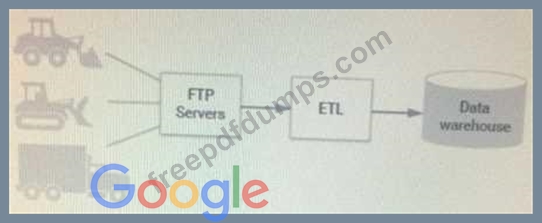
TerramEarth's existing architecture is composed of Linux-based systems that reside in a data center. These systems gzip CSV files from the field and upload via FTP, transform and aggregate them, and place the data in their data warehouse. Because this process takes time, aggregated reports are based on data that is 3 weeks old.
With this data, TerramEarth has been able to preemptively stock replacement parts and reduce unplanned downtime of their vehicles by 60%. However, because the data is stale, some customers are without their vehicles for up to 4 weeks while they wait for replacement parts.
Business Requirements
- Decrease unplanned vehicle downtime to less than 1 week, without
increasing the cost of carrying surplus inventory
- Support the dealer network with more data on how their customers use
their equipment IP better position new products and services.
- Have the ability to partner with different companies-especially with
seed and fertilizer suppliers in the fast-growing agricultural
business-to create compelling joint offerings for their customers
CEO Statement
We have been successful in capitalizing on the trend toward larger vehicles to increase the productivity of our customers. Technological change is occurring rapidly and TerramEarth has taken advantage of connected devices technology to provide our customers with better services, such as our intelligent farming equipment. With this technology, we have been able to increase farmers' yields by 25%, by using past trends to adjust how our vehicles operate. These advances have led to the rapid growth of our agricultural product line, which we expect will generate 50% of our revenues by 2020.
CTO Statement
Our competitive advantage has always been in the manufacturing process with our ability to build better vehicles for tower cost than our competitors. However, new products with different approaches are constantly being developed, and I'm concerned that we lack the skills to undergo the next wave of transformations in our industry. Unfortunately, our CEO doesn't take technology obsolescence seriously and he considers the many new companies in our industry to be niche players. My goals are to build our skills while addressing immediate market needs through incremental innovations.
Your agricultural division is experimenting with fully autonomous vehicles. You want your architecture to promote strong security during vehicle operation.
Which two architectures should you consider? (Choose two.)
Company Overview
TerramEarth manufactures heavy equipment for the mining and agricultural industries: About
80% of their business is from mining and 20% from agriculture. They currently have over 500 dealers and service centers in 100 countries. Their mission is to build products that make their customers more productive.
Company Background
TerramEarth formed in 1946, when several small, family owned companies combined to retool after World War II. The company cares about their employees and customers and considers them to be extended members of their family.
TerramEarth is proud of their ability to innovate on their core products and find new markets as their customers' needs change. For the past 20 years trends in the industry have been largely toward increasing productivity by using larger vehicles with a human operator.
Solution Concept
There are 20 million TerramEarth vehicles in operation that collect 120 fields of data per second.
Data is stored locally on the vehicle and can be accessed for analysis when a vehicle is serviced.
The data is downloaded via a maintenance port. This same port can be used to adjust operational parameters, allowing the vehicles to be upgraded in the field with new computing modules.
Approximately 200,000 vehicles are connected to a cellular network, allowing TerramEarth to collect data directly. At a rate of 120 fields of data per second, with 22 hours of operation per day.
TerramEarth collects a total of about 9 TB/day from these connected vehicles.
Existing Technical Environment
TerramEarth's existing architecture is composed of Linux-based systems that reside in a data center. These systems gzip CSV files from the field and upload via FTP, transform and aggregate them, and place the data in their data warehouse. Because this process takes time, aggregated reports are based on data that is 3 weeks old.
With this data, TerramEarth has been able to preemptively stock replacement parts and reduce unplanned downtime of their vehicles by 60%. However, because the data is stale, some customers are without their vehicles for up to 4 weeks while they wait for replacement parts.
Business Requirements
- Decrease unplanned vehicle downtime to less than 1 week, without
increasing the cost of carrying surplus inventory
- Support the dealer network with more data on how their customers use
their equipment IP better position new products and services.
- Have the ability to partner with different companies-especially with
seed and fertilizer suppliers in the fast-growing agricultural
business-to create compelling joint offerings for their customers
CEO Statement
We have been successful in capitalizing on the trend toward larger vehicles to increase the productivity of our customers. Technological change is occurring rapidly and TerramEarth has taken advantage of connected devices technology to provide our customers with better services, such as our intelligent farming equipment. With this technology, we have been able to increase farmers' yields by 25%, by using past trends to adjust how our vehicles operate. These advances have led to the rapid growth of our agricultural product line, which we expect will generate 50% of our revenues by 2020.
CTO Statement
Our competitive advantage has always been in the manufacturing process with our ability to build better vehicles for tower cost than our competitors. However, new products with different approaches are constantly being developed, and I'm concerned that we lack the skills to undergo the next wave of transformations in our industry. Unfortunately, our CEO doesn't take technology obsolescence seriously and he considers the many new companies in our industry to be niche players. My goals are to build our skills while addressing immediate market needs through incremental innovations.
Your agricultural division is experimenting with fully autonomous vehicles. You want your architecture to promote strong security during vehicle operation.
Which two architectures should you consider? (Choose two.)
Professional-Cloud-Architect Exam Question 98
The operations manager asks you for a list of recommended practices that she should consider when migrating a J2EE application to the cloud. Which three practices should you recommend? Choose 3 answers
Professional-Cloud-Architect Exam Question 99
Your company runs several databases on a single MySQL instance. They need to take backups of a specific database at regular intervals. The backup activity needs to complete as quickly as possible and cannot be allowed to impact disk performance. How should you configure the storage?
Professional-Cloud-Architect Exam Question 100
Case Study: 1 - Mountkirk Games Case Study
Company Overview
Mountkirk Games makes online, session-based. multiplayer games for the most popular mobile platforms.
Company Background
Mountkirk Games builds all of their games with some server-side integration and has historically used cloud providers to lease physical servers. A few of their games were more popular than expected, and they had problems scaling their application servers, MySQL databases, and analytics tools.
Mountkirk's current model is to write game statistics to files and send them through an ETL tool that loads them into a centralized MySQL database for reporting.
Solution Concept
Mountkirk Games is building a new game, which they expect to be very popular. They plan to deploy the game's backend on Google Compute Engine so they can capture streaming metrics, run intensive analytics and take advantage of its autoscaling server environment and integrate with a managed NoSQL database.
Technical Requirements
Requirements for Game Backend Platform
1. Dynamically scale up or down based on game activity.
2. Connect to a managed NoSQL database service.
3. Run customized Linx distro.
Requirements for Game Analytics Platform
1. Dynamically scale up or down based on game activity.
2. Process incoming data on the fly directly from the game servers.
3. Process data that arrives late because of slow mobile networks.
4. Allow SQL queries to access at least 10 TB of historical data.
5. Process files that are regularly uploaded by users' mobile devices.
6. Use only fully managed services
CEO Statement
Our last successful game did not scale well with our previous cloud provider, resuming in lower user adoption and affecting the game's reputation. Our investors want more key performance indicators (KPIs) to evaluate the speed and stability of the game, as well as other metrics that provide deeper insight into usage patterns so we can adapt the gams to target users.
CTO Statement
Our current technology stack cannot provide the scale we need, so we want to replace MySQL and move to an environment that provides autoscaling, low latency load balancing, and frees us up from managing physical servers.
CFO Statement
We are not capturing enough user demographic data usage metrics, and other KPIs. As a result, we do not engage the right users. We are not confident that our marketing is targeting the right users, and we are not selling enough premium Blast-Ups inside the games, which dramatically impacts our revenue.
For this question, refer to the Mountkirk Games case study. Mountkirk Games wants to set up a continuous delivery pipeline. Their architecture includes many small services that they want to be able to update and roll back quickly. Mountkirk Games has the following requirements:
- Services are deployed redundantly across multiple regions in the US
and Europe.
- Only frontend services are exposed on the public internet.
- They can provide a single frontend IP for their fleet of services.
- Deployment artifacts are immutable.
Which set of products should they use?
Company Overview
Mountkirk Games makes online, session-based. multiplayer games for the most popular mobile platforms.
Company Background
Mountkirk Games builds all of their games with some server-side integration and has historically used cloud providers to lease physical servers. A few of their games were more popular than expected, and they had problems scaling their application servers, MySQL databases, and analytics tools.
Mountkirk's current model is to write game statistics to files and send them through an ETL tool that loads them into a centralized MySQL database for reporting.
Solution Concept
Mountkirk Games is building a new game, which they expect to be very popular. They plan to deploy the game's backend on Google Compute Engine so they can capture streaming metrics, run intensive analytics and take advantage of its autoscaling server environment and integrate with a managed NoSQL database.
Technical Requirements
Requirements for Game Backend Platform
1. Dynamically scale up or down based on game activity.
2. Connect to a managed NoSQL database service.
3. Run customized Linx distro.
Requirements for Game Analytics Platform
1. Dynamically scale up or down based on game activity.
2. Process incoming data on the fly directly from the game servers.
3. Process data that arrives late because of slow mobile networks.
4. Allow SQL queries to access at least 10 TB of historical data.
5. Process files that are regularly uploaded by users' mobile devices.
6. Use only fully managed services
CEO Statement
Our last successful game did not scale well with our previous cloud provider, resuming in lower user adoption and affecting the game's reputation. Our investors want more key performance indicators (KPIs) to evaluate the speed and stability of the game, as well as other metrics that provide deeper insight into usage patterns so we can adapt the gams to target users.
CTO Statement
Our current technology stack cannot provide the scale we need, so we want to replace MySQL and move to an environment that provides autoscaling, low latency load balancing, and frees us up from managing physical servers.
CFO Statement
We are not capturing enough user demographic data usage metrics, and other KPIs. As a result, we do not engage the right users. We are not confident that our marketing is targeting the right users, and we are not selling enough premium Blast-Ups inside the games, which dramatically impacts our revenue.
For this question, refer to the Mountkirk Games case study. Mountkirk Games wants to set up a continuous delivery pipeline. Their architecture includes many small services that they want to be able to update and roll back quickly. Mountkirk Games has the following requirements:
- Services are deployed redundantly across multiple regions in the US
and Europe.
- Only frontend services are exposed on the public internet.
- They can provide a single frontend IP for their fleet of services.
- Deployment artifacts are immutable.
Which set of products should they use?