Which correctly characterizes HPE ProLiant Compute XD685 servers?
Correct Answer: B
B is correct. HPE ProLiant Compute XD685 is a purpose-built accelerated system for large AI training and tuning workloads. Current HPE configurations support eight NVIDIA Blackwell-family GPUs, including B200 and Blackwell Ultra options, in a dense direct-liquid-cooled 5U chassis. The platform also uses HPE Integrated Lights-Out (iLO) for secure server-level management, giving it the familiar HPE management and security foundation expected in enterprise deployments. Option A is incorrect in processor count, GPU generation, and management characterization. The XD685 is not a four-processor/four-GPU Lovelace design with a choice between unrelated management controllers. Option C describes a multi-node scale-out chassis architecture that does not match the XD685; the 5U system is a single accelerated server platform with eight GPUs. Option D similarly invents an eight-processor, 8 TB scale-up design. The exam objective is not merely to memorize a model name. The XD685 is positioned where workload requirements demand very high GPU density, large-model training capability, fast accelerator interconnects, and enterprise serviceability. References/topics: Advanced HPE Compute Solutions, Rev. 26.21, Module 1 "HPE solutions for AI"; HPE ProLiant Compute XD685 product specifications and current HPE Blackwell platform materials.
HPE7-S02 Exam Question 12
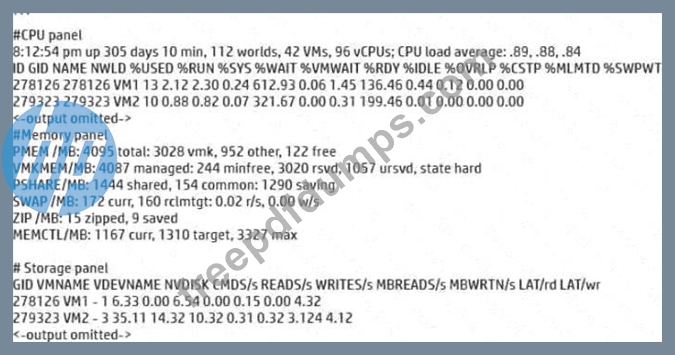
You are helping a customer troubleshoot performance issues on an HPE ProLiant DL server acting as a VMware ESXi host. You have used the esxtop command, and the output is shown below. (In this output, the details for many VMs have been omitted; however, other VMs have similar stats to the ones that are shown.) Based on this output, what should you explain?
Correct Answer: A
A is correct. The esxtop output indicates memory pressure rather than CPU or storage saturation. The host has only about 122 MB of free physical memory, the VMkernel memory state is shown as hard, ballooning is active, and swap is in use. Those are strong indicators that ESXi is reclaiming memory because demand is approaching or exceeding comfortable physical capacity. Reclamation can increase latency sharply, especially when guest memory is swapped to storage. The CPU figures do not show the classic signature of CPU contention. The displayed VMs have low %RDY values, so they are not spending excessive time waiting for physical CPU scheduling. The storage panel also shows relatively low read/write latency for the displayed workloads, which does not support a storage- controller or storage-network bottleneck as the primary cause. The appropriate remediation is therefore to add physical memory, reduce VM memory commitments, or evacuate some VMs to other hosts. The screenshot is a good example of why VMware troubleshooting should correlate multiple esxtop panels rather than infer the bottleneck from utilization alone. References/topics: Advanced HPE Compute Solutions, Rev. 26.21, Module 8 "Troubleshooting HPE running VMware"; VMware ESXi esxtop memory-reclamation concepts.
HPE7-S02 Exam Question 13
A hospital wants to fine-tune an LLM on their own dataset. However, the data needs to have sensitive information redacted. Duplicate records also need to be cleaned up. What can the customer use to achieve this goal?
Correct Answer: D
D is correct. NVIDIA NeMo Curator is the data-curation component intended to prepare large datasets for generative-AI training and fine-tuning. Its pipeline capabilities include filtering, quality processing, deduplication, and privacy-oriented data preparation. That directly matches both requirements in the scenario: duplicate records must be removed and sensitive information must be redacted before the hospital's dataset is used to adapt the LLM. Performing these controls before fine-tuning reduces data leakage risk and prevents repeated records from biasing training. The distractors address different stages of the AI lifecycle. MLflow is principally used for experiment tracking, model lifecycle management, and related MLOps functions; it is not the primary tool for cleansing the raw training corpus. NeMo Customizer performs model customization or fine-tuning after an appropriate dataset has been prepared. Katib is a Kubernetes-native hyperparameter-optimization component and does not provide the required privacy redaction and deduplication workflow. The sequencing matters: curate the data first, then customize and evaluate the model. That separation is part of the software-stack knowledge expected for HPE Private Cloud AI with NVIDIA. References/topics: Advanced HPE Compute Solutions, Rev. 26.21, Module 5 "Using NVIDIA AI Enterprise and Serving Models," NeMo deep dive; NVIDIA NeMo Curator documentation.
HPE7-S02 Exam Question 14
An AI team is using Spark Applications to analyze and format data for AI fine-tuning. The team would like to automate running the applications in a series. Which component of HPE AI Essentials can help?
Correct Answer: B
B is correct. Airflow is the workflow-orchestration component in HPE AI Essentials. It is designed to define directed acyclic graphs (DAGs) whose tasks execute in a controlled sequence based on dependencies. If a team has several Spark applications that prepare, transform, and validate data before model fine-tuning, Airflow can schedule those applications as stages in a repeatable pipeline and coordinate retries, dependencies, and execution order. Katib and Ray Tune are focused on hyperparameter optimization rather than general-purpose workflow orchestration. MLflow tracks experiments, runs, artifacts, and model lifecycle information; it is not the scheduler that executes an ordered series of Spark jobs. Airflow complements these components rather than replacing them. The key exam distinction is between orchestration and execution engines. Spark performs distributed data processing. Airflow controls when the Spark applications run and how one stage depends on another. That separation permits the data-preparation pipeline to be automated without embedding orchestration logic inside each Spark application. References/topics: Advanced HPE Compute Solutions, Rev. 26.21, Module 4 "Using Spark" and "Airflow"; HPE AI Essentials Software Airflow documentation.
HPE7-S02 Exam Question 15
An HPE Private Cloud AI User wants to use KServe to run a NIM that is available in NGC. What is one prerequisite?
Correct Answer: D
D is correct. A NIM image hosted in NVIDIA NGC is protected by NVIDIA registry authentication. To allow KServe in a user namespace to pull that image, the user needs a valid NGC API key and a Kubernetes secret containing the corresponding registry credentials in the namespace where the InferenceService will run. The workload can then reference that secret for the image pull or other required NGC access. Option A describes registering NGC with HPE Machine Learning Inference Software. That is relevant when MLIS is the serving mechanism, but the scenario explicitly uses KServe. Option B is not how NVIDIA AI Enterprise is made available to HPE AI Essentials; it is not imported as a user Helm chart. Option C is also invalid because KServe does not require special "decorators" in application code to launch a NIM. Namespace placement matters because Kubernetes secrets are namespace-scoped. A secret created elsewhere is not automatically available to the user's KServe deployment. References/topics: Advanced HPE Compute Solutions, Rev. 26.21, Module 5 "Other options for serving models on HPE Private Cloud AI" and NVIDIA AI Enterprise; HPE AI Essentials KServe guidance; NVIDIA NGC authentication documentation.