Which of the following statements pertaining to a Criticality Survey is incorrect?
Correct Answer: A
Explanation/Reference: Explanation: The Criticality Survey is implemented through a standard questionnaire to gather input from the most knowledgeable people. Not all personnel that is going to be part of recovery teams is necessarily able to help in identifying critical functions of the organization. The intent of such a survey is to identify the services and systems that are critical to the organization. Having a clearly stated purpose for the survey helps in avoiding misinterpretations. Management's approval of the survey should be obtained before distributing it. References: HARE, Chris, CISSP Study Guide: Business Continuity Planning Domain.
CISSP Exam Question 57
Serial data transmission in which information can be transmitted in two directions, but only one direction at a time, is called:
Correct Answer: D
The time required to switch transmission directions in a half-duplex line is called the turnaround time. *Answer simplex refers to communication that takes place in one direction only. *Answer Synchronized is a distracter. *Full-duplex can transmit and receive information in both directions simultaneously. The transmissions can be asynchronous or synchronous. In asynchronous transmission, a start bit is used to indicate the beginning of transmission. The start bit is followed by data bits and, then, by one or two stop bits to indicate the end of the transmission. Since start and stop bits are sent with every unit of data, the actual data transmission rate is lower since these overhead bits are used for synchronization and do not carry information. In this mode, data is sent only when it is available and the data is not transmitted continuously. In synchronous transmission, the transmitter and receiver have synchronized clocks and the data is sent in a continuous stream. The clocks are synchronized by using transitions in the data and, therefore, start and stop bits are not required for each unit of data sent.
CISSP Exam Question 58
From an asset security perspective, what is the BEST countermeasure to prevent data theft due to data remanence when a sensitive data storage media is no longer needed?
Correct Answer: D
CISSP Exam Question 59
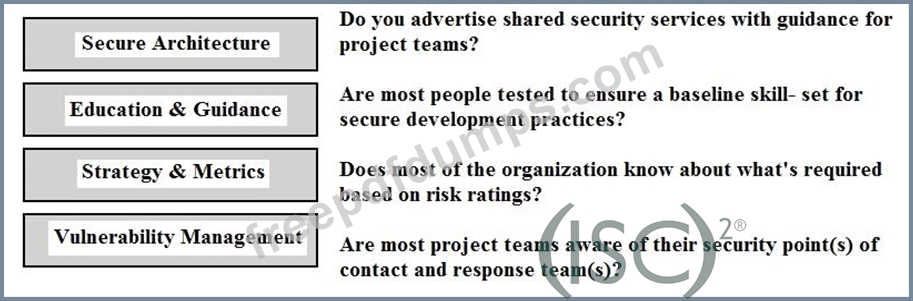
Match the objectives to the assessment questions in the governance domain of Software Assurance Maturity Model (SAMM).
Correct Answer:
CISSP Exam Question 60
Electrical systems are the lifeblood of computer operations. The continued supply of clean, steady power is required to maintain the proper personnel environment as well as to sustain data operations. Which of the following is not an element that can threaten power systems?
Correct Answer: D
Explanation/Reference: Explanation: An uninterruptible power supply (UPS) helps to ensure the continued supply of clean, steady power; it does not threaten it. An uninterruptible power supply (UPS) is an electrical apparatus that provides emergency power to a load when the input power source, typically mains power, fails. A UPS differs from an auxiliary or emergency power system or standby generator in that it will provide near-instantaneous protection from input power interruptions, by supplying energy stored in batteries, supercapacitors, or flywheels. The on-battery runtime of most uninterruptible power sources is relatively short (only a few minutes) but sufficient to start a standby power source or properly shut down the protected equipment. Incorrect Answers: A: Transient Noise is an element that can threaten power systems. Therefore, this answer is incorrect. B: Faulty Ground is an element that can threaten power systems. Therefore, this answer is incorrect. C: A brownout is a prolonged period of lower than expected voltage; this an element that can threaten power systems. Therefore, this answer is incorrect. References: https://en.wikipedia.org/wiki/Uninterruptible_power_supply