

SSCP Exam Question 631
A confidential number used as an authentication factor to verify a user's identity is called a:
Correct Answer: A
PIN Stands for Personal Identification Number, as the name states it is a
combination of numbers.
The following answers are incorrect:
User ID This is incorrect because a Userid is not required to be a number and a Userid is
only used to establish identity not verify it.
Password. This is incorrect because a password is not required to be a number, it could be
any combination of characters.
Challenge. This is incorrect because a challenge is not defined as a number, it could be
anything.
SSCP Exam Question 632
Which of the following rules is least likely to support the concept of least privilege?
Correct Answer: D
Section: Security Operation Adimnistration
Explanation/Reference:
Only data to and from critical systems and applications should be allowed through the firewall is a detractor.
Critical systems or applications do not necessarily need to have traffic go through a firewall. Even if they did, only the minimum required services should be allowed. Systems that are not deemed critical may also need to have traffic go through the firewall.
Least privilege is a basic tenet of computer security that means users should be given only those rights required to do their jobs or tasks. Least privilege is ensuring that you have the minimum privileges necessary to do a task. An admin NOT using his admin account to check email is a clear example of this.
Reference(s) used for this question:
National Security Agency, Systems and Network Attack Center (SNAC), The 60 Minute Network Security Guide, February 2002, page 9.
SSCP Exam Question 633
Which of the following is an IP address that is private (i.e. reserved for internal networks, and not a valid address to use on the Internet)?
Correct Answer: A
Section: Network and Telecommunications
Explanation/Reference:
This is a valid Class A reserved address. For Class A, the reserved addresses are 10.0.0.0 - 10.255.255.255.
The following answers are incorrect:
11.0.42.5 Is incorrect because it is not a Class A reserved address.
12.0.42.5 Is incorrect because it is not a Class A reserved address.
13.0.42.5 Is incorrect because it is not a Class A reserved address.
The private IP address ranges are defined within RFC 1918:
RFC 1918 private ip address range
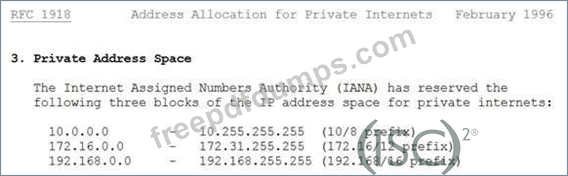
References:
3Com http://www.3com.com/other/pdfs/infra/corpinfo/en_US/501302.pdf
AIOv3 Telecommunications and Networking Security (page 438)
Explanation/Reference:
This is a valid Class A reserved address. For Class A, the reserved addresses are 10.0.0.0 - 10.255.255.255.
The following answers are incorrect:
11.0.42.5 Is incorrect because it is not a Class A reserved address.
12.0.42.5 Is incorrect because it is not a Class A reserved address.
13.0.42.5 Is incorrect because it is not a Class A reserved address.
The private IP address ranges are defined within RFC 1918:
RFC 1918 private ip address range
References:
3Com http://www.3com.com/other/pdfs/infra/corpinfo/en_US/501302.pdf
AIOv3 Telecommunications and Networking Security (page 438)
SSCP Exam Question 634
Which of the following transmission media would NOT be affected by cross talk or interference?
Correct Answer: D
Explanation/Reference:
Only fiber optic cables are not affected by crosstalk or interference.
For your exam you should know the information about transmission media:
Copper Cable
Copper cable is very simple to install and easy to tap. It is used mostly for short distance and supports voice and data.
Copper has been used in electric wiring since the invention of the electromagnet and the telegraph in the
1820s.The invention of the telephone in 1876 created further demand for copper wire as an electrical conductor.
Copper is the electrical conductor in many categories of electrical wiring. Copper wire is used in power generation, power transmission, power distribution, telecommunications, electronics circuitry, and countless types of electrical equipment. Copper and its alloys are also used to make electrical contacts.
Electrical wiring in buildings is the most important market for the copper industry. Roughly half of all copper mined is used to manufacture electrical wire and cable conductors.
Copper Cable

Image Source - http://i00.i.aliimg.com/photo/v0/570456138/FRLS_HR_PVC_Copper_Cable.jpg Coaxial cable
Coaxial cable, or coax (pronounced 'ko.aks), is a type of cable that has an inner conductor surrounded by a tubular insulating layer, surrounded by a tubular conducting shield. Many coaxial cables also have an insulating outer sheath or jacket. The term coaxial comes from the inner conductor and the outer shield sharing a geometric axis. Coaxial cable was invented by English engineer and mathematician Oliver Heaviside, who patented the design in 1880.Coaxial cable differs from other shielded cable used for carrying lower-frequency signals, such as audio signals, in that the dimensions of the cable are controlled to give a precise, constant conductor spacing, which is needed for it to function efficiently as a radio frequency transmission line.
Coaxial cable are expensive and does not support many LAN's. It supports data and video Coaxial Cable

Image Source - http://www.tlc-direct.co.uk/Images/Products/size_3/CARG59.JPG Fiber optics
An optical fiber cable is a cable containing one or more optical fibers that are used to carry light. The optical fiber elements are typically individually coated with plastic layers and contained in a protective tube suitable for the environment where the cable will be deployed. Different types of cable are used for different applications, for example long distance telecommunication, or providing a high-speed data connection between different parts of a building.
Fiber optics used for long distance, hard to splice, not vulnerable to cross talk and difficult to tap. It supports voice data, image and video.
Radio System
Radio systems are used for short distance,cheap and easy to tap.
Radio is the radiation (wireless transmission) of electromagnetic signals through the atmosphere or free space.
Information, such as sound, is carried by systematically changing (modulating) some property of the radiated waves, such as their amplitude, frequency, phase, or pulse width. When radio waves strike an electrical conductor, the oscillating fields induce an alternating current in the conductor. The information in the waves can be extracted and transformed back into its original form.
Fiber Optics

Image Source - http://aboveinfranet.com/wp-content/uploads/2014/04/fiber-optic-cables-above-infranet- solutions.jpg
Microwave radio system
Microwave transmission refers to the technology of transmitting information or energy by the use of radio waves whose wavelengths are conveniently measured in small numbers of centimetre; these are called microwaves.
Microwaves are widely used for point-to-point communications because their small wavelength allows conveniently-sized antennas to direct them in narrow beams, which can be pointed directly at the receiving antenna. This allows nearby microwave equipment to use the same frequencies without interfering with each other, as lower frequency radio waves do. Another advantage is that the high frequency of microwaves gives the microwave band a very large information-carrying capacity; the microwave band has a bandwidth 30 times that of all the rest of the radio spectrum below it. A disadvantage is that microwaves are limited to line of sight propagation; they cannot pass around hills or mountains as lower frequency radio waves can.
Microwave radio transmission is commonly used in point-to-point communication systems on the surface of the Earth, in satellite communications, and in deep space radio communications. Other parts of the microwave radio band are used for radars, radio navigation systems, sensor systems, and radio astronomy.
Microwave radio systems are carriers for voice data signal, cheap and easy to tap.
Microwave Radio System

Image Source - http://www.valiantcom.com/images/applications/e1_digital_microwave_radio.gif Satellite Radio Link
Satellite radio is a radio service broadcast from satellites primarily to cars, with the signal broadcast nationwide, across a much wider geographical area than terrestrial radio stations. It is available by subscription, mostly commercial free, and offers subscribers more stations and a wider variety of programming options than terrestrial radio.
Satellite radio link uses transponder to send information and easy to tap.
The following answers are incorrect:
Copper Cable - Copper cable is very simple to install and easy to tap. It is used mostly for short distance and supports voice and data.
Radio System - Radio systems are used for short distance,cheap and easy to tap.
Satellite Radio Link - Satellite radio link uses transponder to send information and easy to tap.
The following reference(s) were/was used to create this question:
CISA review manual 2014 page number 265 &
Official ISC2 guide to CISSP CBK 3rd Edition Page number 233
Only fiber optic cables are not affected by crosstalk or interference.
For your exam you should know the information about transmission media:
Copper Cable
Copper cable is very simple to install and easy to tap. It is used mostly for short distance and supports voice and data.
Copper has been used in electric wiring since the invention of the electromagnet and the telegraph in the
1820s.The invention of the telephone in 1876 created further demand for copper wire as an electrical conductor.
Copper is the electrical conductor in many categories of electrical wiring. Copper wire is used in power generation, power transmission, power distribution, telecommunications, electronics circuitry, and countless types of electrical equipment. Copper and its alloys are also used to make electrical contacts.
Electrical wiring in buildings is the most important market for the copper industry. Roughly half of all copper mined is used to manufacture electrical wire and cable conductors.
Copper Cable
Image Source - http://i00.i.aliimg.com/photo/v0/570456138/FRLS_HR_PVC_Copper_Cable.jpg Coaxial cable
Coaxial cable, or coax (pronounced 'ko.aks), is a type of cable that has an inner conductor surrounded by a tubular insulating layer, surrounded by a tubular conducting shield. Many coaxial cables also have an insulating outer sheath or jacket. The term coaxial comes from the inner conductor and the outer shield sharing a geometric axis. Coaxial cable was invented by English engineer and mathematician Oliver Heaviside, who patented the design in 1880.Coaxial cable differs from other shielded cable used for carrying lower-frequency signals, such as audio signals, in that the dimensions of the cable are controlled to give a precise, constant conductor spacing, which is needed for it to function efficiently as a radio frequency transmission line.
Coaxial cable are expensive and does not support many LAN's. It supports data and video Coaxial Cable
Image Source - http://www.tlc-direct.co.uk/Images/Products/size_3/CARG59.JPG Fiber optics
An optical fiber cable is a cable containing one or more optical fibers that are used to carry light. The optical fiber elements are typically individually coated with plastic layers and contained in a protective tube suitable for the environment where the cable will be deployed. Different types of cable are used for different applications, for example long distance telecommunication, or providing a high-speed data connection between different parts of a building.
Fiber optics used for long distance, hard to splice, not vulnerable to cross talk and difficult to tap. It supports voice data, image and video.
Radio System
Radio systems are used for short distance,cheap and easy to tap.
Radio is the radiation (wireless transmission) of electromagnetic signals through the atmosphere or free space.
Information, such as sound, is carried by systematically changing (modulating) some property of the radiated waves, such as their amplitude, frequency, phase, or pulse width. When radio waves strike an electrical conductor, the oscillating fields induce an alternating current in the conductor. The information in the waves can be extracted and transformed back into its original form.
Fiber Optics
Image Source - http://aboveinfranet.com/wp-content/uploads/2014/04/fiber-optic-cables-above-infranet- solutions.jpg
Microwave radio system
Microwave transmission refers to the technology of transmitting information or energy by the use of radio waves whose wavelengths are conveniently measured in small numbers of centimetre; these are called microwaves.
Microwaves are widely used for point-to-point communications because their small wavelength allows conveniently-sized antennas to direct them in narrow beams, which can be pointed directly at the receiving antenna. This allows nearby microwave equipment to use the same frequencies without interfering with each other, as lower frequency radio waves do. Another advantage is that the high frequency of microwaves gives the microwave band a very large information-carrying capacity; the microwave band has a bandwidth 30 times that of all the rest of the radio spectrum below it. A disadvantage is that microwaves are limited to line of sight propagation; they cannot pass around hills or mountains as lower frequency radio waves can.
Microwave radio transmission is commonly used in point-to-point communication systems on the surface of the Earth, in satellite communications, and in deep space radio communications. Other parts of the microwave radio band are used for radars, radio navigation systems, sensor systems, and radio astronomy.
Microwave radio systems are carriers for voice data signal, cheap and easy to tap.
Microwave Radio System
Image Source - http://www.valiantcom.com/images/applications/e1_digital_microwave_radio.gif Satellite Radio Link
Satellite radio is a radio service broadcast from satellites primarily to cars, with the signal broadcast nationwide, across a much wider geographical area than terrestrial radio stations. It is available by subscription, mostly commercial free, and offers subscribers more stations and a wider variety of programming options than terrestrial radio.
Satellite radio link uses transponder to send information and easy to tap.
The following answers are incorrect:
Copper Cable - Copper cable is very simple to install and easy to tap. It is used mostly for short distance and supports voice and data.
Radio System - Radio systems are used for short distance,cheap and easy to tap.
Satellite Radio Link - Satellite radio link uses transponder to send information and easy to tap.
The following reference(s) were/was used to create this question:
CISA review manual 2014 page number 265 &
Official ISC2 guide to CISSP CBK 3rd Edition Page number 233
SSCP Exam Question 635
What is the name of a one way transformation of a string of characters into a usually shorter fixed-length value or key that represents the original string? Such a transformation cannot be reversed?
Correct Answer: A
Explanation/Reference:
A cryptographic hash function is a transformation that takes an input (or 'message') and returns a fixed- size string, which is called the hash value (sometimes termed a message digest, a digital fingerprint, a digest or a checksum).
The ideal hash function has three main properties - it is extremely easy to calculate a hash for any given data, it is extremely difficult or almost impossible in a practical sense to calculate a text that has a given hash, and it is extremely unlikely that two different messages, however close, will have the same hash.
Functions with these properties are used as hash functions for a variety of purposes, both within and outside cryptography. Practical applications include message integrity checks, digital signatures, authentication, and various information security applications. A hash can also act as a concise representation of the message or document from which it was computed, and allows easy indexing of duplicate or unique data files.
In various standards and applications, the two most commonly used hash functions are MD5 and SHA-1.
In 2005, security flaws were identified in both of these, namely that a possible mathematical weakness might exist, indicating that a stronger hash function would be desirable. In 2007 the National Institute of Standards and Technology announced a contest to design a hash function which will be given the name SHA-3 and be the subject of a FIPS standard.
A hash function takes a string of any length as input and produces a fixed length string which acts as a kind of "signature" for the data provided. In this way, a person knowing the hash is unable to work out the original message, but someone knowing the original message can prove the hash is created from that message, and none other. A cryptographic hash function should behave as much as possible like a random function while still being deterministic and efficiently computable.
A cryptographic hash function is considered "insecure" from a cryptographic point of view, if either of the following is computationally feasible:
finding a (previously unseen) message that matches a given digest
finding "collisions", wherein two different messages have the same message digest.
An attacker who can do either of these things might, for example, use them to substitute an authorized message with an unauthorized one.
Ideally, it should not even be feasible to find two messages whose digests are substantially similar; nor would one want an attacker to be able to learn anything useful about a message given only its digest. Of course the attacker learns at least one piece of information, the digest itself, which for instance gives the attacker the ability to recognise the same message should it occur again.
REFERENCES:
Source: KRUTZ, Ronald L. & VINES, Russel D., The CISSP Prep Guide: Mastering the Ten Domains of Computer Security, 2001, John Wiley & Sons, Pages 40-41.
also see:
http://en.wikipedia.org/wiki/Cryptographic_hash_function
- Other Version
- 77ISC.Vceprep.SSCP.v2022-05-30.by.mildred.592q.pdf
- 12806ISC.SSCP.v2022-05-14.q592
- 20084ISC.SSCP.v2022-01-26.q859
- 112ISC.Exam4labs.SSCP.v2021-08-27.by.janice.837q.pdf
- Latest Upload
- 123Salesforce.OmniStudio-Consultant.v2026-11-25.q93
- 326IIA.IIA-CIA-Part3-CN.v2026-11-24.q351
- 252Microsoft.AZ-801.v2026-11-24.q144
- 193CIRO.RSE.v2026-11-24.q58
- 199MongoDB.C100DBA.v2026-11-24.q78
- 197PaloAltoNetworks.NetSec-Pro.v2026-11-24.q60
- 161Salesforce.MCE-Con-201.v2026-11-24.q49
- 259Microsoft.DP-900.v2026-11-23.q149
- 184Anthropic.CCAR-F.v2026-11-23.q30
- 340CISI.IFC.v2026-11-23.q238