The acceptance criteria associated with a user story:
Correct Answer: C
Explanation The acceptance criteria associated with a user story are the conditions that must be met for the user story to be considered done and to deliver the expected value to the user. They are often written in different formats, such as rule-oriented, scenario-oriented, or table-oriented, depending on the nature and complexity of the user story.They represent an aspect of a user story referred to as confirmation, which is one of the so called "3 C's" of user stories. The other two aspects are card and conversation. Card refers to the concise and informal description of the user story, usually following the template: "As a [role], I want [feature], so that I can [benefit]". Conversation refers to the ongoing dialogue between the stakeholders and the team members to clarify and refine the user story and its acceptance criteria. Therefore, option C is the correct answer. References: ISTQB Certified Tester Foundation Level Syllabus v4.01, Section 3.2.2, page 35-36; ISTQB Glossary v4.02, page 37.
CTFL_Syll_4.0 Exam Question 92
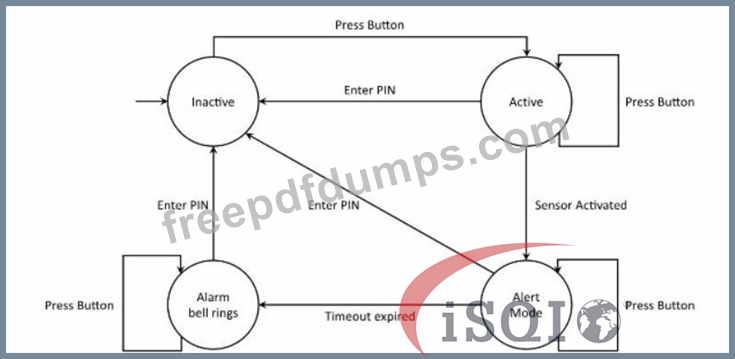
An anti-intrusion system is battery powered and is activated by pressing the only available button. To deactivate the system, the operator must enter a PIN code. The system will stay in alert mode within a configurable timeout and an alarm bell will ring if the system is not deactivated before the timeout expires. The following state transition diagram describes the behavior of the system: What is the minimum number of test cases needed to cover every unique sequence of exactly 4 states/3 transitions starting and ending in the "Inactive" state? (note that "Inactive" is not a final state in the diagram)
Correct Answer: C
In the given state transition diagram, we need to identify the minimum number of test cases required to cover every unique sequence of exactly 4 states/3 transitions starting and ending in the "Inactive" state. The states are: * Inactive * Active * Alert Mode * Alarm bell rings * Inactive -> Active -> Inactive -> Active -> Inactive * Sequence: Press Button, Enter PIN, Press Button, Enter PIN * Inactive -> Active -> Alert Mode -> Inactive * Sequence: Press Button, Sensor Activated, Enter PIN * Inactive -> Active -> Alert Mode -> Alarm bell rings -> Inactive * Sequence: Press Button, Sensor Activated, Timeout expired, Press Button Test Case Analysis:These sequences cover every unique combination of exactly 4 states and 3 transitions starting and ending in the "Inactive" state. References: * ISTQB CTFL Syllabus Section 4.2 on state transition testing.
CTFL_Syll_4.0 Exam Question 93
The fact that defects are usually not evenly distributed among the various modules that make up a software application, but rather their distribution tend to reflect the Pareto principle:
Correct Answer: C
The fact that defects are usually not evenly distributed among the various modules that make up a software application, but rather their distribution tend to reflect the Pareto principle, is expressed by the testing principle referred to as 'Defects cluster together'. This principle states that a small number of modules contain most of the defects detected, or that a small number of causes are responsible for most of the defects. This principle can be used to guide the test analysis and design activities, by prioritizing the testing of the most critical or risky modules, or by applying more rigorous test techniques to them. Therefore, option C is the correct answer. References: ISTQB Certified Tester Foundation Level Syllabus v4.01, Section 1.2.1, page 11; ISTQB Glossary v4.02, page 16.
CTFL_Syll_4.0 Exam Question 94
A test manager has started a cycle of testing for an e-commerce application. The reason for testing is the change in the protocol for connecting to the payment gateway because of new regulations. Which of the following correctly names this type of testing?
Correct Answer: D
Maintenance testing is performed to ensure that the application continues to function correctly after changes have been made. These changes can include modifications due to new regulations, bug fixes, enhancements, or any other updates. In this case, the change in the protocol for connecting to the payment gateway due to new regulations falls under maintenance testing, as it involves testing the application to ensure it works correctly after the implementation of the required changes. Top of Form Bottom of Form