

AI-102 Exam Question 6
You develop an app in O named App1 that performs speech-to-speech translation.
You need to configure App1 to translate English to German.
How should you complete the speechTransiationConf ig object? To answer, drag the appropriate values to the correct targets. Each value may be used once, more than once, or not at all. You may need to drag the split bar between panes or scroll to view content.
NOTE: Each correct selection is worth one point.

AI-102 Exam Question 7
You need to measure the public perception of your brand on social media by using natural language processing. Which Azure service should you use?
AI-102 Exam Question 8
Your company uses an Azure Cognitive Services solution to detect faces in uploaded images. The method to detect the faces uses the following code.

You discover that the solution frequently fails to detect faces in blurred images and in images that contain sideways faces.
You discover that the solution frequently fails to detect faces in blurred images and in images that contain sideways faces.
AI-102 Exam Question 9
You plan to use containerized versions of the Anomaly Detector API on local devices for testing and in on-premises datacenters.
You need to ensure that the containerized deployments meet the following requirements:
Prevent billing and API information from being stored in the command-line histories of the devices that run the container.
Control access to the container images by using Azure role-based access control (Azure RBAC).
Which four actions should you perform in sequence? To answer, move the appropriate actions from the list of actions to the answer area and arrange them in the correct order. (Choose four.) NOTE: More than one order of answer choices is correct. You will receive credit for any of the correct orders you select.
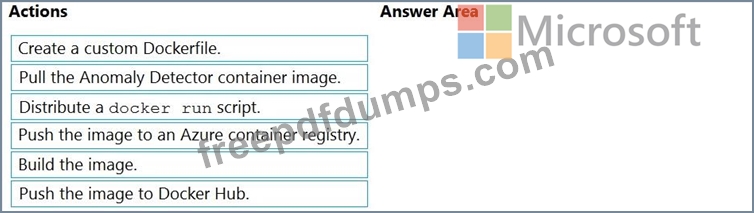
You need to ensure that the containerized deployments meet the following requirements:
Prevent billing and API information from being stored in the command-line histories of the devices that run the container.
Control access to the container images by using Azure role-based access control (Azure RBAC).
Which four actions should you perform in sequence? To answer, move the appropriate actions from the list of actions to the answer area and arrange them in the correct order. (Choose four.) NOTE: More than one order of answer choices is correct. You will receive credit for any of the correct orders you select.

AI-102 Exam Question 10
Note: This question is part of a series of questions that present the same scenario. Each question in the series contains a unique solution that might meet the stated goals. Some question sets might have more than one correct solution, while others might not have a correct solution.
After you answer a question in this section, you will NOT be able to return to it. As a result, these questions will not appear in the review screen.
You create a web app named app1 that runs on an Azure virtual machine named vm1. Vm1 is on an Azure virtual network named vnet1.
You plan to create a new Azure Cognitive Search service named service1.
You need to ensure that app1 can connect directly to service1 without routing traffic over the public internet.
Solution: You deploy service1 and a public endpoint to a new virtual network, and you configure Azure Private Link.
Does this meet the goal?