

AZ-104 Exam Question 1
You have an Azure subscription that contains a user account named User1.
You need to ensure that User1 can assign a policy to the tenant root management group.
What should you do?
You need to ensure that User1 can assign a policy to the tenant root management group.
What should you do?
AZ-104 Exam Question 2
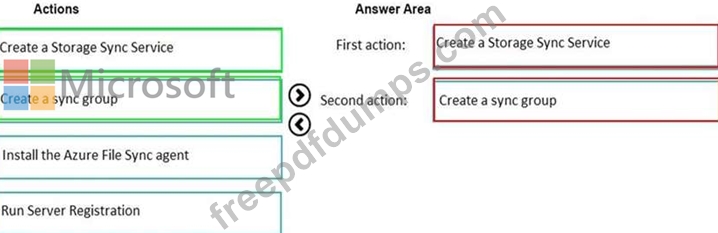
You have an Azure subscription that contains an Azure file share.
You have an on-premises server named Server1 that runs Windows Server 2016.
You plan to set up Azure File Sync between Server1 and the Azure file share.
You need to prepare the subscription for the planned Azure File Sync.
Which two actions should you perform in the Azure subscription? To answer, drag the appropriate actions to the correct targets. Each action may be used once, more than once, or not at all. You may need to drag the split bar between panes or scroll to view content.


AZ-104 Exam Question 3
You have an Azure subscription that contains an Azure Directory (Azure AD) tenant named contoso.com. The tenant is synced to the on-premises Active Directory domain. The domain contains the users shown in the following table.

You enable self-service password reset (SSPR) for all users and configure SSPR to have the following authentication methods:
* Number of methods required to reset: 2
* Methods available to users: Mobile phone, Security questions
* Number of questions required to register: 3
* Number of questions required to reset: 3
You select the following security questions:
* What is your favorite food?
* In what city was your first job?
* What was the name of your first pet?
For each of the following statements, select Yes if the statement is true. Otherwise, select No.
NOTE: Each correct selection is worth one point.


AZ-104 Exam Question 4
You have an Azure subscription that contains the Azure virtual machines shown in the following table.

You configure the network interfaces of the virtual machines to use the settings shown in the following table

From the settings of VNET1, you configure the DNS servers shown in the following exhibit.

The virtual machines can successfully connect to the DNS server that has an IP address of 192.168.10.15 and the DNS server that has an IP address of 193.77.134.10.
For each of the following statements, select Yes if the statement is true. Otherwise, select No.

You configure the network interfaces of the virtual machines to use the settings shown in the following table
From the settings of VNET1, you configure the DNS servers shown in the following exhibit.
The virtual machines can successfully connect to the DNS server that has an IP address of 192.168.10.15 and the DNS server that has an IP address of 193.77.134.10.
For each of the following statements, select Yes if the statement is true. Otherwise, select No.

AZ-104 Exam Question 5
Note: This question is part of a series of questions that present the same scenario. Each question in the series contains a unique solution that might meet the stated goals. Some question sets might have more than one correct solution, while others might not have a correct solution.
After you answer a question in this section, you will NOT be able to return to it. As a result, these questions will not appear in the review screen.
You have an Azure subscription that contains the following resources:
* A virtual network that has a subnet named Subnet1
* Two network security groups (NSGs) named NSG-VM1 and NSG-Subnet1
* A virtual machine named VM1 that has the required Windows Server configurations to allow Remote Desktop connections NSG-Subnet1 has the default inbound security rules only.
NSG-VM1 has the default inbound security rules and the following custom inbound security rule:
* Priority: 100
* Source: Any
* Source port range: *
* Destination: *
* Destination port range: 3389
* Protocol: UDP
* Action: Allow
VM1 has a public IP address and is connected to Subnet1. NSG-VM1 is associated to the network interface of VM1. NSG-Subnet1 is associated to Subnet1.
You need to be able to establish Remote Desktop connections from the internet to VM1.
Solution: You add an inbound security rule to NSG-Subnet1 that allows connections from the Any source to the
*destination for port range 3389 and uses the TCP protocol. You remove NSG-VM1 from the network interface of VM1.
Does this meet the goal?