

AZ-120 Exam Question 131
Your on-premises network contains SAP and non-SAP applications.
You have JAVA-based SAP systems that use SPNEGO for single-sign on (SSO) authentication.
Your external portal uses multi-factor authentication (MFA) to authenticate users.
You plan to extend the on-premises authentication features to Azure and to migrate the SAP applications to Azure.
For each of the following statements, select Yes if the statement is true. Otherwise, select No.
NOTE: Each correct selection is worth one point.
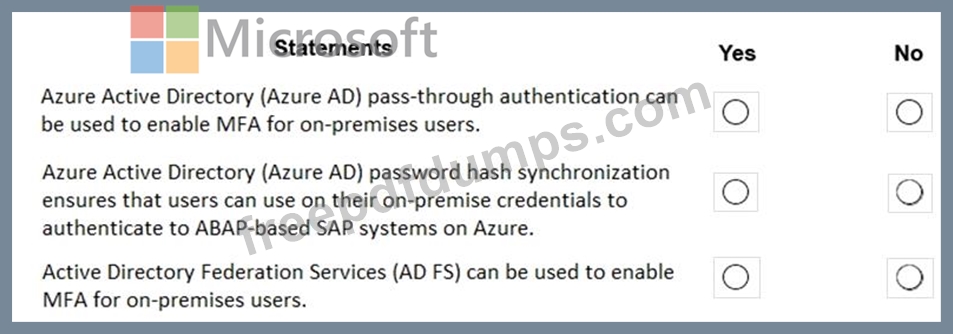
You have JAVA-based SAP systems that use SPNEGO for single-sign on (SSO) authentication.
Your external portal uses multi-factor authentication (MFA) to authenticate users.
You plan to extend the on-premises authentication features to Azure and to migrate the SAP applications to Azure.
For each of the following statements, select Yes if the statement is true. Otherwise, select No.
NOTE: Each correct selection is worth one point.

AZ-120 Exam Question 132
You deploy an SAP production landscape on Azure virtual machines that run SUSE Linux Enterprise Server (SLES).
You need to generate a report that details performance differences between instances of an SAP AS ABAP system.
What should you use?
You need to generate a report that details performance differences between instances of an SAP AS ABAP system.
What should you use?
AZ-120 Exam Question 133
You have an Azure subscription.
Your company has an SAP environment that runs on SUSE Linux Enterprise Server (SLES) servers and SAP HANA. The environment has a primary site and a disaster recovery site. Disaster recovery is based on SAP HANA system replication. The SAP ERP environment is 4 TB and has a projected growth of 5% per month.
The company has an uptime Service Level Agreement (SLA) of 99.99%, a maximum recovery time objective (RTO) of four hours, and a recovery point objective (RPO) of 10 minutes.
You plan to migrate to Azure.
You need to design an SAP landscape for the company.
Which options meet the company's requirements?
Your company has an SAP environment that runs on SUSE Linux Enterprise Server (SLES) servers and SAP HANA. The environment has a primary site and a disaster recovery site. Disaster recovery is based on SAP HANA system replication. The SAP ERP environment is 4 TB and has a projected growth of 5% per month.
The company has an uptime Service Level Agreement (SLA) of 99.99%, a maximum recovery time objective (RTO) of four hours, and a recovery point objective (RPO) of 10 minutes.
You plan to migrate to Azure.
You need to design an SAP landscape for the company.
Which options meet the company's requirements?
AZ-120 Exam Question 134
You deploy on SAP environment on Azure.
You need to monitor the performance of the SAP NetWeaver environment by using the Azure Enhanced Monitoring Extension for SAP.
What should you do first?
You need to monitor the performance of the SAP NetWeaver environment by using the Azure Enhanced Monitoring Extension for SAP.
What should you do first?
AZ-120 Exam Question 135
You have an on-premises network and an Azure subscription.
You plan to deploy a standard three-tier SAP architecture to a new Azure virtual network.
You need to configure network isolation for the virtual network. The solution must meet the following requirements:
* Allow client access from the on-premises network to the presentation servers.
* Only allow the application servers to communicate with the database servers.
* Only allow the presentation servers to access the application servers.
* Block all other inbound traffic.
What is the minimum number of network security groups (NSGs) and subnets required? To answer, drag the appropriate number to the correct targets. Each number may be used once, more than once, or not at all. You may need to drag the split bar between panes or scroll to view content.
NOTE Each correct selection is worth one point.

You plan to deploy a standard three-tier SAP architecture to a new Azure virtual network.
You need to configure network isolation for the virtual network. The solution must meet the following requirements:
* Allow client access from the on-premises network to the presentation servers.
* Only allow the application servers to communicate with the database servers.
* Only allow the presentation servers to access the application servers.
* Block all other inbound traffic.
What is the minimum number of network security groups (NSGs) and subnets required? To answer, drag the appropriate number to the correct targets. Each number may be used once, more than once, or not at all. You may need to drag the split bar between panes or scroll to view content.
NOTE Each correct selection is worth one point.

