

AZ-500 Exam Question 71
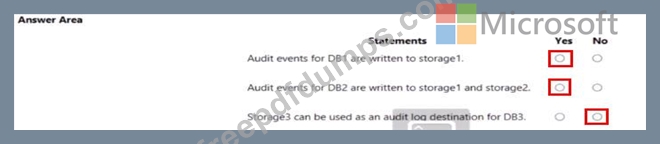
You have an Azure subscription that contains three storage accounts, an Azure SQL managed instance named SQL and three Azure SQL databases. The storage accounts are configured as shown in the following table.
SQ11 has the following settings:
* Auditing: On
* Audit tog destination: storage1
The Azure SQL databases are configured as shown in the following table.

SQ11 has the following settings:
* Auditing: On
* Audit tog destination: storage1
The Azure SQL databases are configured as shown in the following table.
AZ-500 Exam Question 72
You have an Azure subscription named Sub1 that contains an Azure Log Analytics workspace named LAW1.
You have 100 on-premises servers that run Windows Server 2012 R2 and Windows Server 2016. The servers connect to LAW1. LAW1 is configured to collect security-related performance counters from the connected servers.
You need to configure alerts based on the data collected by LAW1. The solution must meet the following requirements:
Alert rules must support dimensions.
The time it takes to generate an alert must be minimized.
Alert notifications must be generated only once when the alert is generated and once when the alert is resolved.
Which signal type should you use when you create the alert rules?
You have 100 on-premises servers that run Windows Server 2012 R2 and Windows Server 2016. The servers connect to LAW1. LAW1 is configured to collect security-related performance counters from the connected servers.
You need to configure alerts based on the data collected by LAW1. The solution must meet the following requirements:
Alert rules must support dimensions.
The time it takes to generate an alert must be minimized.
Alert notifications must be generated only once when the alert is generated and once when the alert is resolved.
Which signal type should you use when you create the alert rules?
AZ-500 Exam Question 73
You have a network security group (NSG) bound to an Azure subnet.
You run Get-AzureRmNetworkSecurityRuleConfig and receive the output shown in the following exhibit.
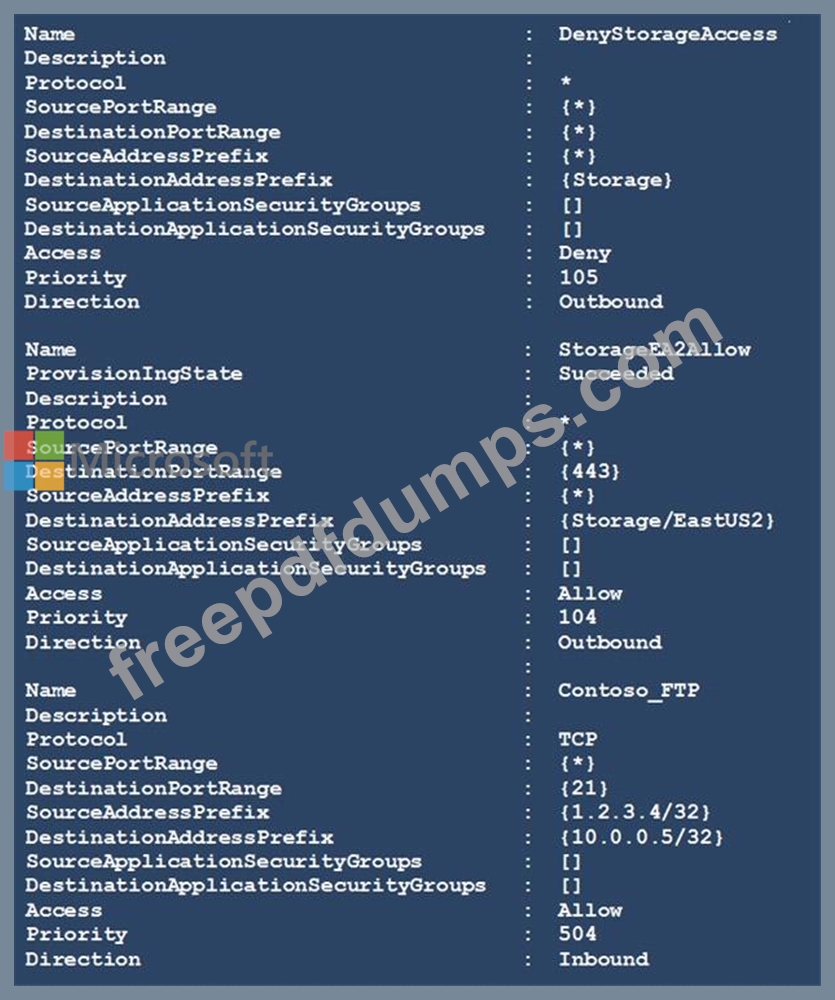
Use the drop-down menus to select the answer choice that completes each statement based on the information presented in the graphic.
NOTE: Each correct selection is worth one point.
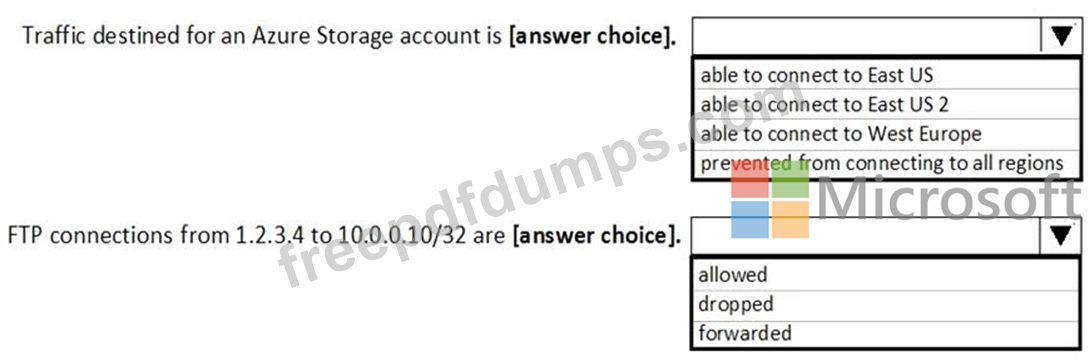
You run Get-AzureRmNetworkSecurityRuleConfig and receive the output shown in the following exhibit.
Use the drop-down menus to select the answer choice that completes each statement based on the information presented in the graphic.
NOTE: Each correct selection is worth one point.

AZ-500 Exam Question 74
You have an Azure subscription named Subcription1 that contains an Azure Active Directory (Azure AD) tenant named contosos.com and a resource group named RG1.
You create a custom role named Role1 for contoso.com.
You need to identify where you can use Role1 for permission delegation.
What should you identify?
You create a custom role named Role1 for contoso.com.
You need to identify where you can use Role1 for permission delegation.
What should you identify?
AZ-500 Exam Question 75
You have two Azure virtual machines in the East US2 region as shown in the following table.

You deploy and configure an Azure Key vault.
You need to ensure that you can enable Azure Disk Encryption on VM1 and VM2.
What should you modify on each virtual machine? To answer, select the appropriate options in the answer area.
NOTE: Each correct selection is worth one point.

You deploy and configure an Azure Key vault.
You need to ensure that you can enable Azure Disk Encryption on VM1 and VM2.
What should you modify on each virtual machine? To answer, select the appropriate options in the answer area.
NOTE: Each correct selection is worth one point.
