AZ-500 Exam Question 111
You need to ensure that users can access VM0. The solution must meet the platform protection requirements.
What should you do?
What should you do?
AZ-500 Exam Question 112
You have an Azure Active Directory (Azure AD) tenant named Contoso.com and an Azure Service (AKS) cluster AKS1.
You discover that AKS1 cannot be accessed by using accounts from Contoso.com You need to ensure AKS1 can be accessed by using accounts from Contoso.com The solution must minimize administrative effort.
What should you do first?
You discover that AKS1 cannot be accessed by using accounts from Contoso.com You need to ensure AKS1 can be accessed by using accounts from Contoso.com The solution must minimize administrative effort.
What should you do first?
AZ-500 Exam Question 113
You have a Azure subscription.
You enable Azure Active Directory (Azure AD) Privileged identify (PIM).
Your company's security policy for administrator accounts has the following conditions:
* The accounts must use multi-factor authentication (MFA).
* The account must use 20-character complex passwords.
* The passwords must be changed every 180 days.
* The account must be managed by using PIM.
You receive alerts about administrator who have not changed their password during the last 90 days.
You need to minimize the number of generated alerts.
Which PIM alert should you modify?
You enable Azure Active Directory (Azure AD) Privileged identify (PIM).
Your company's security policy for administrator accounts has the following conditions:
* The accounts must use multi-factor authentication (MFA).
* The account must use 20-character complex passwords.
* The passwords must be changed every 180 days.
* The account must be managed by using PIM.
You receive alerts about administrator who have not changed their password during the last 90 days.
You need to minimize the number of generated alerts.
Which PIM alert should you modify?
AZ-500 Exam Question 114
You have an Azure Active Directory (Azure AD) tenant named contoso.com that contains the users shown in the following table.
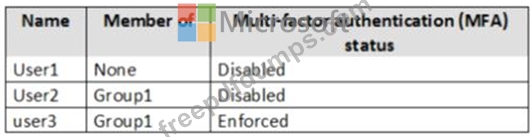
Azure AD Privileged Identity Management (PIM) is enabled for the tenant.
In PIM, the Password Administrator role has the following settings:
Maximum activation duration (hours): 2
Send email notifying admins of activation: Disable
Require incident/request ticket number during activation: Disable
Require Azure Multi-Factor Authentication for activation: Enable
Require approval to activate this role: Enable
Selected approver: Group1
You assign users the Password Administrator role as shown in the following table.
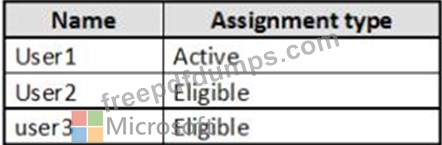
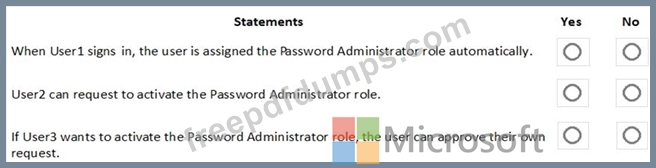
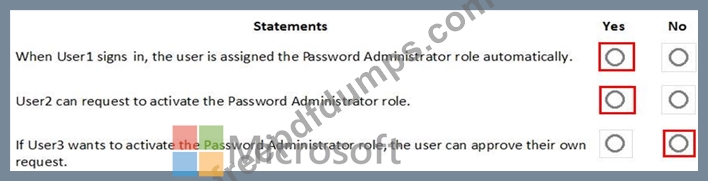
For each of the following statements, select Yes if the statement is true. Otherwise, select No.
NOTE: Each correct selection is worth one point.
Azure AD Privileged Identity Management (PIM) is enabled for the tenant.
In PIM, the Password Administrator role has the following settings:
Maximum activation duration (hours): 2
Send email notifying admins of activation: Disable
Require incident/request ticket number during activation: Disable
Require Azure Multi-Factor Authentication for activation: Enable
Require approval to activate this role: Enable
Selected approver: Group1
You assign users the Password Administrator role as shown in the following table.
For each of the following statements, select Yes if the statement is true. Otherwise, select No.
NOTE: Each correct selection is worth one point.
AZ-500 Exam Question 115
You have an Azure Active Directory (Azure AD) tenant that contains the users shown in the following table.

The tenant contains the named locations shown in the following table.

You create the conditional access policies for a cloud app named App1 as shown in the following table.

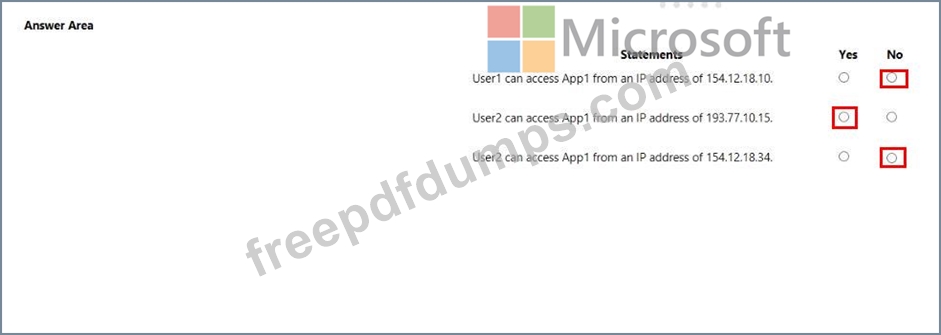
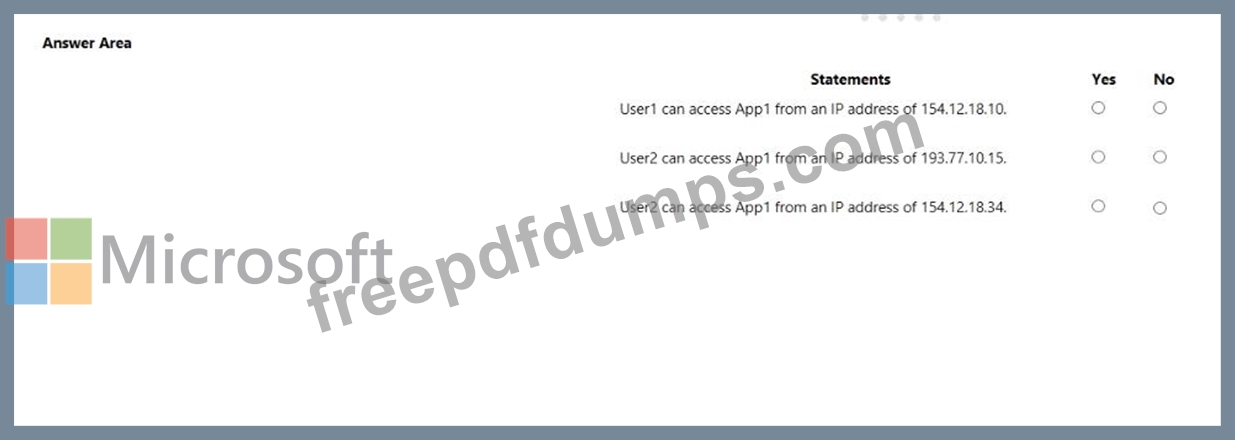
For each of the following statements, select Yes if the statement is true. Otherwise, select No.
NOTE: Each correct selection is worth one point.
The tenant contains the named locations shown in the following table.
You create the conditional access policies for a cloud app named App1 as shown in the following table.
For each of the following statements, select Yes if the statement is true. Otherwise, select No.
NOTE: Each correct selection is worth one point.