

AZ-500 Exam Question 126
You have an Azure subscription named Sub1 that contains the Azure key vaults shown in the following table:
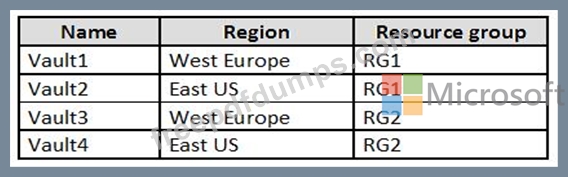
In Sub1, you create a virtual machine that has the following configurations:
Name: VM1
Size: DS2v2
Resource group: RG1
Region: West Europe
Operating system: Windows Server 2016
You plan to enable Azure Disk Encryption on VM1.
In which key vaults can you store the encryption key for VM1?
In Sub1, you create a virtual machine that has the following configurations:
Name: VM1
Size: DS2v2
Resource group: RG1
Region: West Europe
Operating system: Windows Server 2016
You plan to enable Azure Disk Encryption on VM1.
In which key vaults can you store the encryption key for VM1?
AZ-500 Exam Question 127
You need to create an Azure key vault. The solution must ensure that any object deleted from the key vault be retained for 90 days.
How should you complete the command? To answer, select the appropriate options in the answer area.
NOTE: Each correct selection is worth one point.

How should you complete the command? To answer, select the appropriate options in the answer area.
NOTE: Each correct selection is worth one point.

AZ-500 Exam Question 128
You have an Azure Active Directory (Azure AD) tenant that contains a user named User1.
You need to ensure that User1 can create and manage administrative units. The solution must use the principle of least privilege.
Which role should you assign to User1?
You need to ensure that User1 can create and manage administrative units. The solution must use the principle of least privilege.
Which role should you assign to User1?
AZ-500 Exam Question 129
Lab Task
use the following login credentials as needed:
To enter your username, place your cursor in the Sign in box and click on the username below.
To enter your password. place your cursor in the Enter password box and click on the password below.
Azure Username: Userl [email protected]
Azure Password: GpOAe4@lDg
If the Azure portal does not load successfully in the browser, press CTRL-K to reload the portal in a new browser tab.
The following information is for technical support purposes only:
Lab Instance: 28681041
Task 6
You need to email an alert to a user named [email protected] if the average CPU usage of a virtual machine named VM1 is greater than 70 percent for a period of 15 minutes.
use the following login credentials as needed:
To enter your username, place your cursor in the Sign in box and click on the username below.
To enter your password. place your cursor in the Enter password box and click on the password below.
Azure Username: Userl [email protected]
Azure Password: GpOAe4@lDg
If the Azure portal does not load successfully in the browser, press CTRL-K to reload the portal in a new browser tab.
The following information is for technical support purposes only:
Lab Instance: 28681041
Task 6
You need to email an alert to a user named [email protected] if the average CPU usage of a virtual machine named VM1 is greater than 70 percent for a period of 15 minutes.
AZ-500 Exam Question 130
You have an Azure subscription that contains several Azure SQL databases and an Azure Sentinel workspace.
You need to create a saved query in the workspace to find events reported by Advanced Threat Protection for Azure SQL Database.
What should you do?
You need to create a saved query in the workspace to find events reported by Advanced Threat Protection for Azure SQL Database.
What should you do?