AZ-700 Exam Question 41
You have an Azure virtual network that contains a subnet named Subnet1. Subnet1 is associated to a network security group (NSG) named NSG1. NSG1 blocks all outbound traffic that is not allowed explicitly.
Subnet1 contains virtual machines that must communicate with the Azure Cosmos DB service.
You need to create an outbound security rule in NSG1 to enable the virtual machines to connect to Azure Cosmos DB.
What should you include in the solution?
Subnet1 contains virtual machines that must communicate with the Azure Cosmos DB service.
You need to create an outbound security rule in NSG1 to enable the virtual machines to connect to Azure Cosmos DB.
What should you include in the solution?
AZ-700 Exam Question 42
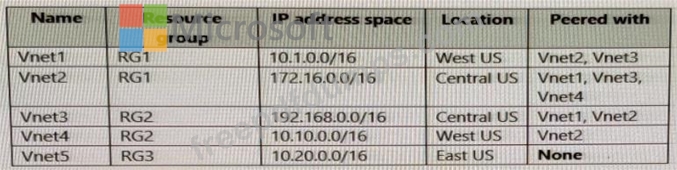
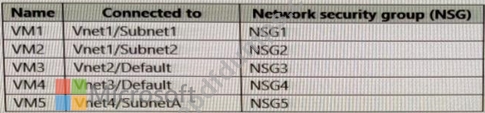
What should you implement to meet the virtual network requirements for the virtual machines that connect to Vnet4 and Vnet5?
AZ-700 Exam Question 43
You have three on-premises sites. Each site has a third-party VPN device.
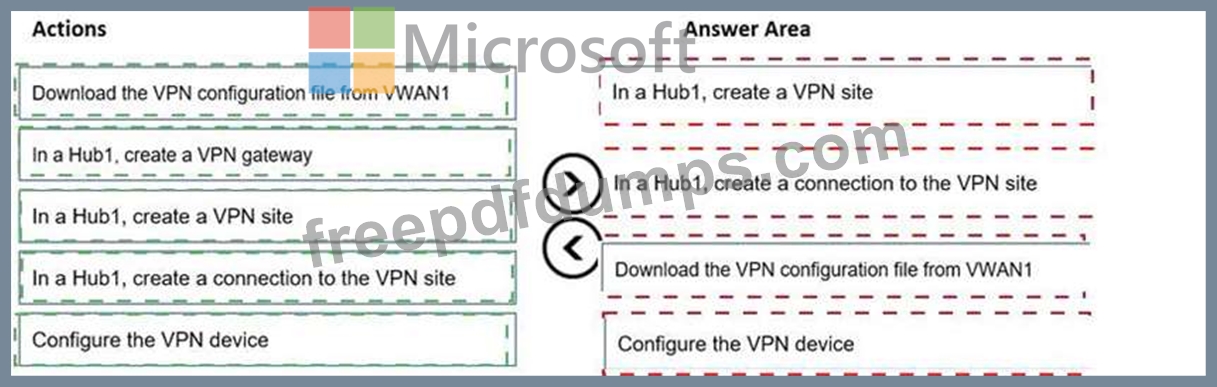
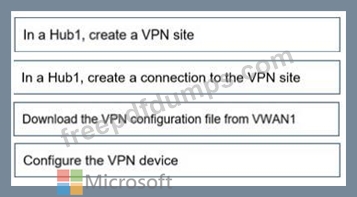
You have an Azure virtual WAN named VWAN1 that has a hub named Hub1. Hub1 connects two of the three on-premises sites by using a Site-to-Site VPN connection.
You need to connect the third site to the other two sites by using Hub1.
Which four actions should you perform in sequence? To answer, move the appropriate actions from the list of actions to the answer area and arrange them in the correct order.
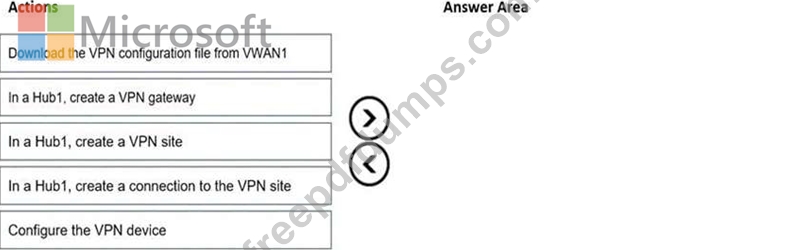
You have an Azure virtual WAN named VWAN1 that has a hub named Hub1. Hub1 connects two of the three on-premises sites by using a Site-to-Site VPN connection.
You need to connect the third site to the other two sites by using Hub1.
Which four actions should you perform in sequence? To answer, move the appropriate actions from the list of actions to the answer area and arrange them in the correct order.
AZ-700 Exam Question 44
You have a hybrid environment that uses ExpressRoute to connect an on-premises network and Azure.
You need to log the uptime and the latency of the connection periodically by using an Azure virtual machine and an on-premises virtual machine.
What should you use?
You need to log the uptime and the latency of the connection periodically by using an Azure virtual machine and an on-premises virtual machine.
What should you use?
AZ-700 Exam Question 45
Note: This question is part of a series of questions that present the same scenario. Each question in the series contains a unique solution that might meet the stated goals. Some question sets might have more than one correct solution, while others might not have a correct solution.
After you answer a question in this section, you will NOT be able to return to it. As a result, these questions will not appear in the review screen.
You have two Azure virtual networks named Vnet1 and Vnet2.
You have a Windows 10 device named Client1 that connects to Vnet1 by using a Point-to-Site (P2S) IKEv2 VPN.
You implement virtual network peering between Vnet1 and Vnet2. Vnet1 allows gateway transit. Vnet2 can use the remote gateway.
You discover that Client1 cannot communicate with Vnet2.
You need to ensure that Client1 can communicate with Vnet2.
Solution: You download and reinstall the VPN client configuration.
Does this meet the goal?
After you answer a question in this section, you will NOT be able to return to it. As a result, these questions will not appear in the review screen.
You have two Azure virtual networks named Vnet1 and Vnet2.
You have a Windows 10 device named Client1 that connects to Vnet1 by using a Point-to-Site (P2S) IKEv2 VPN.
You implement virtual network peering between Vnet1 and Vnet2. Vnet1 allows gateway transit. Vnet2 can use the remote gateway.
You discover that Client1 cannot communicate with Vnet2.
You need to ensure that Client1 can communicate with Vnet2.
Solution: You download and reinstall the VPN client configuration.
Does this meet the goal?