AZ-700 Exam Question 11
You have an Azure subscription that contains the virtual machines shown in the following table.
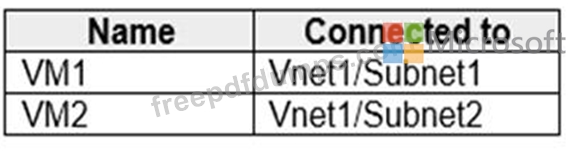
Subnet1 and Subnet2 are associated to a network security group (NSG) named NSG1 that has the following outbound rule:
Priority: 100
Port: Any
Protocol: Any
Source: Any
Destination: Storage
Action: Deny
You create a private endpoint that has the following settings:
Name: Private1
Resource type: Microsoft.Storage/storageAccounts
Resource: storage1
Target sub-resource: blob
Virtual network: Vnet1
Subnet: Subnet1
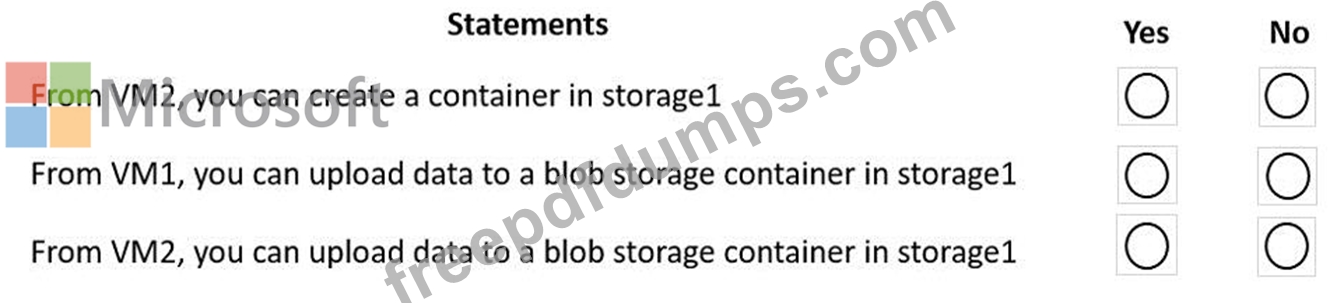
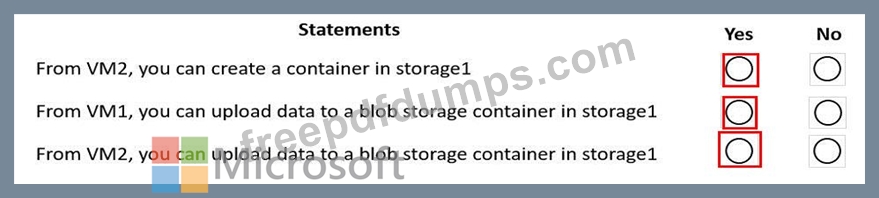
For each of the following statements, select Yes of the statement is true. Otherwise, select No.
NOTE: Each correct selection is worth one point.
Subnet1 and Subnet2 are associated to a network security group (NSG) named NSG1 that has the following outbound rule:
Priority: 100
Port: Any
Protocol: Any
Source: Any
Destination: Storage
Action: Deny
You create a private endpoint that has the following settings:
Name: Private1
Resource type: Microsoft.Storage/storageAccounts
Resource: storage1
Target sub-resource: blob
Virtual network: Vnet1
Subnet: Subnet1
For each of the following statements, select Yes of the statement is true. Otherwise, select No.
NOTE: Each correct selection is worth one point.
AZ-700 Exam Question 12
You have an application named App1 that listens for incoming requests on a preconfigured group of 50 TCP ports and UDP ports.
You install App1 on 10 Azure virtual machines.
You need to implement load balancing for App1 across all the virtual machines. The solution must minimize the number of load balancing rules.
What should you include in the solution?
You install App1 on 10 Azure virtual machines.
You need to implement load balancing for App1 across all the virtual machines. The solution must minimize the number of load balancing rules.
What should you include in the solution?
AZ-700 Exam Question 13
Note: This question is part of a series of questions that present the same scenario. Each question in the series contains a unique solution that might meet the stated goals. Some question sets might have more than one correct solution, while others might not have a correct solution.
After you answer a question in this section, you will NOT be able to return to it. As a result, these questions will not appear in the review screen.
You have an Azure subscription that contains the following resources:
* A virtual network named Vnet1
* A subnet named Subnet1 in Vnet1
* A virtual machine named VM1 that connects to Subnet1
* Three storage accounts named storage1, storage2, and storage3
You need to ensure that VM1 can access storage1. VM1 must be prevented from accessing any other storage accounts.
Solution: You configure the firewall on storage1 to only accept connections from Vnet1.
Does this meet the goal?
After you answer a question in this section, you will NOT be able to return to it. As a result, these questions will not appear in the review screen.
You have an Azure subscription that contains the following resources:
* A virtual network named Vnet1
* A subnet named Subnet1 in Vnet1
* A virtual machine named VM1 that connects to Subnet1
* Three storage accounts named storage1, storage2, and storage3
You need to ensure that VM1 can access storage1. VM1 must be prevented from accessing any other storage accounts.
Solution: You configure the firewall on storage1 to only accept connections from Vnet1.
Does this meet the goal?
AZ-700 Exam Question 14
You have an Azure virtual network that contains two subnets named Subnet1 and Subnet2. Subnet1 contains a virtual machine named VM1. Subnet2 contains a virtual machine named VM2.
You have two network security groups (NSGs) named NSG1 and NSG2. NSG1 has 100 inbound security rules and is associated to VM1. NSG2 has 200 inbound security rules and is associated to Subnet1.
VM2 cannot connect to VM1.
You suspect that an NSG rule blocks connectivity.
You need to identify which rule blocks the connection. The issue must be resolved as quickly as possible.
Which Azure Network Watcher feature should you use?
You have two network security groups (NSGs) named NSG1 and NSG2. NSG1 has 100 inbound security rules and is associated to VM1. NSG2 has 200 inbound security rules and is associated to Subnet1.
VM2 cannot connect to VM1.
You suspect that an NSG rule blocks connectivity.
You need to identify which rule blocks the connection. The issue must be resolved as quickly as possible.
Which Azure Network Watcher feature should you use?
AZ-700 Exam Question 15
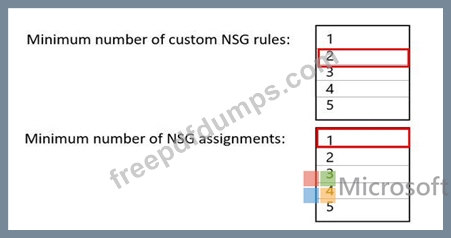
You need to restrict traffic from VMScaleSet1 to VMScaleSet2. The solution must meet the virtual networking requirements.
What is the minimum number of custom NSG rules and NSG assignments required? To answer, select the appropriate options in the answer area.
NOTE: Each correct selection is worth one point.
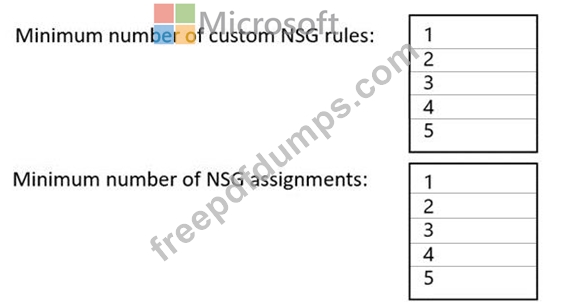
What is the minimum number of custom NSG rules and NSG assignments required? To answer, select the appropriate options in the answer area.
NOTE: Each correct selection is worth one point.