

AZ-700 Exam Question 6
Your company has offices in New York and Amsterdam. The company has an Azure subscription. Both offices connect to Azure by using a Site-to-Site VPN connection.
The office in Amsterdam uses resources in the North Europe Azure region. The office in New York uses resources in the East US Azure region.
You need to implement ExpressRoute circuits to connect each office to the nearest Azure region. Once the ExpressRoute circuits are connected, the on-premises computers in the Amsterdam office must be able to connect to the on-premises servers in the New York office by using the ExpressRoute circuits.
Which ExpressRoute option should you use?
The office in Amsterdam uses resources in the North Europe Azure region. The office in New York uses resources in the East US Azure region.
You need to implement ExpressRoute circuits to connect each office to the nearest Azure region. Once the ExpressRoute circuits are connected, the on-premises computers in the Amsterdam office must be able to connect to the on-premises servers in the New York office by using the ExpressRoute circuits.
Which ExpressRoute option should you use?
AZ-700 Exam Question 7
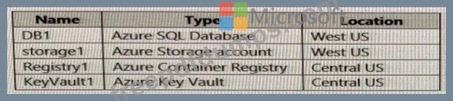
You have the Azure Traffic Manager profiles shown in the following table.
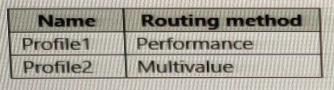
You plan to add the endpoints shown in the following table.

Which endpoints can you add to Profile2?
You plan to add the endpoints shown in the following table.
Which endpoints can you add to Profile2?
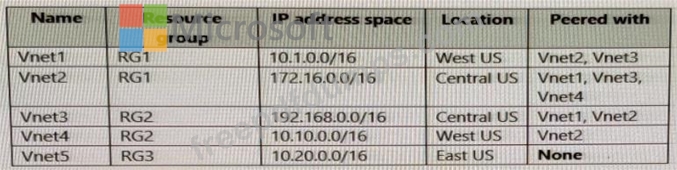
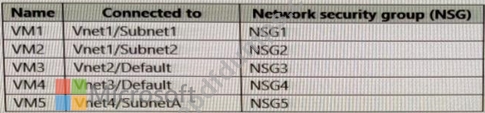
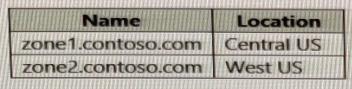



AZ-700 Exam Question 8
Note: This question is part of a series of questions that present the same scenario. Each question in the series contains a unique solution that might meet the stated goals. Some question sets might have more than one correct solution, while others might not have a correct solution.
After you answer a question in this section, you will NOT be able to return to it. As a result, these questions will not appear in the review screen.
You have an Azure subscription that contains the following resources:
* A virtual network named Vnet1
* A subnet named Subnet1 in Vnet1
* A virtual machine named VM1 that connects to Subnet1
* Three storage accounts named storage1, storage2, and storage3
You need to ensure that VM1 can access storage1. VM1 must be prevented from accessing any other storage accounts.
Solution: You create a network security group (NSG) and associate the NSG to Subnet1.
Does this meet the goal?
After you answer a question in this section, you will NOT be able to return to it. As a result, these questions will not appear in the review screen.
You have an Azure subscription that contains the following resources:
* A virtual network named Vnet1
* A subnet named Subnet1 in Vnet1
* A virtual machine named VM1 that connects to Subnet1
* Three storage accounts named storage1, storage2, and storage3
You need to ensure that VM1 can access storage1. VM1 must be prevented from accessing any other storage accounts.
Solution: You create a network security group (NSG) and associate the NSG to Subnet1.
Does this meet the goal?
AZ-700 Exam Question 9
You have an Azure Traffic Manager parent profile named TM1. TM1 has two child profiles named TM2 and TM3.
TM1 uses the performance traffic-routing method and has the endpoints shown in the following table.
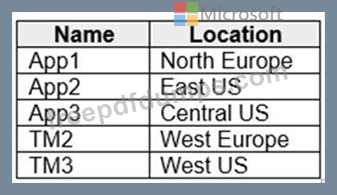
TM2 uses the weighted traffic-routing method with MinChildEndpoint = 2 and has the endpoints shown in the following table.
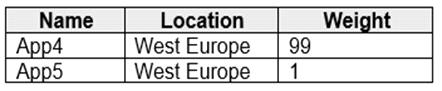
TM3 uses priority traffic-routing method and has the endpoints shown in the following table.
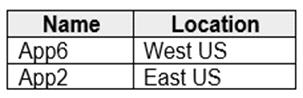
The App2, App4, and App6 endpoints have a degraded monitoring status.
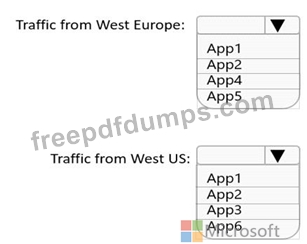
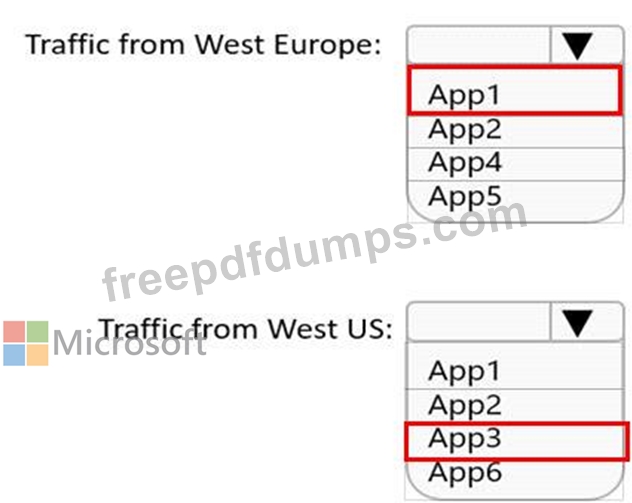
To which endpoint is traffic directed? To answer, select the appropriate options in the answer area.
NOTE: Each correct selection is worth one point
TM1 uses the performance traffic-routing method and has the endpoints shown in the following table.
TM2 uses the weighted traffic-routing method with MinChildEndpoint = 2 and has the endpoints shown in the following table.
TM3 uses priority traffic-routing method and has the endpoints shown in the following table.
The App2, App4, and App6 endpoints have a degraded monitoring status.
To which endpoint is traffic directed? To answer, select the appropriate options in the answer area.
NOTE: Each correct selection is worth one point
AZ-700 Exam Question 10
Note: This question is part of a series of questions that present the same scenario. Each question in the series contains a unique solution that might meet the stated goals. Some question sets might have more than one correct solution, while others might not have a correct solution.
After you answer a question in this section, you will NOT be able to return to it. As a result, these questions will not appear in the review screen.
You have two Azure virtual networks named Vnet1 and Vnet2.
You have a Windows 10 device named Client1 that connects to Vnet1 by using a Point-to-Site (P2S) IKEv2 VPN.
You implement virtual network peering between Vnet1 and Vnet2. Vnet1 allows gateway transit. Vnet2 can use the remote gateway.
You discover that Client1 cannot communicate with Vnet2.
You need to ensure that Client1 can communicate with Vnet2.
Solution: You download and reinstall the VPN client configuration.
Does this meet the goal?
After you answer a question in this section, you will NOT be able to return to it. As a result, these questions will not appear in the review screen.
You have two Azure virtual networks named Vnet1 and Vnet2.
You have a Windows 10 device named Client1 that connects to Vnet1 by using a Point-to-Site (P2S) IKEv2 VPN.
You implement virtual network peering between Vnet1 and Vnet2. Vnet1 allows gateway transit. Vnet2 can use the remote gateway.
You discover that Client1 cannot communicate with Vnet2.
You need to ensure that Client1 can communicate with Vnet2.
Solution: You download and reinstall the VPN client configuration.
Does this meet the goal?