AZ-800 Exam Question 1
You have a server named Server1 that runs Windows Server and has the Hyper V server role installed. Server1 hosts a virtual machine named VM1.
Server1 has an NVMe storage device. The device is currently assigned to VM1 by using Discrete Device Assignment.
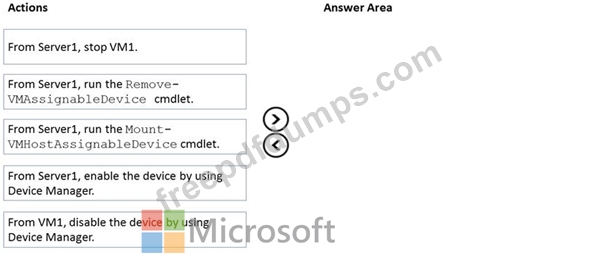
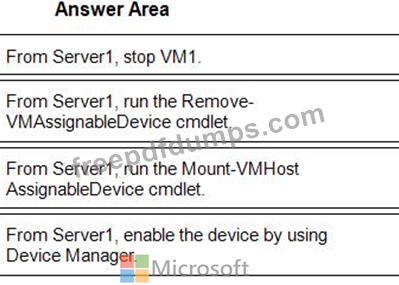
You need to make the device available to Server1.
Which four actions should you perform in sequence? To answer, move the appropriate actions from the list of actions to the answer area and arrange them in the correct order.
Server1 has an NVMe storage device. The device is currently assigned to VM1 by using Discrete Device Assignment.
You need to make the device available to Server1.
Which four actions should you perform in sequence? To answer, move the appropriate actions from the list of actions to the answer area and arrange them in the correct order.
AZ-800 Exam Question 2
You have 10 on-premises servers that run Windows Server.
You plan to use Azure Network Adapter to connect the servers to the resources in Azure.
Which prerequisites do you require on-premises and in Azure? To answer, select the appropriate options in the answer area.
NOTE: Each correct selection is worth one point.

You plan to use Azure Network Adapter to connect the servers to the resources in Azure.
Which prerequisites do you require on-premises and in Azure? To answer, select the appropriate options in the answer area.
NOTE: Each correct selection is worth one point.

AZ-800 Exam Question 3
You have a server that runs Windows Server and contains a shared folder named UserData.
You need to limit the amount of storage space that each user can consume in UserData.
What should you use?
You need to limit the amount of storage space that each user can consume in UserData.
What should you use?
AZ-800 Exam Question 4
You need to sync files from an on-premises server named Server1 to Azure by using Azure File Sync
You have a cloud tiering policy that is configured for 30 percent free space and 70 days.
Volume f on Server1 is 500 GB.
A year ago. you configured E:\Oata on Server1 to sync by using Azure File Sync. The files that are visible in E:\Data are shown in the following table.

Volume E does NOT contain any other files.
Where are File1 and flle3 located? To answer, select the appropriate options In the answer area.

You have a cloud tiering policy that is configured for 30 percent free space and 70 days.
Volume f on Server1 is 500 GB.
A year ago. you configured E:\Oata on Server1 to sync by using Azure File Sync. The files that are visible in E:\Data are shown in the following table.
Volume E does NOT contain any other files.
Where are File1 and flle3 located? To answer, select the appropriate options In the answer area.

AZ-800 Exam Question 5
You have on-premises servers that run Windows Server as shown in the following table.

You have an Azure file share named share1 that stores two files named File2.docx and File3.docx.
You create an Azure File Sync sync group that includes the following endpoints:
share
D:\Folder1 on Server1
D:\Datal on Server2
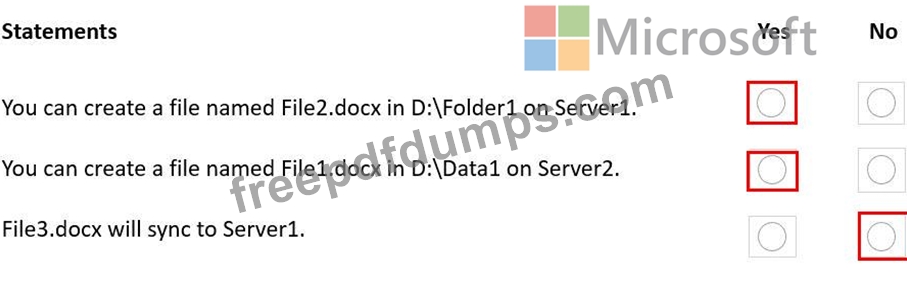
For each of the following statements, select Yes if the statement is true. Otherwise, select No.
NOTE: Each correct selection is worth one point.
You have an Azure file share named share1 that stores two files named File2.docx and File3.docx.
You create an Azure File Sync sync group that includes the following endpoints:
share
D:\Folder1 on Server1
D:\Datal on Server2
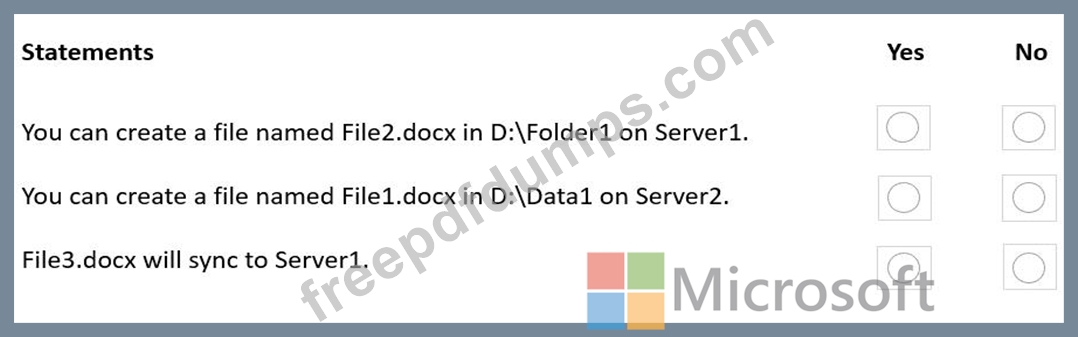
For each of the following statements, select Yes if the statement is true. Otherwise, select No.
NOTE: Each correct selection is worth one point.