

DP-203 Exam Question 106
You are performing exploratory analysis of the bus fare data in an Azure Data Lake Storage Gen2 account by using an Azure Synapse Analytics serverless SQL pool.
You execute the Transact-SQL query shown in the following exhibit.

What do the query results include?
You execute the Transact-SQL query shown in the following exhibit.
What do the query results include?
DP-203 Exam Question 107
Note: This question is part of a series of questions that present the same scenario. Each question in the series contains a unique solution that might meet the stated goals. Some question sets might have more than one correct solution, while others might not have a correct solution.
After you answer a question in this section, you will NOT be able to return to it. As a result, these questions will not appear in the review screen.
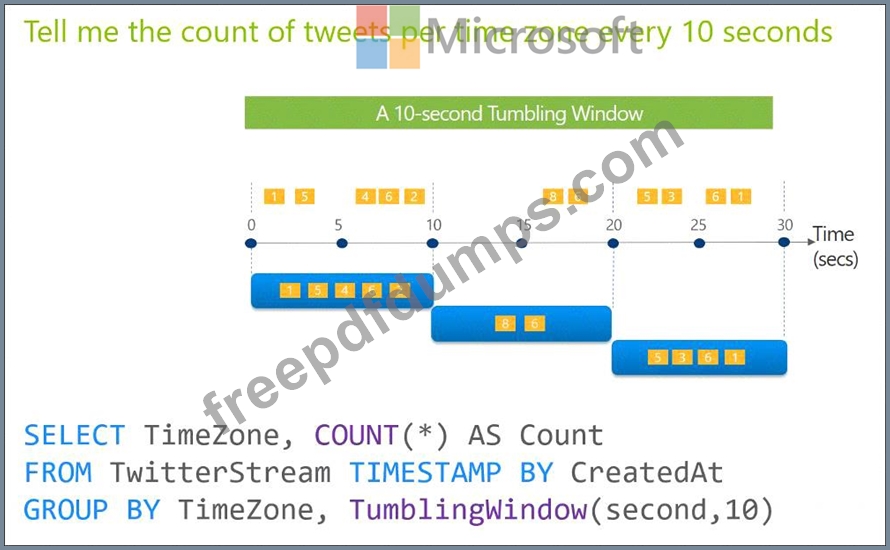
You are designing an Azure Stream Analytics solution that will analyze Twitter data.
You need to count the tweets in each 10-second window. The solution must ensure that each tweet is counted only once.
Solution: You use a tumbling window, and you set the window size to 10 seconds.
Does this meet the goal?
DP-203 Exam Question 108
You are designing an Azure Synapse Analytics dedicated SQL pool.
You need to ensure that you can audit access to Personally Identifiable information (PII).
What should you include in the solution?
You need to ensure that you can audit access to Personally Identifiable information (PII).
What should you include in the solution?
DP-203 Exam Question 109
You store files in an Azure Data Lake Storage Gen2 container. The container has the storage policy shown in the following exhibit.
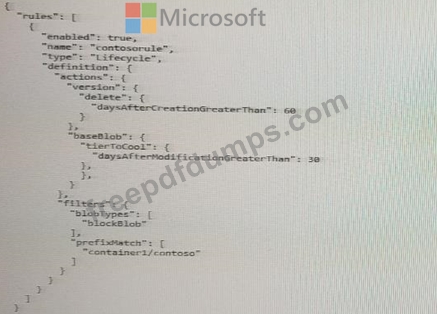
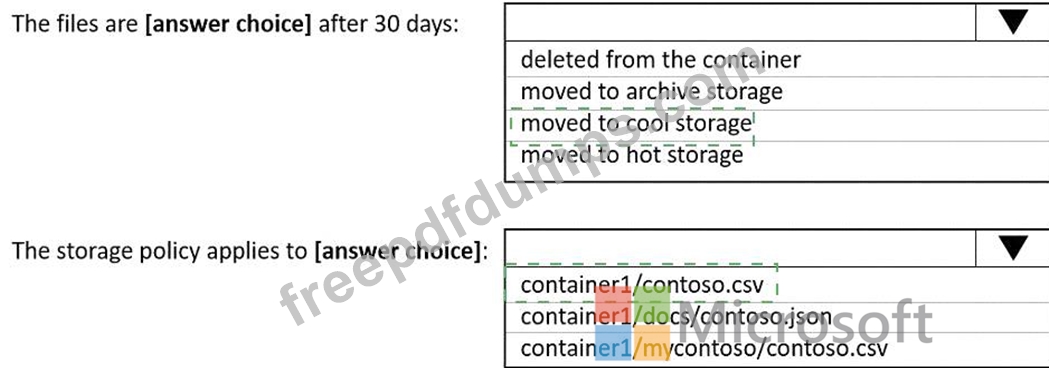
Use the drop-down menus to select the answer choice that completes each statement based on the information presented in the graphic.
NOTE: Each correct selection Is worth one point.

Use the drop-down menus to select the answer choice that completes each statement based on the information presented in the graphic.
NOTE: Each correct selection Is worth one point.

DP-203 Exam Question 110
Note: This question is part of a series of questions that present the same scenario. Each question in the series contains a unique solution that might meet the stated goals. Some question sets might have more than one correct solution, while others might not have a correct solution.
After you answer a question in this section, you will NOT be able to return to it. As a result, these questions will not appear in the review screen.
You plan to create an Azure Databricks workspace that has a tiered structure. The workspace will contain the following three workloads:
* A workload for data engineers who will use Python and SQL.
* A workload for jobs that will run notebooks that use Python, Scala, and SOL.
* A workload that data scientists will use to perform ad hoc analysis in Scala and R.
The enterprise architecture team at your company identifies the following standards for Databricks environments:
* The data engineers must share a cluster.
* The job cluster will be managed by using a request process whereby data scientists and data engineers provide packaged notebooks for deployment to the cluster.
* All the data scientists must be assigned their own cluster that terminates automatically after 120 minutes of inactivity. Currently, there are three data scientists.
You need to create the Databricks clusters for the workloads.
Solution: You create a Standard cluster for each data scientist, a High Concurrency cluster for the data engineers, and a Standard cluster for the jobs.
Does this meet the goal?