DP-203 Exam Question 46
You have an Azure Synapse Analytics dedicated SQL pool that contains a table named Table1.
You have files that are ingested and loaded into an Azure Data Lake Storage Gen2 container named container1.
You plan to insert data from the files into Table1 and azure Data Lake Storage Gen2 container named container1.
You plan to insert data from the files into Table1 and transform the data. Each row of data in the files will produce one row in the serving layer of Table1.
You need to ensure that when the source data files are loaded to container1, the DateTime is stored as an additional column in Table1.
Solution: In an Azure Synapse Analytics pipeline, you use a data flow that contains a Derived Column transformation.
DP-203 Exam Question 47
You have an Azure Synapse Analytics SQL pool named Pool1 on a logical Microsoft SQL server named Server1.
You need to implement Transparent Data Encryption (TDE) on Pool1 by using a custom key named key1.
Which five actions should you perform in sequence? To answer, move the appropriate actions from the list of actions to the answer area and arrange them in the correct order.

You need to implement Transparent Data Encryption (TDE) on Pool1 by using a custom key named key1.
Which five actions should you perform in sequence? To answer, move the appropriate actions from the list of actions to the answer area and arrange them in the correct order.


DP-203 Exam Question 48
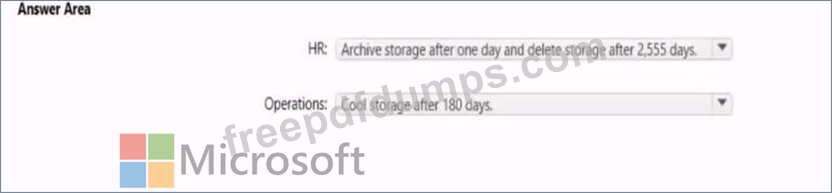
You are designing an Azure Data Lake Storage Gen2 container to store data for the human resources (HR) department and the operations department at your company. You have the following data access requirements:
* After initial processing, the HR department data will be retained for seven years.
* The operations department data will be accessed frequently for the first six months, and then accessed once per month.
You need to design a data retention solution to meet the access requirements. The solution must minimize storage costs.
DP-203 Exam Question 49
You use Azure Data Lake Storage Gen2.
You need to ensure that workloads can use filter predicates and column projections to filter data at the time the data is read from disk.
Which two actions should you perform? Each correct answer presents part of the solution.
NOTE: Each correct selection is worth one point.
You need to ensure that workloads can use filter predicates and column projections to filter data at the time the data is read from disk.
Which two actions should you perform? Each correct answer presents part of the solution.
NOTE: Each correct selection is worth one point.
DP-203 Exam Question 50
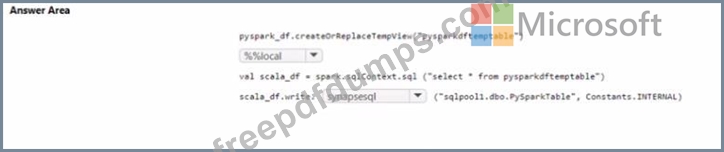
You have an Azure subscription that contains an Azure Synapse Analytics workspace named workspace1.
Workspace1 contains a dedicated SQL pool named SQL Pool and an Apache Spark pool named sparkpool.
Sparkpool1 contains a DataFrame named pyspark.df.
You need to write the contents of pyspark_df to a tabte in SQLPooM by using a PySpark notebook.
How should you complete the code? To answer, select the appropriate options in the answer area.
NOTE: Each correct selection is worth one point.