

DP-300 Exam Question 21
Case Study 2 - Contoso, Ltd
Overview
General Overview
Contoso, Ltd. is a financial data company that has 100 employees. The company delivers financial data to customers.
Physical Locations
Contoso has a datacenter in Los Angeles and an Azure subscription. All Azure resources are in the US West 2 Azure region. Contoso has a 10-Gb ExpressRoute connection to Azure.
The company has customers worldwide.
Existing Environment
Active Directory
Contoso has a hybrid Azure Active Directory (Azure AD) deployment that syncs to on-premises Active Directory.
Database Environment
Contoso has SQL Server 2017 on Azure virtual machines shown in the following table.

SQL1 and SQL2 are in an Always On availability group and are actively queried. SQL3 runs jobs, provides historical data, and handles the delivery of data to customers.
The on-premises datacenter contains a PostgreSQL server that has a 50-TB database.
Current Business Model
Contoso uses Microsoft SQL Server Integration Services (SSIS) to create flat files for customers.
The customers receive the files by using FTP.
Requirements
Planned Changes
Contoso plans to move to a model in which they deliver data to customer databases that run as platform as a service (PaaS) offerings. When a customer establishes a service agreement with Contoso, a separate resource group that contains an Azure SQL database will be provisioned for the customer. The database will have a complete copy of the financial data. The data to which each customer will have access will depend on the service agreement tier. The customers can change tiers by changing their service agreement.
The estimated size of each PaaS database is 1 TB.
Contoso plans to implement the following changes:
Move the PostgreSQL database to Azure Database for PostgreSQL during the next six months.
Upgrade SQL1, SQL2, and SQL3 to SQL Server 2019 during the next few months.
Start onboarding customers to the new PaaS solution within six months.
Business Goals
Contoso identifies the following business requirements:
Use built-in Azure features whenever possible.
Minimize development effort whenever possible.
Minimize the compute costs of the PaaS solutions.
Provide all the customers with their own copy of the database by using the PaaS solution.
Provide the customers with different table and row access based on the customer's service agreement.
In the event of an Azure regional outage, ensure that the customers can access the PaaS solution with minimal downtime. The solution must provide automatic failover.
Ensure that users of the PaaS solution can create their own database objects but he prevented from modifying any of the existing database objects supplied by Contoso.
Technical Requirements
Contoso identifies the following technical requirements:
Users of the PaaS solution must be able to sign in by using their own corporate Azure AD credentials or have Azure AD credentials supplied to them by Contoso. The solution must avoid using the internal Azure AD of Contoso to minimize guest users.
All customers must have their own resource group, Azure SQL server, and Azure SQL database. The deployment of resources for each customer must be done in a consistent fashion.
Users must be able to review the queries issued against the PaaS databases and identify any new objects created.
Downtime during the PostgreSQL database migration must be minimized.
Monitoring Requirements
Contoso identifies the following monitoring requirements:
Notify administrators when a PaaS database has a higher than average CPU usage.
Use a single dashboard to review security and audit data for all the PaaS databases.
Use a single dashboard to monitor query performance and bottlenecks across all the PaaS databases.
Monitor the PaaS databases to identify poorly performing queries and resolve query performance issues automatically whenever possible.
PaaS Prototype
During prototyping of the PaaS solution in Azure, you record the compute utilization of a customer's Azure SQL database as shown in the following exhibit.

Role Assignments
For each customer's Azure SQL Database server, you plan to assign the roles shown in the following exhibit.

What should you implement to meet the disaster recovery requirements for the PaaS solution?
Overview
General Overview
Contoso, Ltd. is a financial data company that has 100 employees. The company delivers financial data to customers.
Physical Locations
Contoso has a datacenter in Los Angeles and an Azure subscription. All Azure resources are in the US West 2 Azure region. Contoso has a 10-Gb ExpressRoute connection to Azure.
The company has customers worldwide.
Existing Environment
Active Directory
Contoso has a hybrid Azure Active Directory (Azure AD) deployment that syncs to on-premises Active Directory.
Database Environment
Contoso has SQL Server 2017 on Azure virtual machines shown in the following table.
SQL1 and SQL2 are in an Always On availability group and are actively queried. SQL3 runs jobs, provides historical data, and handles the delivery of data to customers.
The on-premises datacenter contains a PostgreSQL server that has a 50-TB database.
Current Business Model
Contoso uses Microsoft SQL Server Integration Services (SSIS) to create flat files for customers.
The customers receive the files by using FTP.
Requirements
Planned Changes
Contoso plans to move to a model in which they deliver data to customer databases that run as platform as a service (PaaS) offerings. When a customer establishes a service agreement with Contoso, a separate resource group that contains an Azure SQL database will be provisioned for the customer. The database will have a complete copy of the financial data. The data to which each customer will have access will depend on the service agreement tier. The customers can change tiers by changing their service agreement.
The estimated size of each PaaS database is 1 TB.
Contoso plans to implement the following changes:
Move the PostgreSQL database to Azure Database for PostgreSQL during the next six months.
Upgrade SQL1, SQL2, and SQL3 to SQL Server 2019 during the next few months.
Start onboarding customers to the new PaaS solution within six months.
Business Goals
Contoso identifies the following business requirements:
Use built-in Azure features whenever possible.
Minimize development effort whenever possible.
Minimize the compute costs of the PaaS solutions.
Provide all the customers with their own copy of the database by using the PaaS solution.
Provide the customers with different table and row access based on the customer's service agreement.
In the event of an Azure regional outage, ensure that the customers can access the PaaS solution with minimal downtime. The solution must provide automatic failover.
Ensure that users of the PaaS solution can create their own database objects but he prevented from modifying any of the existing database objects supplied by Contoso.
Technical Requirements
Contoso identifies the following technical requirements:
Users of the PaaS solution must be able to sign in by using their own corporate Azure AD credentials or have Azure AD credentials supplied to them by Contoso. The solution must avoid using the internal Azure AD of Contoso to minimize guest users.
All customers must have their own resource group, Azure SQL server, and Azure SQL database. The deployment of resources for each customer must be done in a consistent fashion.
Users must be able to review the queries issued against the PaaS databases and identify any new objects created.
Downtime during the PostgreSQL database migration must be minimized.
Monitoring Requirements
Contoso identifies the following monitoring requirements:
Notify administrators when a PaaS database has a higher than average CPU usage.
Use a single dashboard to review security and audit data for all the PaaS databases.
Use a single dashboard to monitor query performance and bottlenecks across all the PaaS databases.
Monitor the PaaS databases to identify poorly performing queries and resolve query performance issues automatically whenever possible.
PaaS Prototype
During prototyping of the PaaS solution in Azure, you record the compute utilization of a customer's Azure SQL database as shown in the following exhibit.
Role Assignments
For each customer's Azure SQL Database server, you plan to assign the roles shown in the following exhibit.
What should you implement to meet the disaster recovery requirements for the PaaS solution?
DP-300 Exam Question 22
You have an Azure SQL managed instance named SQL1.
You need to configure a backup solution for SQL1. The solution must ensure that database backups can be retained for up to 10 years.
Which two resources can you include in the solution? Each correct answer presents a complete solution.
NOTE: Each correct selection is worth one point.
You need to configure a backup solution for SQL1. The solution must ensure that database backups can be retained for up to 10 years.
Which two resources can you include in the solution? Each correct answer presents a complete solution.
NOTE: Each correct selection is worth one point.
DP-300 Exam Question 23
You have a Microsoft SQL Server 2022 instance.
You need to troubleshoot failing SQL Agent Jobs.
Which command should you run?
You need to troubleshoot failing SQL Agent Jobs.
Which command should you run?
DP-300 Exam Question 24
You have a SQL pool in Azure Synapse that contains a table named dbo.Customers. The table contains a column name Email.
You need to prevent nonadministrative users from seeing the full email addresses in the Email column. The users must see values in a format of [email protected] instead.
What should you do?
You need to prevent nonadministrative users from seeing the full email addresses in the Email column. The users must see values in a format of [email protected] instead.
What should you do?
DP-300 Exam Question 25
You have two on premises Microsoft SQL Server 2022 instances as shown in the following table.
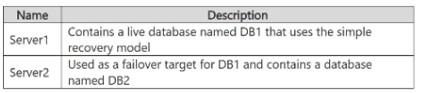
You need to configure log shipping between DB1 and DB2.
What should you do first on DB1?
You need to configure log shipping between DB1 and DB2.
What should you do first on DB1?