

DP-300 Exam Question 126
You have the on premises networks shown in the following table.

You have an Azure subscription that contains an Azure SQL Database server named SQL1. SQL1 contains two databases named DB1 and DB2.
You need to configure access to DB1 and DB2. The solution must meet the following requirements:
Ensure that DB1 can be accessed only by users in Branch1.
Ensure that DB2 can be accessed only by users in Branch2.
Solution: You connect to DB1 and run the following command:
EXECUTE sp_set_firewall_rule ' Deny db1 users ' , ' 131.107.11.0 ' , ' 131.107.11.255 ' You connect to DB2 and run the following command:
EXECUTE sp_set_database_firewall_rule ' Deny db2 users ' , ' 131.107.10.0 ' , ' 131.107.10.255 ' Does this meet the goal?
DP-300 Exam Question 127
You are monitoring an Azure Stream Analytics job.
You discover that the Backlogged input Events metric is increasing slowly and is consistently non-zero.
You need to ensure that the job can handle all the events.
What should you do?
You discover that the Backlogged input Events metric is increasing slowly and is consistently non-zero.
You need to ensure that the job can handle all the events.
What should you do?
DP-300 Exam Question 128
You have an Azure data factory that has two pipelines named PipelineA and PipelineB.
PipelineA has four activities as shown in the following exhibit.

PipelineB has two activities as shown in the following exhibit.

You create an alert for the data factory that uses Failed pipeline runs metrics for both pipelines and all failure types. The metric has the following settings:
Operator: Greater than
Aggregation type: Total
Threshold value: 2
Aggregation granularity (Period): 5 minutes
Frequency of evaluation: Every 5 minutes
Data Factory monitoring records the failures shown in the following table.
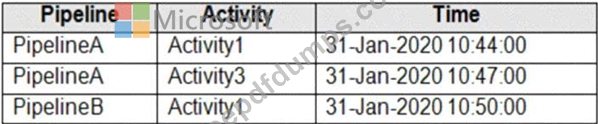
For each of the following statements, select Yes if the statement is true. Otherwise, select No.
NOTE: Each correct selection is worth one point.
PipelineA has four activities as shown in the following exhibit.
PipelineB has two activities as shown in the following exhibit.
You create an alert for the data factory that uses Failed pipeline runs metrics for both pipelines and all failure types. The metric has the following settings:
Operator: Greater than
Aggregation type: Total
Threshold value: 2
Aggregation granularity (Period): 5 minutes
Frequency of evaluation: Every 5 minutes
Data Factory monitoring records the failures shown in the following table.
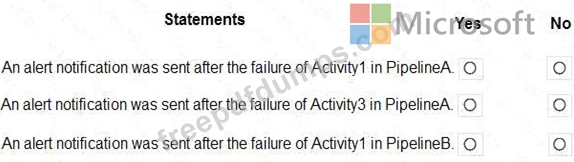
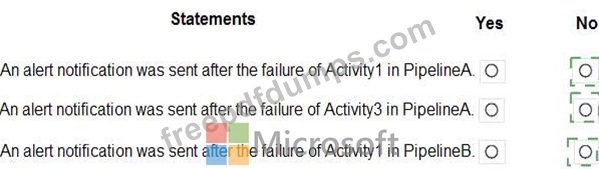
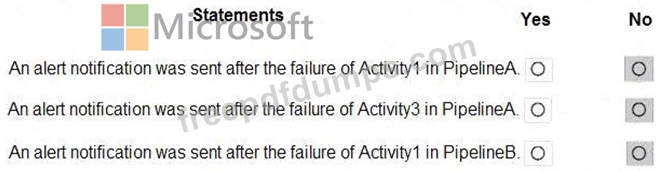
For each of the following statements, select Yes if the statement is true. Otherwise, select No.
NOTE: Each correct selection is worth one point.
DP-300 Exam Question 129
You have an Azure subscription.
You plan to migrate 10 on-premises Microsoft SQL Server instances to Azure.
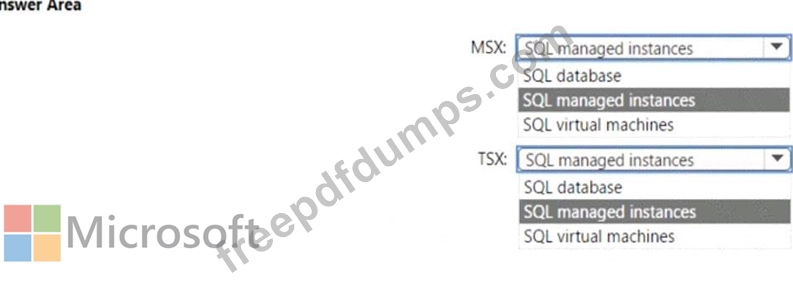
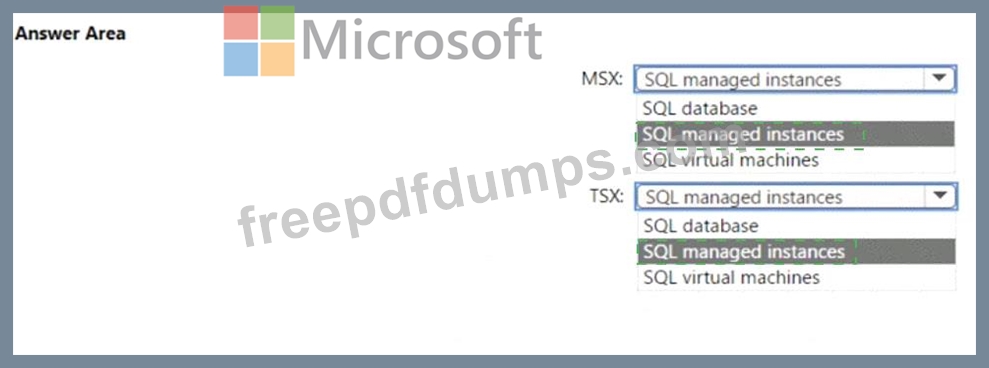
You need to ensure that the migrated environment can be managed by using multiserver administration and supports master/target (MSX/TSX) jobs. The solution must minimize administrative effort.
Which SQL deployment options should you select as the master server (MSX) and the target server (TSX)?
To answer, select the appropriate options in the answer area.
NOTE: Each correct selection is worth one point.
You plan to migrate 10 on-premises Microsoft SQL Server instances to Azure.
You need to ensure that the migrated environment can be managed by using multiserver administration and supports master/target (MSX/TSX) jobs. The solution must minimize administrative effort.
Which SQL deployment options should you select as the master server (MSX) and the target server (TSX)?
To answer, select the appropriate options in the answer area.
NOTE: Each correct selection is worth one point.

DP-300 Exam Question 130
Note: This question is part of a series of questions that present the same scenario. Each question in the series contains a unique solution that might meet the stated goals. Some question sets might have more than one correct solution, while others might not have a correct solution.
After you answer a question in this section, you will NOT be able to return to it. As a result, these questions will not appear in the review screen.
You have an Azure Synapse Analytics dedicated SQL pool that contains a table named Table1.
You have files that are ingested and loaded into an Azure Data Lake Storage Gen2 container named container1.
You plan to insert data from the files into Table1 and transform the data. Each row of data in the files will produce one row in the serving layer of Table1.
You need to ensure that when the source data files are loaded to container1, the DateTime is stored as an additional column in Table1.
Solution: You use a dedicated SQL pool to create an external table that has an additional DateTime column.
Does this meet the goal?