

DP-420 Exam Question 21
You have an Azure Cosmos DB for NoSQL account1 that is configured for automatic failover. The account1 account has a single read-write region in West US and a and a read region in East US.
You run the following PowerShell command.

What is the effect of running the command?
You run the following PowerShell command.
What is the effect of running the command?
DP-420 Exam Question 22
The settings for a container in an Azure Cosmos DB Core (SQL) API account are configured as shown in the following exhibit.
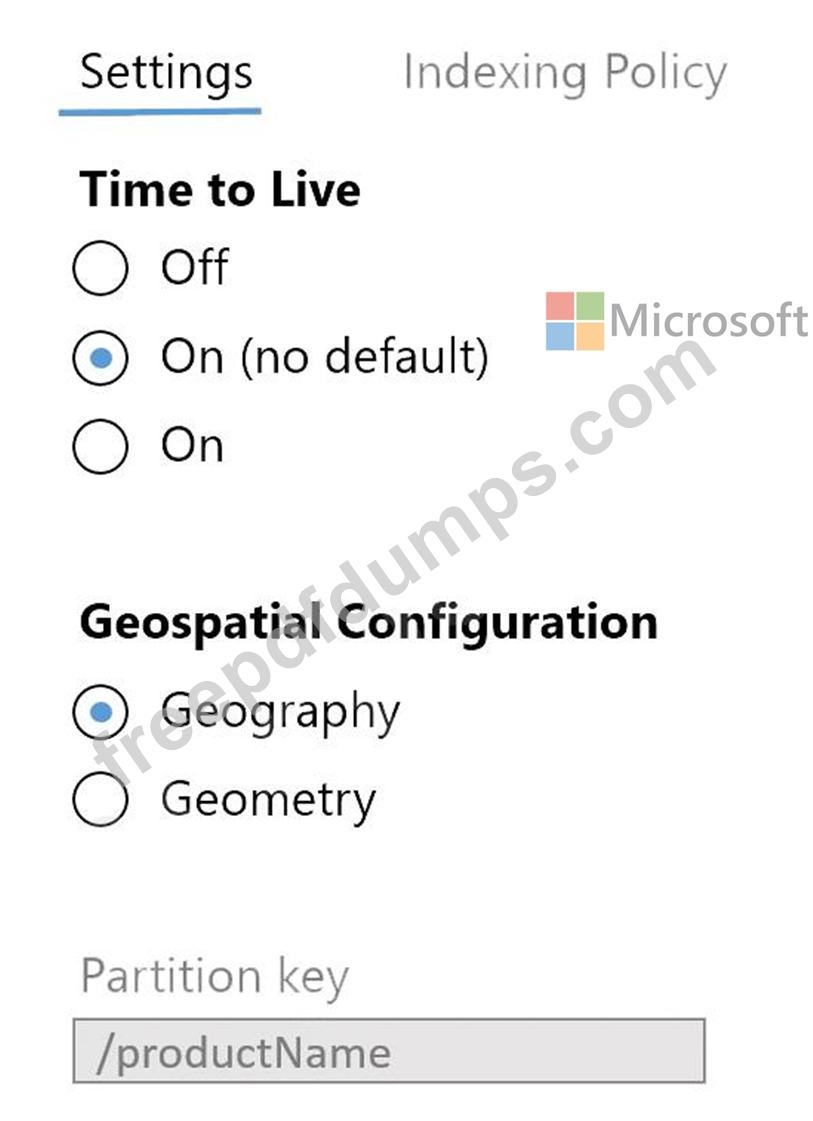
Which statement describes the configuration of the container?
Which statement describes the configuration of the container?
DP-420 Exam Question 23
You have an Azure Cosmos DB Core (SQL) API account that is used by 10 web apps.
You need to analyze the data stored in the account by using Apache Spark to create machine learning models. The solution must NOT affect the performance of the web apps.
Which two actions should you perform? Each correct answer presents part of the solution.
NOTE: Each correct selection is worth one point.
You need to analyze the data stored in the account by using Apache Spark to create machine learning models. The solution must NOT affect the performance of the web apps.
Which two actions should you perform? Each correct answer presents part of the solution.
NOTE: Each correct selection is worth one point.
DP-420 Exam Question 24
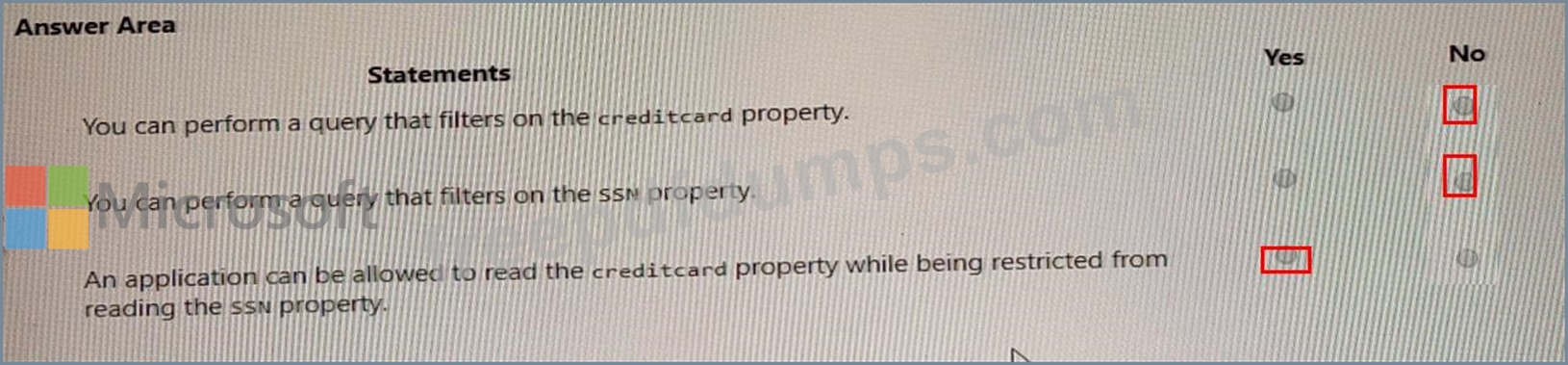
You have a container named container1 in an Azure Cosmos DB for NoSQL account named account1.
You configure container1 to use Always Encrypted by using an encryption policy as shown in the C# and the Java exhibits. (Click the C# tab to view the encryption policy in C#. Click the Java tab to see the encryption policy in Java.)
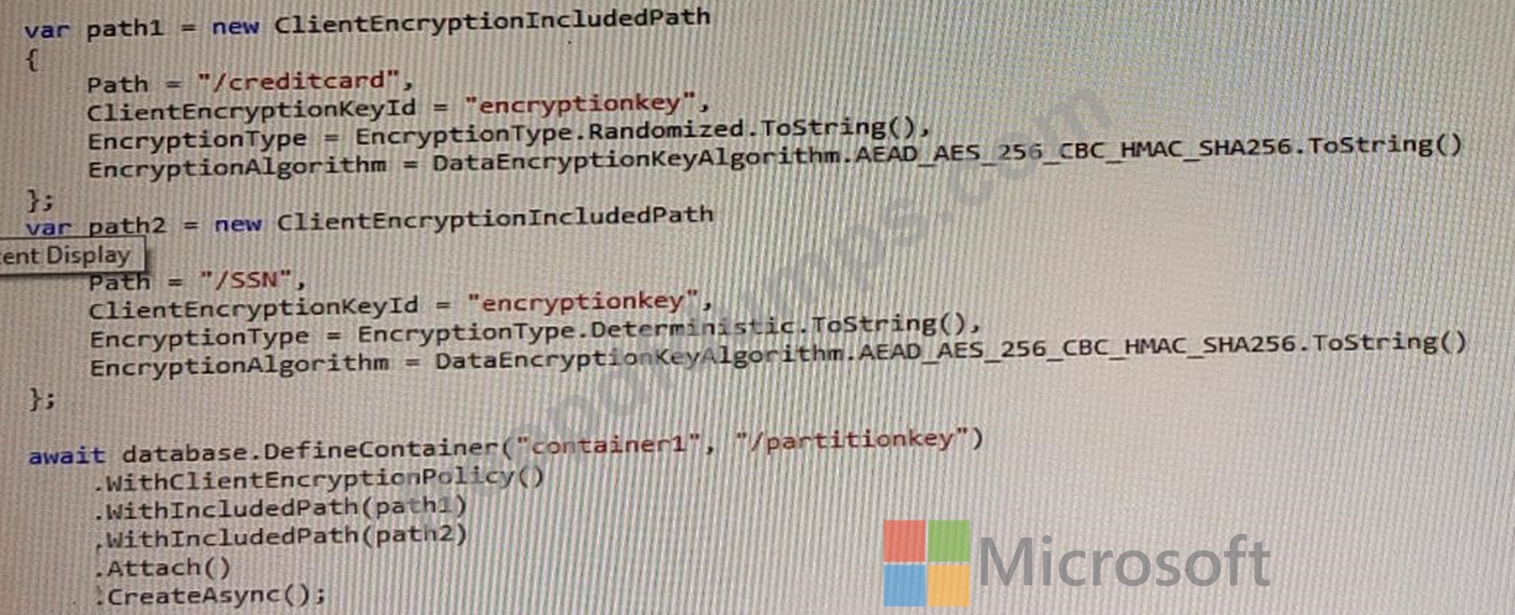
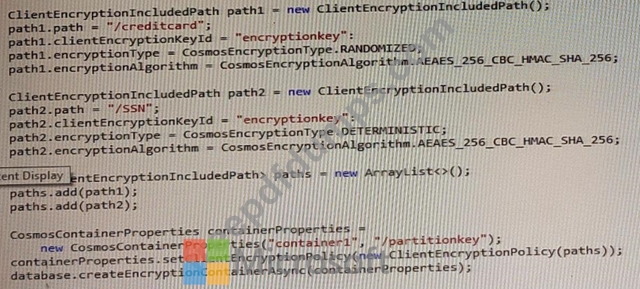
For each of the following statements, select Yes if the statement is true. Otherwise, select No.
NOTE: Each correct selection is worth one point.
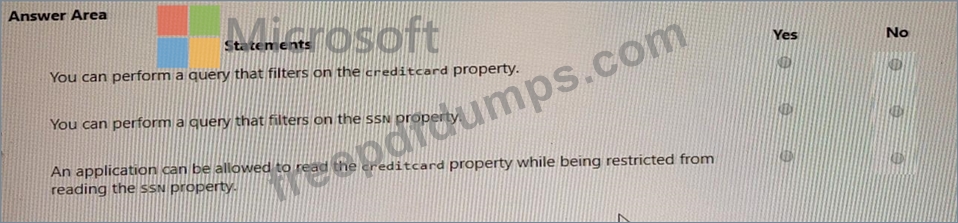
You configure container1 to use Always Encrypted by using an encryption policy as shown in the C# and the Java exhibits. (Click the C# tab to view the encryption policy in C#. Click the Java tab to see the encryption policy in Java.)
For each of the following statements, select Yes if the statement is true. Otherwise, select No.
NOTE: Each correct selection is worth one point.
DP-420 Exam Question 25
Note: This question is part of a series of questions that present the same scenario. Each question in the series contains a unique solution that might meet the stated goals. Some question sets might have more than one correct solution, while others might not have a correct solution.
After you answer a question in this section, you will NOT be able to return to it. As a result, these questions will not appear in the review screen.
You have an Azure Cosmos DB Core (SQL) API account named account 1 that uses autoscale throughput.
You need to run an Azure function when the normalized request units per second for a container in account1 exceeds a specific value.
Solution: You configure an Azure Monitor alert to trigger the function.
Does this meet the goal?
After you answer a question in this section, you will NOT be able to return to it. As a result, these questions will not appear in the review screen.
You have an Azure Cosmos DB Core (SQL) API account named account 1 that uses autoscale throughput.
You need to run an Azure function when the normalized request units per second for a container in account1 exceeds a specific value.
Solution: You configure an Azure Monitor alert to trigger the function.
Does this meet the goal?