DP-420 Exam Question 46
You have an Azure Cosmos DB for NoSQL account that contains a container named container1.
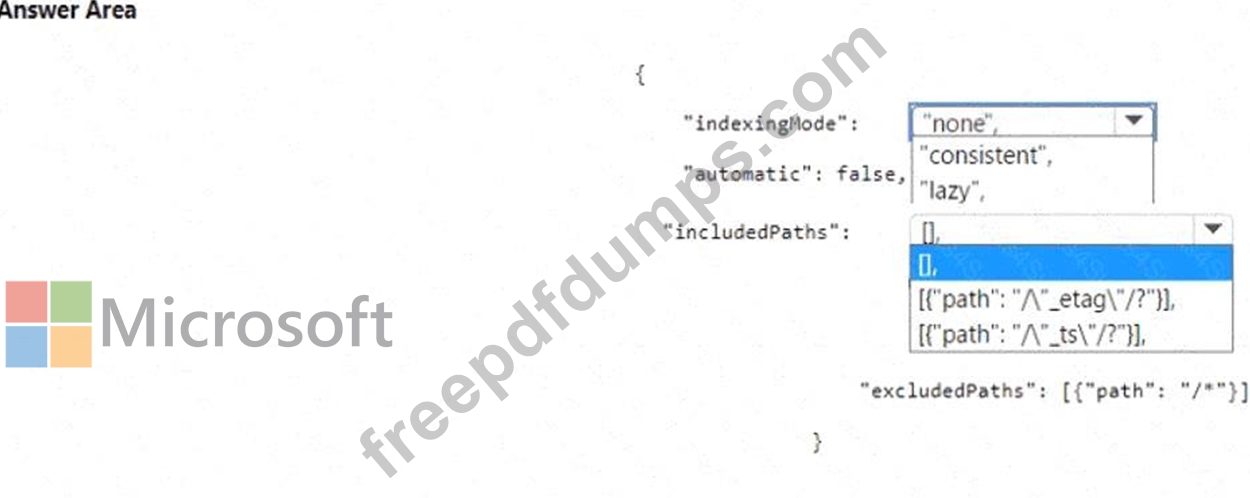
You plan to use container1 as a key-value store that will perform point reads on the item ID and partition key.
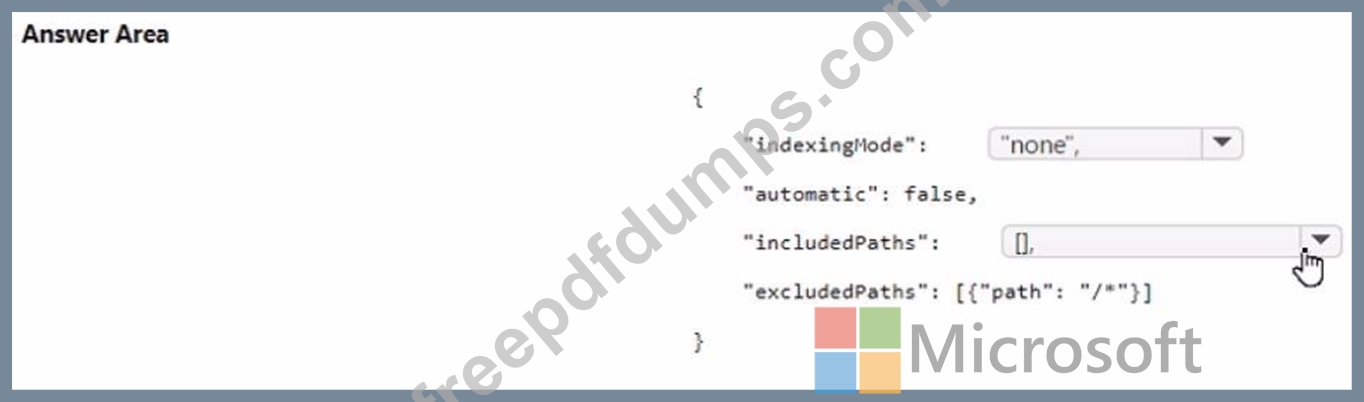
You need to define an indexing policy for container! The solution must meet the following requirements:
* Provide the ability to set DefauitTimeToLive for container1.
* Minimize implementation time.
* Minimize costs.
How should you complete the JSON definition of the indexing policy? To answer, select the appropriate options in the answer area.
NOTE: Each correct selection is worth one point.
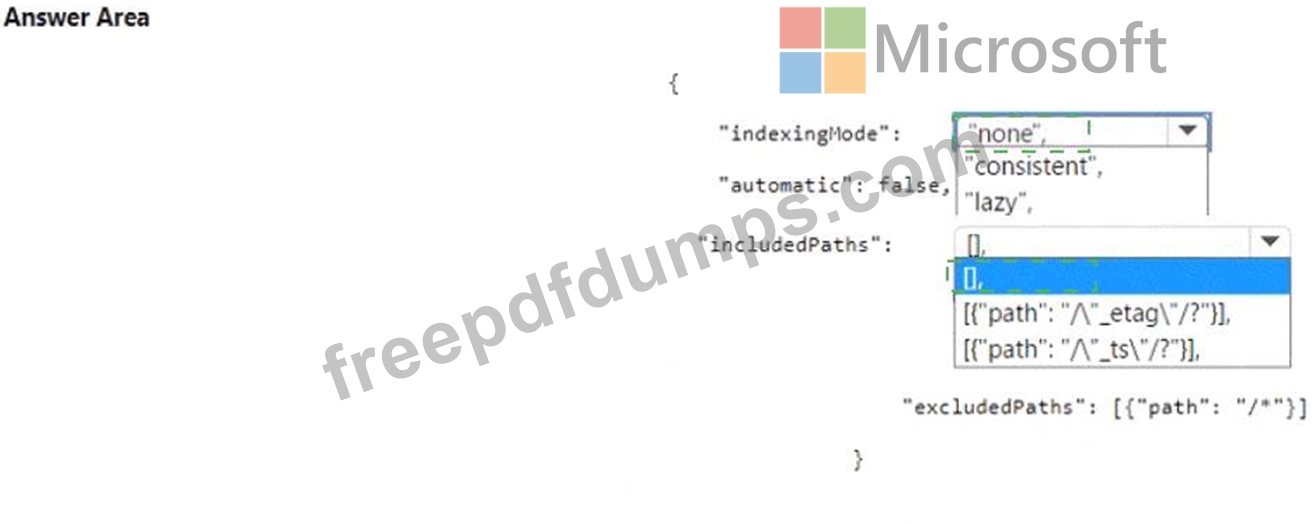
You plan to use container1 as a key-value store that will perform point reads on the item ID and partition key.
You need to define an indexing policy for container! The solution must meet the following requirements:
* Provide the ability to set DefauitTimeToLive for container1.
* Minimize implementation time.
* Minimize costs.
How should you complete the JSON definition of the indexing policy? To answer, select the appropriate options in the answer area.
NOTE: Each correct selection is worth one point.
DP-420 Exam Question 47
You have a container m an Azure Cosmos DB for NoSQL account.
Data update volumes are unpredictable.
You need to process the change teed of the container by using a web app that has multiple instances. The change feed will be processed by using the change feed processor from the Azure Cosmos DB SDK. The multiple instances must share the workload.
Which three actions should you perform? Each correct answer presents part of the solution.
NOTE: Each correct selection is worth one point.
Data update volumes are unpredictable.
You need to process the change teed of the container by using a web app that has multiple instances. The change feed will be processed by using the change feed processor from the Azure Cosmos DB SDK. The multiple instances must share the workload.
Which three actions should you perform? Each correct answer presents part of the solution.
NOTE: Each correct selection is worth one point.
DP-420 Exam Question 48
You have an Azure subscription.
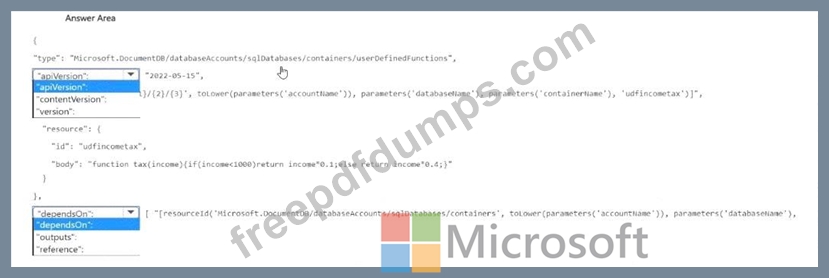
You need to deploy the following resources to an Azure Cosmos DB for NoSQL account:
* A container
* A user-defined function (UDF)
The solution must minimize the possibility of the deployment failing.
How should you complete the template? To answer, select the appropriate options in the answer area.
NOTE: Each correct selection is worth one point.
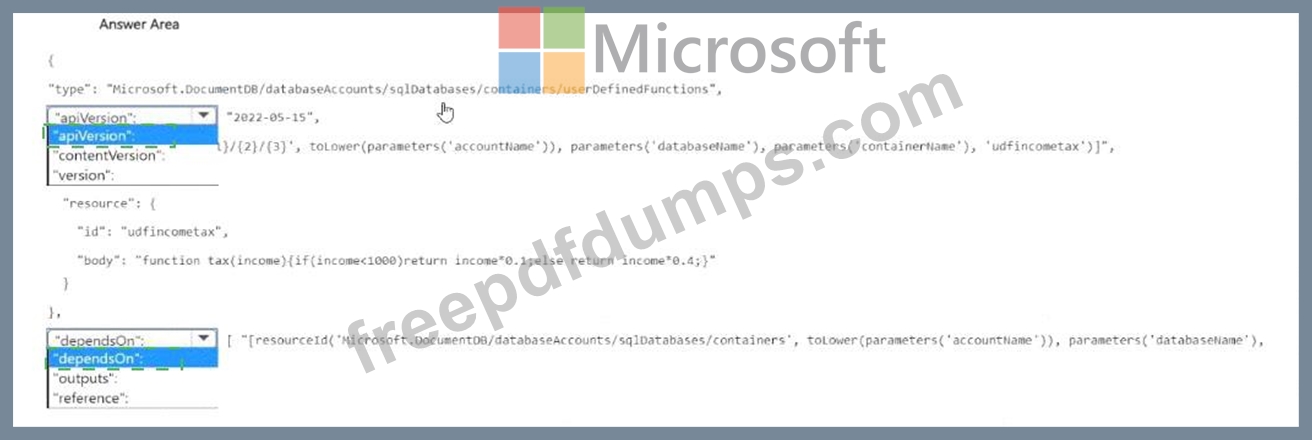
You need to deploy the following resources to an Azure Cosmos DB for NoSQL account:
* A container
* A user-defined function (UDF)
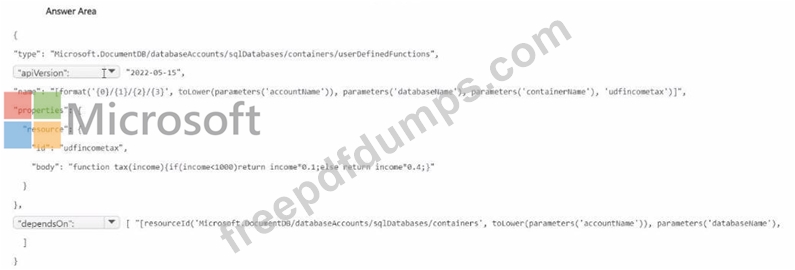
The solution must minimize the possibility of the deployment failing.
How should you complete the template? To answer, select the appropriate options in the answer area.
NOTE: Each correct selection is worth one point.
DP-420 Exam Question 49
You have an Azure Cosmos DB for NoSQL account that has multiple write regions.
You need to receive an alert when requests that target the database exceed the available request units per second (RU/s).
Which Azure Monitor signal should you use?
You need to receive an alert when requests that target the database exceed the available request units per second (RU/s).
Which Azure Monitor signal should you use?
DP-420 Exam Question 50
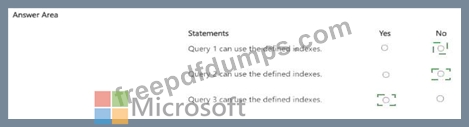
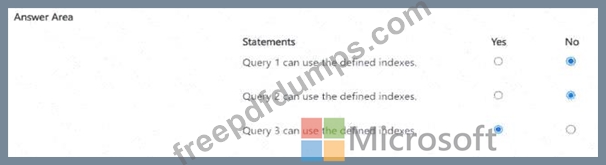
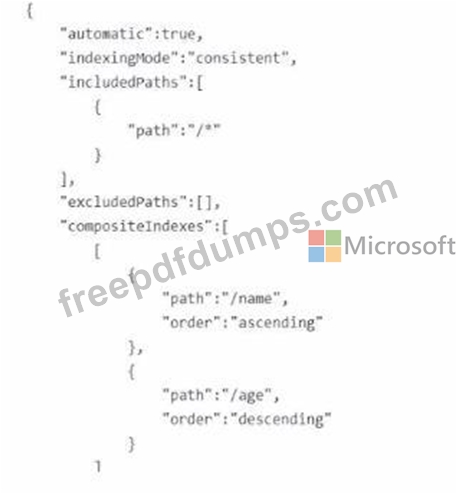
You have an Azure subscription that contains an Azure Cosmos DB for NoSQL account. You create a container and assign the following indexing policy.
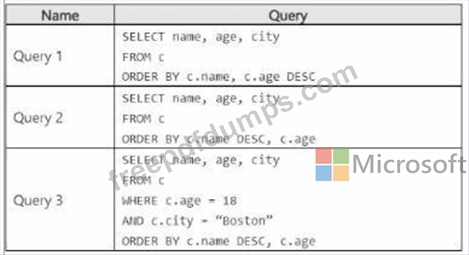
You run the queries shown in the following table.
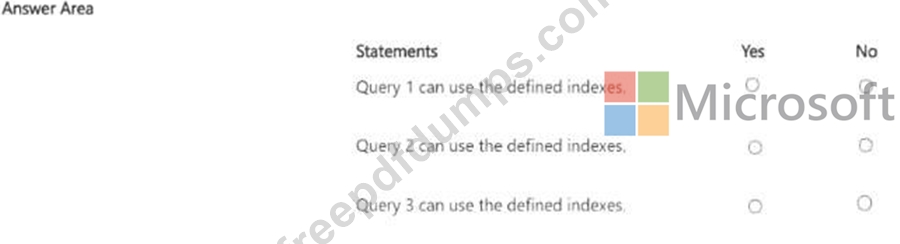
For each of the following statements, select yes if the statement is true. Otherwise, select No NOTE: Each correct selection is worth one point.
You run the queries shown in the following table.
For each of the following statements, select yes if the statement is true. Otherwise, select No NOTE: Each correct selection is worth one point.