

DP-700 Exam Question 26
You have an Azure Data Lake Storage Gen2 account named storage1 and an Amazon S3 bucket named storage2.
You have the Delta Parquet files shown in the following table.

You have a Fabric workspace named Workspace1 that has the cache for shortcuts enabled. Workspace1 contains a lakehouse named Lakehouse1. Lakehouse1 has the following shortcuts:
A shortcut to ProductFile aliased as Products
A shortcut to StoreFile aliased as Stores
A shortcut to TripsFile aliased as Trips
The data from which shortcuts will be retrieved from the cache?
You have the Delta Parquet files shown in the following table.
You have a Fabric workspace named Workspace1 that has the cache for shortcuts enabled. Workspace1 contains a lakehouse named Lakehouse1. Lakehouse1 has the following shortcuts:
A shortcut to ProductFile aliased as Products
A shortcut to StoreFile aliased as Stores
A shortcut to TripsFile aliased as Trips
The data from which shortcuts will be retrieved from the cache?
DP-700 Exam Question 27
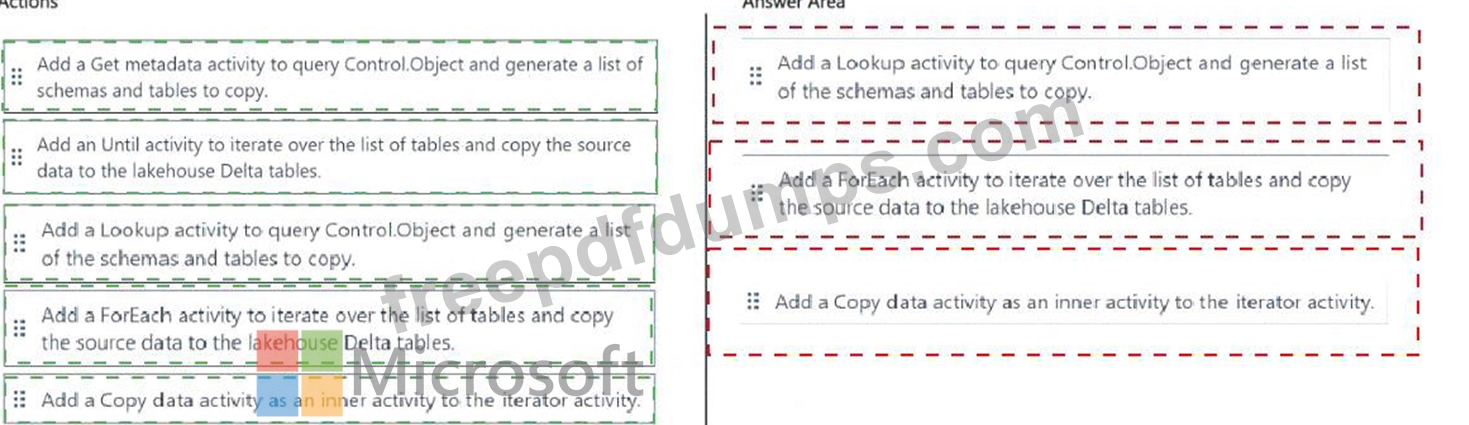
You are building a data loading pattern by using a Fabric data pipeline. The source is an Azure SQL database that contains 25 tables. The destination is a lakehouse.
In a warehouse, you create a control table named Control.Object as shown in the exhibit. (Click the Exhibit tab.) You need to build a data pipeline that will support the dynamic ingestion of the tables listed in the control table by using a single execution.
Which three actions should you perform in sequence? To answer, move the appropriate actions from the list of actions to the answer area and arrange them in the correct order.

DP-700 Exam Question 28
You have three users named User1, User2, and User3.
You have the Fabric workspaces shown in the following table.

You have a security group named Group1 that contains User1 and User3.
The Fabric admin creates the domains shown in the following table.

User1 creates a new workspace named Workspace3.
You add Group1 to the default domain of Domain1.
For each of the following statements, select Yes if the statement is true. Otherwise, select No.
NOTE: Each correct selection is worth one point.

You have the Fabric workspaces shown in the following table.
You have a security group named Group1 that contains User1 and User3.
The Fabric admin creates the domains shown in the following table.
User1 creates a new workspace named Workspace3.
You add Group1 to the default domain of Domain1.
For each of the following statements, select Yes if the statement is true. Otherwise, select No.
NOTE: Each correct selection is worth one point.


DP-700 Exam Question 29
You are implementing the following data entities in a Fabric environment:
Entity1: Available in a lakehouse and contains data that will be used as a core organization entity Entity2: Available in a semantic model and contains data that meets organizational standards Entity3: Available in a Microsoft Power BI report and contains data that is ready for sharing and reuse Entity4: Available in a Power BI dashboard and contains approved data for executive-level decision making Your company requires that specific governance processes be implemented for the data.
You need to apply endorsement badges to the entities based on each entity's use case.
Which badge should you apply to each entity? To answer, drag the appropriate badges the correct entities.
Each badge may be used once, more than once, or not at all. You may need to drag the split bar between panes or scroll to view content.
NOTE: Each correct selection is worth one point.


DP-700 Exam Question 30
You have a Fabric workspace that contains a lakehouse named Lakehouse1.
In an external data source, you have data files that are 500 GB each. A new file is added every day.
You need to ingest the data into Lakehouse1 without applying any transformations. The solution must meet the following requirements Trigger the process when a new file is added.
Provide the highest throughput.
Which type of item should you use to ingest the data?