

SC-300 Exam Question 31
You have an Azure Active Directory (Azure AD) tenant.
You need to review the Azure AD sign-ins log to investigate sign ins that occurred in the past.
For how long does Azure AD store events in the sign-in log?
You need to review the Azure AD sign-ins log to investigate sign ins that occurred in the past.
For how long does Azure AD store events in the sign-in log?
SC-300 Exam Question 32
You have an Azure Active Directory (Azure AD) tenant that contains the following objects:
* A device named Device1
* Users named User1, User2, User3, User4, and User5
* Groups named Group1, Group2, Group3, Group4, and Group5
The groups are configured as shown in the following table.

To which groups can you assign a Microsoft Office 365 Enterprise E5 license directly?
* A device named Device1
* Users named User1, User2, User3, User4, and User5
* Groups named Group1, Group2, Group3, Group4, and Group5
The groups are configured as shown in the following table.
To which groups can you assign a Microsoft Office 365 Enterprise E5 license directly?
SC-300 Exam Question 33
Your company requires that users request access before they can access corporate applications.
You register a new enterprise application named MyApp1 in Azure Active Dilatory (Azure AD) and configure single sign-on (SSO) for MyApp1.
Which settings should you configure next for MyApp1?
You register a new enterprise application named MyApp1 in Azure Active Dilatory (Azure AD) and configure single sign-on (SSO) for MyApp1.
Which settings should you configure next for MyApp1?
SC-300 Exam Question 34
You have a Microsoft 365 tenant.
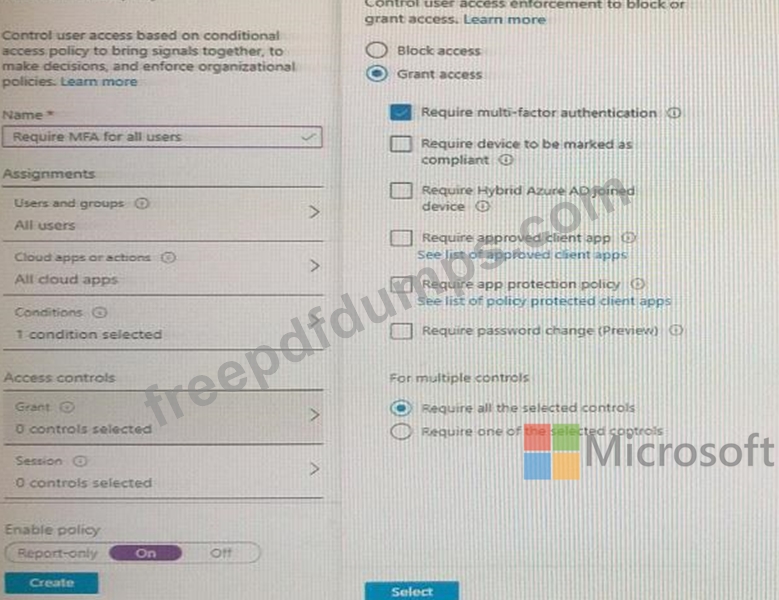
You configure a conditional access policy as shown in the Conditional Access policy exhibit. (Click the Conditional Access policy tab.)
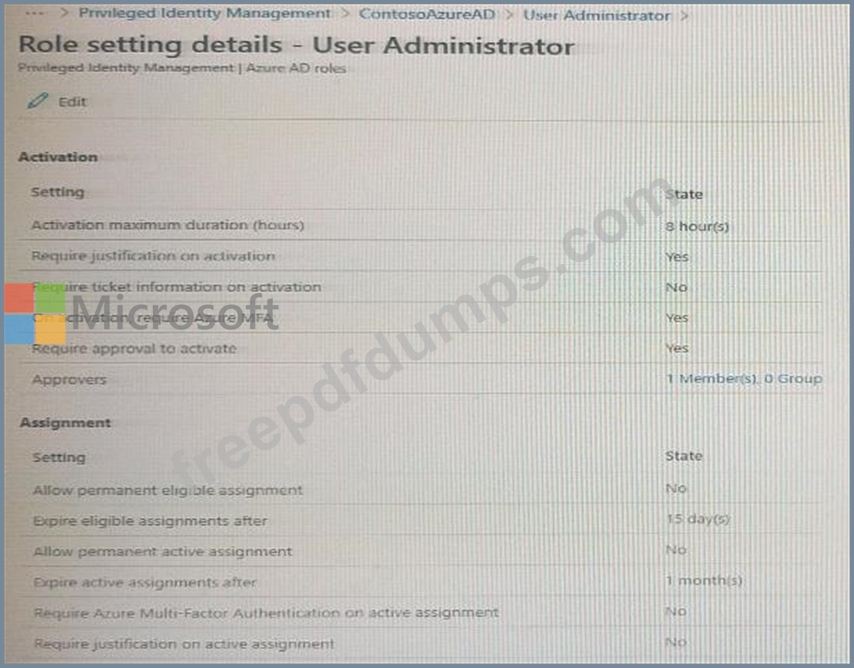
You view the User administrator role settings as shown in the Role setting details exhibit. (Click the Role setting details tab.)
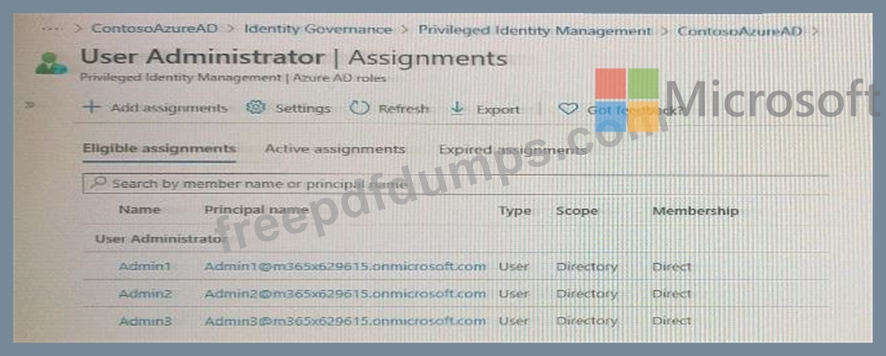
You view the User administrator role assignments as shown in the Rote assignments exhibit. (Click the Role assignments lab.)
For each of the following statement, select Yes if the statement is true. Otherwise, select No.
NOTE: Each correct selection is worth one point.

You configure a conditional access policy as shown in the Conditional Access policy exhibit. (Click the Conditional Access policy tab.)
You view the User administrator role settings as shown in the Role setting details exhibit. (Click the Role setting details tab.)
You view the User administrator role assignments as shown in the Rote assignments exhibit. (Click the Role assignments lab.)
For each of the following statement, select Yes if the statement is true. Otherwise, select No.
NOTE: Each correct selection is worth one point.

SC-300 Exam Question 35
You have a Microsoft 365 tenant that contains a group named Group! as shown in the Group1 exhibit. (Click the Group 1 tab.)

You create an enterprise application named App1 as shown in the App1 Properties exhibit. (Click the App1 Properties tab.)

You configure self-service for App1 as shown in the App1 Self-service exhibit: (Click the App1 Self-service tab.)

For each of the following statements, select Yes if the statement is true, Otherwise select NO.
NOTE: Each correct selection is worth one point.

You create an enterprise application named App1 as shown in the App1 Properties exhibit. (Click the App1 Properties tab.)
You configure self-service for App1 as shown in the App1 Self-service exhibit: (Click the App1 Self-service tab.)
For each of the following statements, select Yes if the statement is true, Otherwise select NO.
NOTE: Each correct selection is worth one point.
