

SC-300 Exam Question 26
You have an Azure Active Directory (Azure AD) tenant that contains the groups shown in the following table.

For which groups can you create an access review?
For which groups can you create an access review?
SC-300 Exam Question 27
You have a Microsoft 365 tenant.
All users have computers that run Windows 10. Most computers are company-owned and joined to Azure Active Directory (Azure AD). Some computers are user-owned and are only registered in Azure AD.
You need to prevent users who connect to Microsoft SharePoint Online on their user-owned computer from downloading or syncing files. Other users must NOT be restricted.
Which policy type should you create?
All users have computers that run Windows 10. Most computers are company-owned and joined to Azure Active Directory (Azure AD). Some computers are user-owned and are only registered in Azure AD.
You need to prevent users who connect to Microsoft SharePoint Online on their user-owned computer from downloading or syncing files. Other users must NOT be restricted.
Which policy type should you create?
SC-300 Exam Question 28
You have an on-premises Microsoft Exchange organization that uses an SMTP address space of contoso.com.
You discover that users use their email address for self-service sign-up to Microsoft 365 services.
You need to gain global administrator privileges to the Azure Active Directory (Azure AD) tenant that contains the self-signed users.
Which four actions should you perform in sequence? To answer, move the appropriate actions from the list of actions to the answer area and arrange them in the correct order.
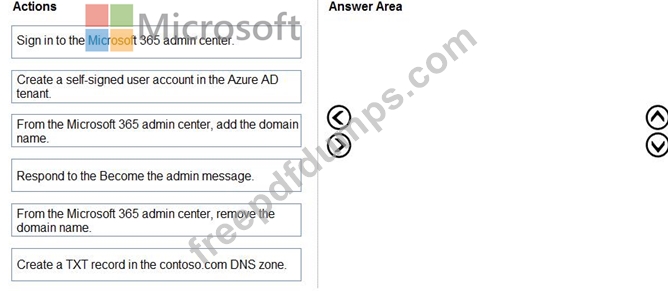
You discover that users use their email address for self-service sign-up to Microsoft 365 services.
You need to gain global administrator privileges to the Azure Active Directory (Azure AD) tenant that contains the self-signed users.
Which four actions should you perform in sequence? To answer, move the appropriate actions from the list of actions to the answer area and arrange them in the correct order.

SC-300 Exam Question 29
You need to meet the technical requirements for license management by the helpdesk administrators.
What should you create first, and which tool should you use? To answer, select the appropriate options in the answer area.
NOTE: Each correct selection is worth one point.

What should you create first, and which tool should you use? To answer, select the appropriate options in the answer area.
NOTE: Each correct selection is worth one point.

SC-300 Exam Question 30
You have a Microsoft 365 tenant.
All users must use the Microsoft Authenticator app for multi-factor authentication (MFA) when accessing Microsoft 365 services.
Some users report that they received an MFA prompt on their Microsoft Authenticator app without initiating a sign-in request.
You need to block the users automatically when they report an MFA request that they did not Initiate.
Solution: From the Azure portal, you configure the Account lockout settings for multi-factor authentication (MFA).
Does this meet the goal?
All users must use the Microsoft Authenticator app for multi-factor authentication (MFA) when accessing Microsoft 365 services.
Some users report that they received an MFA prompt on their Microsoft Authenticator app without initiating a sign-in request.
You need to block the users automatically when they report an MFA request that they did not Initiate.
Solution: From the Azure portal, you configure the Account lockout settings for multi-factor authentication (MFA).
Does this meet the goal?
Premium Bundle
Newest SC-300 Exam PDF Dumps shared by Actual4test.com for Helping Passing SC-300 Exam! Actual4test.com now offer the updated SC-300 exam dumps, the Actual4test.com SC-300 exam questions have been updated and answers have been corrected get the latest Actual4test.com SC-300 pdf dumps with Exam Engine here:
(480 Q&As Dumps, 30%OFF Special Discount: Freepdfdumps)