

SC-300 Exam Question 31
You have an Azure Active Directory (Azure AD) tenant named contoso.com that contains a user named User1.
User1 has the devices shown in the following table.

On November 5, 2020, you create and enforce terms of use in contoso.com that has the following settings:
Name: Terms1
Display name: Contoso terms of use
Require users to expand the terms of use: On
Require users to consent on every device: On
Expire consents: On
Expire starting on: December 10, 2020
Frequency: Monthly
On November 15, 2020, User1 accepts Terms1 on Device3.
For each of the following statements, select Yes if the statement is true. Otherwise, select No.
NOTE: Each correct selection is worth one point.

User1 has the devices shown in the following table.
On November 5, 2020, you create and enforce terms of use in contoso.com that has the following settings:
Name: Terms1
Display name: Contoso terms of use
Require users to expand the terms of use: On
Require users to consent on every device: On
Expire consents: On
Expire starting on: December 10, 2020
Frequency: Monthly
On November 15, 2020, User1 accepts Terms1 on Device3.
For each of the following statements, select Yes if the statement is true. Otherwise, select No.
NOTE: Each correct selection is worth one point.

SC-300 Exam Question 32
You have an Azure AD tenant that contains the groups shown in the following table.

You create an access review for Group1 as shown in the following table.

You create an access review for Group2 as shown in the following table.

What is the minimum number of Azure AD Premium P2 licenses required for each group? To answer, select the appropriate options in the answer are a. NOTE: Each correct selection is worth one point.

You create an access review for Group1 as shown in the following table.
You create an access review for Group2 as shown in the following table.
What is the minimum number of Azure AD Premium P2 licenses required for each group? To answer, select the appropriate options in the answer are a. NOTE: Each correct selection is worth one point.

SC-300 Exam Question 33
Note: This question is part of a series of questions that present the same scenario. Each question in the series contains a unique solution that might meet the stated goals. Some question sets might have more than one correct solution, while others might not have a correct solution.
After you answer a question in this section, you will NOT be able to return to it. As a result, these questions will not appear in the review screen.
You have an Azure Active Directory (Azure AD) tenant that syncs to an Active Directory forest.
You discover that when a user account is disabled in Active Directory, the disabled user can still authenticate to Azure AD for up to 30 minutes.
You need to ensure that when a user account is disabled in Active Directory, the user account is immediately prevented from authenticating to Azure AD.
Solution: You configure conditional access policies.
Does this meet the goal?
After you answer a question in this section, you will NOT be able to return to it. As a result, these questions will not appear in the review screen.
You have an Azure Active Directory (Azure AD) tenant that syncs to an Active Directory forest.
You discover that when a user account is disabled in Active Directory, the disabled user can still authenticate to Azure AD for up to 30 minutes.
You need to ensure that when a user account is disabled in Active Directory, the user account is immediately prevented from authenticating to Azure AD.
Solution: You configure conditional access policies.
Does this meet the goal?
SC-300 Exam Question 34
You have an Azure Active Directory (Azure AD) tenant that contains the users shown in the following table.
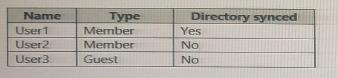
For which users can you configure the Job title property and the Usage location property in Azure AD? To answer, select the appropriate options in the answer area.
NOTE: Each correct selection is worth one point.

For which users can you configure the Job title property and the Usage location property in Azure AD? To answer, select the appropriate options in the answer area.
NOTE: Each correct selection is worth one point.

SC-300 Exam Question 35
You have an Azure Active Directory (Azure AD) tenant that contains cloud-based enterprise apps.
You need to group related apps into categories in the My Apps portal.
What should you create?
You need to group related apps into categories in the My Apps portal.
What should you create?
Premium Bundle
Newest SC-300 Exam PDF Dumps shared by Actual4test.com for Helping Passing SC-300 Exam! Actual4test.com now offer the updated SC-300 exam dumps, the Actual4test.com SC-300 exam questions have been updated and answers have been corrected get the latest Actual4test.com SC-300 pdf dumps with Exam Engine here:
(480 Q&As Dumps, 30%OFF Special Discount: Freepdfdumps)