

1z0-071 Exam Question 1
Examine the create table statements for the stores and sales tables.
SQL> CREATE TABLE stores(store_id NUMBER(4) CONSTRAINT store_id_pk PRIMARY KEY, store_name VARCHAR2(12), store_address VARCHAR2(20), start_date DATE);
SQL> CREATE TABLE sales(sales_id NUMBER(4) CONSTRAINT sales_id_pk PRIMARY KEY, item_id NUMBER(4), quantity NUMBER(10), sales_date DATE, store_id NUMBER(4), CONSTRAINT store_id_fk FOREIGN KEY(store_id) REFERENCES stores(store_id));
You executed the following statement:
SQL> DELETE from stores
WHERE store_id=900;
The statement fails due to the integrity constraint error:
ORA-02292: integrity constraint (HR.STORE_ID_FK) violated
Which three options ensure that the statement will execute successfully? (Choose three.)
SQL> CREATE TABLE stores(store_id NUMBER(4) CONSTRAINT store_id_pk PRIMARY KEY, store_name VARCHAR2(12), store_address VARCHAR2(20), start_date DATE);
SQL> CREATE TABLE sales(sales_id NUMBER(4) CONSTRAINT sales_id_pk PRIMARY KEY, item_id NUMBER(4), quantity NUMBER(10), sales_date DATE, store_id NUMBER(4), CONSTRAINT store_id_fk FOREIGN KEY(store_id) REFERENCES stores(store_id));
You executed the following statement:
SQL> DELETE from stores
WHERE store_id=900;
The statement fails due to the integrity constraint error:
ORA-02292: integrity constraint (HR.STORE_ID_FK) violated
Which three options ensure that the statement will execute successfully? (Choose three.)
1z0-071 Exam Question 2
See the Exhibit and examine the structure of the PROMOTIONS table:
Using the PROMOTIONS table,
you need to find out the average cost for all promos in the range $0-2000 and $2000-5000 in category A.
You issue the following SQL statements:
What would be the outcome?
Using the PROMOTIONS table,
you need to find out the average cost for all promos in the range $0-2000 and $2000-5000 in category A.
You issue the following SQL statements:
What would be the outcome?
1z0-071 Exam Question 3
View the Exhibit and examine the details of the ORDER_ITEMS table.
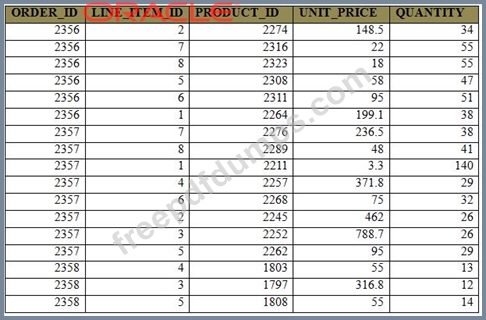
Evaluate the following SQL statements:
Statement 1:
SELECT MAX(unit_price*quantity) "Maximum Order"
FROM order_items;
Statement 2:
SELECT MAX(unit_price*quantity) "Maximum Order"
FROM order_items
GROUP BY order_id;
Which statements are true regarding the output of these SQL statements? (Choose all that apply.)
Evaluate the following SQL statements:
Statement 1:
SELECT MAX(unit_price*quantity) "Maximum Order"
FROM order_items;
Statement 2:
SELECT MAX(unit_price*quantity) "Maximum Order"
FROM order_items
GROUP BY order_id;
Which statements are true regarding the output of these SQL statements? (Choose all that apply.)
1z0-071 Exam Question 4
The user SCOTTwho is the owner of ORDERSand ORDER_ITEMStables issues this GRANTcommand:
GRANT ALL
ON orders, order_items
TO PUBLIC;
What must be done to fix the statement?
GRANT ALL
ON orders, order_items
TO PUBLIC;
What must be done to fix the statement?
1z0-071 Exam Question 5
Examine this statement which returns the name of each employee and their manager:
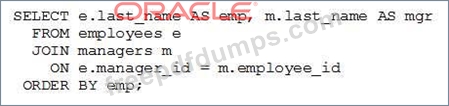
You want to extend the query to include employees with no manager. What must you add before JOINto do this?
You want to extend the query to include employees with no manager. What must you add before JOINto do this?