

1z0-809 Exam Question 161
Given the code fragment:
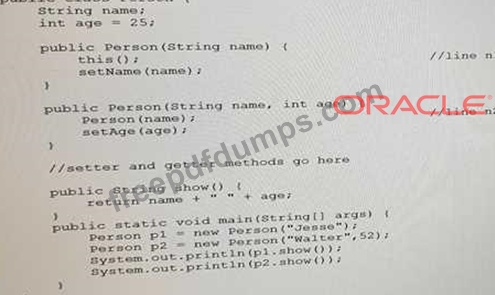
What is the result?
What is the result?
1z0-809 Exam Question 162
In 2015, daylight saving time in New York, USA, begins on March 8th at 2:00 AM. As a result, 2:00 AM becomes 3:00 AM.
Given the code fragment:

Which is the result?
Given the code fragment:
Which is the result?
1z0-809 Exam Question 163
Given the code fragments:
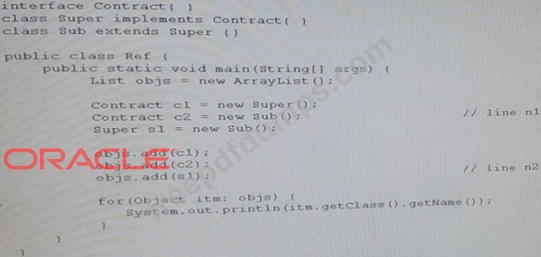
What is the result?
What is the result?
1z0-809 Exam Question 164
Given:
public class Test<T> {
private T t;
public T get () {
return t;
}
public void set (T t) {
this.t = t;
}
public static void main (String args [ ] ) {
Test<String> type = new Test<>();
Test type 1 = new Test (); //line n1
type.set("Java");
type1.set(100); //line n2
System.out.print(type.get() + " " + type1.get());
}
}
What is the result?
public class Test<T> {
private T t;
public T get () {
return t;
}
public void set (T t) {
this.t = t;
}
public static void main (String args [ ] ) {
Test<String> type = new Test<>();
Test type 1 = new Test (); //line n1
type.set("Java");
type1.set(100); //line n2
System.out.print(type.get() + " " + type1.get());
}
}
What is the result?
1z0-809 Exam Question 165
Given the code fragment:
List<Integer> codes = Arrays.asList (10, 20);
UnaryOperator<Double> uo = s -> s +10.0;
codes.replaceAll(uo);
codes.forEach(c -> System.out.println(c));
What is the result?
List<Integer> codes = Arrays.asList (10, 20);
UnaryOperator<Double> uo = s -> s +10.0;
codes.replaceAll(uo);
codes.forEach(c -> System.out.println(c));
What is the result?