

CAPM Exam Question 251
Which of the following is an enterprise environmental factor that can influence the Develop Project Charter process?
Correct Answer: B
According to the PMBOKGuide, the Develop Project Charter process involves internal and external influences categorized as either Enterprise Environmental Factors (EEFs) or Organizational Process Assets (OPAs).
* Enterprise Environmental Factors (EEFs): These are conditions, not under the control of the project team, that influence, constrain, or direct the project. They can be internal (e.g., organizational culture, infrastructure) or external (e.g., currency rates, legal requirements).
* Marketplace Conditions: This is a specific external EEF. It refers to the current state of the market, including competitor performance, market share, brand recognition, and trademarks. These factors help determine if a project is viable or necessary to maintain a competitive edge.
* Other EEFs for Project Charter:
* Government or industry standards (e.g., regulatory agency regulations, codes of conduct).
* Legal and regulatory requirements and/or constraints.
* Organizational culture and political climate.
* Governance framework.
* Stakeholder expectations and risk thresholds.
Comparison with other options:
* A. Organizational standard processes: These are Organizational Process Assets (OPAs). They are the plans, processes, policies, procedures, and knowledge bases specific to and used by the performing organization.
* C. Historical information: This is a component of OPAs (specifically the corporate knowledge base). It includes lessons learned and records from previous projects used to help authorize the current one.
* D. Templates: These are OPAs. They are pre-formatted documents (like a Project Charter template) provided by the organization to ensure consistency across projects.
* Enterprise Environmental Factors (EEFs): These are conditions, not under the control of the project team, that influence, constrain, or direct the project. They can be internal (e.g., organizational culture, infrastructure) or external (e.g., currency rates, legal requirements).
* Marketplace Conditions: This is a specific external EEF. It refers to the current state of the market, including competitor performance, market share, brand recognition, and trademarks. These factors help determine if a project is viable or necessary to maintain a competitive edge.
* Other EEFs for Project Charter:
* Government or industry standards (e.g., regulatory agency regulations, codes of conduct).
* Legal and regulatory requirements and/or constraints.
* Organizational culture and political climate.
* Governance framework.
* Stakeholder expectations and risk thresholds.
Comparison with other options:
* A. Organizational standard processes: These are Organizational Process Assets (OPAs). They are the plans, processes, policies, procedures, and knowledge bases specific to and used by the performing organization.
* C. Historical information: This is a component of OPAs (specifically the corporate knowledge base). It includes lessons learned and records from previous projects used to help authorize the current one.
* D. Templates: These are OPAs. They are pre-formatted documents (like a Project Charter template) provided by the organization to ensure consistency across projects.
CAPM Exam Question 252
Which grid shows which resources are tied to work packages?
Correct Answer: B
In accordance with the PMBOKGuide (Project Resource Management), the Responsibility Assignment Matrix (RAM) is a grid that shows the project resources assigned to each work package. It is used to illustrate the connections between work packages or activities and project team members.
* Function: The RAM ensures that there is only one person accountable for any one task to avoid confusion. On larger projects, RAMs can be developed at various levels. For example, a high-level RAM can define what a project team group or unit is responsible for within each component of the WBS, while lower-level RAMs are used within the group to designate roles, responsibilities, and levels of authority for specific activities.
* RACI Chart: The most common type of RAM is the RACI (Responsible, Accountable, Consulted, and Informed) chart. In a RACI chart, the work is listed in the left-hand column as activities or work packages, and the resources are listed across the top as individuals or groups.
Analysis of Distractors:
* A. Work breakdown structure (WBS): This is a hierarchical decomposition of the total scope of work to be carried out by the project team. While it defines the work packages, it does not inherently show the resources assigned to them.
* C. Project assignment chart: This is not a standard PMI term. While " Project Team Assignments " is an output of the Acquire Resources process (documenting that the team is in place), it is not the grid used to map resources to specific work packages.
* D. Personnel assignment matrix: Similar to option C, this is not a recognized term in the PMBOK Guide. The standard term for this functional grid is the Responsibility Assignment Matrix (RAM).
* Function: The RAM ensures that there is only one person accountable for any one task to avoid confusion. On larger projects, RAMs can be developed at various levels. For example, a high-level RAM can define what a project team group or unit is responsible for within each component of the WBS, while lower-level RAMs are used within the group to designate roles, responsibilities, and levels of authority for specific activities.
* RACI Chart: The most common type of RAM is the RACI (Responsible, Accountable, Consulted, and Informed) chart. In a RACI chart, the work is listed in the left-hand column as activities or work packages, and the resources are listed across the top as individuals or groups.
Analysis of Distractors:
* A. Work breakdown structure (WBS): This is a hierarchical decomposition of the total scope of work to be carried out by the project team. While it defines the work packages, it does not inherently show the resources assigned to them.
* C. Project assignment chart: This is not a standard PMI term. While " Project Team Assignments " is an output of the Acquire Resources process (documenting that the team is in place), it is not the grid used to map resources to specific work packages.
* D. Personnel assignment matrix: Similar to option C, this is not a recognized term in the PMBOK Guide. The standard term for this functional grid is the Responsibility Assignment Matrix (RAM).
CAPM Exam Question 253
A software development team is working on a project to adapt an application to new, government-established data-privacy rules. What factor led to the creation of this project?
Correct Answer: A
According to the PMBOKGuide, projects are initiated by an organization's influential stakeholders or senior management in response to several factors. These factors, often referred to as " Project Initiation Contexts, " are categorized based on the specific need they address.
* Legal requirement: This project is a direct response to government-established data-privacy rules.
When an organization must comply with new laws, regulations, or standards (such as GDPR, HIPAA, or local data privacy acts), it initiates a project to bring its systems or processes into compliance. This is a mandatory driver for project creation to avoid legal penalties or loss of license to operate.
Analysis of other options:
* New technology (Option B): This refers to projects initiated because of technical advancements that make a new product or service possible (e.g., creating a mobile app because of a new OS update).
While the project involves software, the driver is the law, not the technology itself.
* Social need (Option C): These projects are initiated to address a community or societal problem (e.g., a project to provide clean water to a remote village). While data privacy is a social concern, the government mandate makes it a legal requirement.
* Economic change (Option D): These projects are initiated due to shifts in the market, such as a recession or changes in interest rates, which force an organization to pivot its strategy.
Per PMI standards, understanding the fundamental reason for a project ' s existence is essential for the project manager to ensure the Project Charter and subsequent requirements are correctly aligned with the business case and organizational strategy.
* Legal requirement: This project is a direct response to government-established data-privacy rules.
When an organization must comply with new laws, regulations, or standards (such as GDPR, HIPAA, or local data privacy acts), it initiates a project to bring its systems or processes into compliance. This is a mandatory driver for project creation to avoid legal penalties or loss of license to operate.
Analysis of other options:
* New technology (Option B): This refers to projects initiated because of technical advancements that make a new product or service possible (e.g., creating a mobile app because of a new OS update).
While the project involves software, the driver is the law, not the technology itself.
* Social need (Option C): These projects are initiated to address a community or societal problem (e.g., a project to provide clean water to a remote village). While data privacy is a social concern, the government mandate makes it a legal requirement.
* Economic change (Option D): These projects are initiated due to shifts in the market, such as a recession or changes in interest rates, which force an organization to pivot its strategy.
Per PMI standards, understanding the fundamental reason for a project ' s existence is essential for the project manager to ensure the Project Charter and subsequent requirements are correctly aligned with the business case and organizational strategy.
CAPM Exam Question 254
Which statement about identification and engagement of stakeholders during a project is correct?
Correct Answer: A
According to the PMBOKGuide, stakeholder engagement is not a one-time event or a task limited to the beginning of the project. It is a continuous and iterative process that must occur throughout the entire project life cycle.
* Continuous Identification: New stakeholders can emerge at any time-during a change in project direction, a transition between phases, or shifts in the organizational landscape. Therefore, the Identify Stakeholders process should be revisited at the start of every phase and whenever a significant change occurs.
* Direct Influence on Success: Stakeholders hold the power to support or resist project objectives. Their early and ongoing engagement helps the project manager manage expectations, resolve conflicts, and ensure the deliverables meet the actual business need.
* Engagement Levels: The degree and nature of engagement may shift (e.g., a stakeholder may be heavily involved in requirements gathering but only receive status reports during execution), but they remain " engaged " throughout to ensure their continued alignment with project goals.
* Iterative Nature: The Stakeholder Engagement Plan is a living document. As the project progresses, the project manager must monitor these relationships and adjust strategies to keep stakeholders supportive.
Analysis of Other Options:
* B. Project stakeholders should be identified and engaged once the prototype is completed...: This is far too late. Waiting until a prototype is built to engage stakeholders often leads to costly rework if their requirements or expectations were not captured early.
* C. Project stakeholders should be identified when the project charter is being completed and engaged during requirements gathering: While identification starts during the charter and engagement is heavy during requirements, this statement implies that engagement stops there. Stakeholders must remain engaged through execution and closing to ensure final acceptance.
* D. Project stakeholders should be identified and engaged during requirements elicitation but not during the Define Scope process: This is contradictory. The Define Scope process relies heavily on stakeholder input to determine what is in and out of the project. Excluding them from this process would likely result in scope gaps or misalignment.
* Continuous Identification: New stakeholders can emerge at any time-during a change in project direction, a transition between phases, or shifts in the organizational landscape. Therefore, the Identify Stakeholders process should be revisited at the start of every phase and whenever a significant change occurs.
* Direct Influence on Success: Stakeholders hold the power to support or resist project objectives. Their early and ongoing engagement helps the project manager manage expectations, resolve conflicts, and ensure the deliverables meet the actual business need.
* Engagement Levels: The degree and nature of engagement may shift (e.g., a stakeholder may be heavily involved in requirements gathering but only receive status reports during execution), but they remain " engaged " throughout to ensure their continued alignment with project goals.
* Iterative Nature: The Stakeholder Engagement Plan is a living document. As the project progresses, the project manager must monitor these relationships and adjust strategies to keep stakeholders supportive.
Analysis of Other Options:
* B. Project stakeholders should be identified and engaged once the prototype is completed...: This is far too late. Waiting until a prototype is built to engage stakeholders often leads to costly rework if their requirements or expectations were not captured early.
* C. Project stakeholders should be identified when the project charter is being completed and engaged during requirements gathering: While identification starts during the charter and engagement is heavy during requirements, this statement implies that engagement stops there. Stakeholders must remain engaged through execution and closing to ensure final acceptance.
* D. Project stakeholders should be identified and engaged during requirements elicitation but not during the Define Scope process: This is contradictory. The Define Scope process relies heavily on stakeholder input to determine what is in and out of the project. Excluding them from this process would likely result in scope gaps or misalignment.
CAPM Exam Question 255
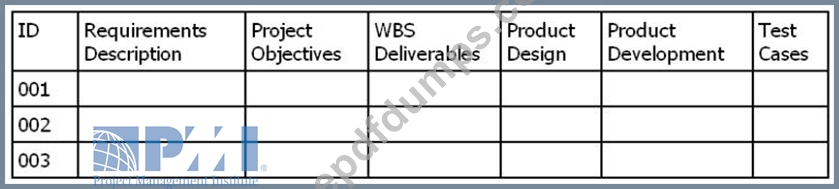
The chart below is an example of a:
Correct Answer: D
According to the PMBOKGuide (Project Management Body of Knowledge), specifically within the Project Scope Management knowledge area and the Collect Requirements process:
* Requirements Traceability Matrix (Option D): The image provided is a textbook example of a Requirements Traceability Matrix (RTM). An RTM is a grid that links product requirements from their origin to the deliverables that satisfy them. As shown in the chart, it tracks the ID and Requirements Description through various stages of the project life cycle, including Project Objectives, WBS Deliverables, Product Design, Product Development, and Test Cases. This ensures that each requirement adds business value and that all requirements are accounted for at the end of the project.
* Responsibility Assignment Matrix (RAM) / RACI Chart (Options A and C): These are tools used in Project Resource Management. They map project work packages to the individuals or groups responsible for them (Responsible, Accountable, Consulted, Informed). They do not track technical requirements or product design stages.
* Work Breakdown Structure (WBS) (Option B): A WBS is a hierarchical decomposition of the total scope of work to be carried out by the project team. It is typically displayed as a tree diagram or an indented list of work packages, not a horizontal matrix tracking the development lifecycle of specific requirements.
In the PMI framework, the Requirements Traceability Matrix is essential for managing scope creep. It provides a means to track requirements throughout the project life cycle, ensuring that requirements approved in the charter and scope statement are actually delivered and tested.
* Requirements Traceability Matrix (Option D): The image provided is a textbook example of a Requirements Traceability Matrix (RTM). An RTM is a grid that links product requirements from their origin to the deliverables that satisfy them. As shown in the chart, it tracks the ID and Requirements Description through various stages of the project life cycle, including Project Objectives, WBS Deliverables, Product Design, Product Development, and Test Cases. This ensures that each requirement adds business value and that all requirements are accounted for at the end of the project.
* Responsibility Assignment Matrix (RAM) / RACI Chart (Options A and C): These are tools used in Project Resource Management. They map project work packages to the individuals or groups responsible for them (Responsible, Accountable, Consulted, Informed). They do not track technical requirements or product design stages.
* Work Breakdown Structure (WBS) (Option B): A WBS is a hierarchical decomposition of the total scope of work to be carried out by the project team. It is typically displayed as a tree diagram or an indented list of work packages, not a horizontal matrix tracking the development lifecycle of specific requirements.
In the PMI framework, the Requirements Traceability Matrix is essential for managing scope creep. It provides a means to track requirements throughout the project life cycle, ensuring that requirements approved in the charter and scope statement are actually delivered and tested.
- Other Version
- 4477PMI.CAPM.v2023-02-14.q281
- 10135PMI.CAPM.v2022-05-24.q570
- 59PMI.Pass4guide.CAPM.v2022-05-12.by.shirley.570q.pdf
- 12535PMI.CAPM.v2022-01-02.q768
- 89PMI.Exams4sures.CAPM.v2021-08-25.by.odelette.722q.pdf
- Latest Upload
- 132Pegasystems.PEGACPDC25V1.v2026-07-17.q45
- 225CompTIA.N10-009.v2026-07-17.q230
- 146EMC.D-PDM-DY-23.v2026-07-17.q66
- 147Salesforce.ADM-201.v2026-07-17.q63
- 371PMI.CAPM.v2026-07-17.q643
- 153Cisco.300-215.v2026-07-17.q60
- 397CollegeAdmission.PMHNP.v2026-07-17.q640
- 201Microsoft.MB-240.v2026-07-17.q174
- 134SAP.C_CE325_2601.v2026-07-17.q37
- 278Microsoft.AZ-900.v2026-07-16.q224