

CAPM Exam Question 81
Which stakeholder classification model groups stakeholders based on their level of authority and their active involvement in the project?
Correct Answer: A
According to the PMBOKGuide and the Standard for Project Management, specifically within the Identify Stakeholders process, the Power/Influence Grid is the specific classification model that groups stakeholders based on their level of authority (power) and their active involvement (influence) in the project.
As per PMI standards, these grids help the project manager prioritize stakeholders and determine the appropriate engagement strategy. The definitions of the axes in this model are:
* Power (Authority): The level of ability a stakeholder has to influence the project ' s outcome or the organization ' s strategic direction.
* Influence (Active Involvement): The stakeholder ' s active involvement in the project and their ability to affect others ' decisions or the project ' s execution.

The other options are incorrect based on the following PMI definitions:
* Power/Interest Grid: This model groups stakeholders based on their level of authority (power) and their level of concern or curiosity (interest) regarding the project ' s outcomes.
* Influence/Impact Grid: This model groups stakeholders based on their active involvement (influence) in the project and their ability to effect changes to the project ' s planning or execution (impact).
* Salience Model: This is a more complex model that describes classes of stakeholders based on their assessments of three variables: power (level of authority), urgency (need for immediate attention), and legitimacy (their involvement is appropriate).
As per the PMI Lexicon of Project Management Terms, the use of these grids is a critical component of Stakeholder Analysis, ensuring that the project manager focuses the necessary effort on the stakeholders who can most significantly affect project success.
As per PMI standards, these grids help the project manager prioritize stakeholders and determine the appropriate engagement strategy. The definitions of the axes in this model are:
* Power (Authority): The level of ability a stakeholder has to influence the project ' s outcome or the organization ' s strategic direction.
* Influence (Active Involvement): The stakeholder ' s active involvement in the project and their ability to affect others ' decisions or the project ' s execution.
The other options are incorrect based on the following PMI definitions:
* Power/Interest Grid: This model groups stakeholders based on their level of authority (power) and their level of concern or curiosity (interest) regarding the project ' s outcomes.
* Influence/Impact Grid: This model groups stakeholders based on their active involvement (influence) in the project and their ability to effect changes to the project ' s planning or execution (impact).
* Salience Model: This is a more complex model that describes classes of stakeholders based on their assessments of three variables: power (level of authority), urgency (need for immediate attention), and legitimacy (their involvement is appropriate).
As per the PMI Lexicon of Project Management Terms, the use of these grids is a critical component of Stakeholder Analysis, ensuring that the project manager focuses the necessary effort on the stakeholders who can most significantly affect project success.
CAPM Exam Question 82
An output of the Validate Scope process is:
Correct Answer: D
According to the PMBOK Guide and the Standard for Project Management, the Validate Scope process is the process of formalizing acceptance of the completed project deliverables. It belongs to the Monitoring and Controlling Process Group.
While the primary goal of this process is to obtain Accepted Deliverables, it frequently results in Change Requests. According to PMI standards, if deliverables are inspected and do not meet the acceptance criteria established in the scope documentation, change requests are created for defect repair or enhancement. These requests are then processed through the Perform Integrated Change Control process.
The outputs of Validate Scope include:
* Accepted Deliverables: Deliverables that meet acceptance criteria and are formally signed off by the customer or sponsor.
* Change Requests: Requests for modifications or repairs to deliverables that were not accepted.
* Work Performance Information: Includes data on which deliverables have been started, their progress, or which have been finished and accepted.
* Project Documents Updates: Updates to documents such as the Requirements Traceability Matrix or Lessons Learned Register.
The other options are incorrect based on their classification in the PMI framework:
* A requirements traceability matrix: This is an input to the Validate Scope process, used to compare requirements against the actual results. It is an output of the Collect Requirements process.
* The scope management plan: This is an input to Validate Scope, as it contains the procedures for formalizing acceptance. It is an output of the Plan Scope Management process.
* Work performance reports: These are outputs of the Monitor and Control Project Work process and serve as inputs to several other processes; they are not generated by Validate Scope.
As per the PMI Lexicon of Project Management Terms, the Validate Scope process is primarily concerned with the acceptance of the deliverables, whereas Quality Control is concerned with the correctness of the deliverables.
CAPM Exam Question 83
Which of the following must be included in the risk register when the project manager completes the Identify Risks process?
Correct Answer: A
According to the PMBOK Guide and standard PMI practice for the Identify Risks process, the primary output of this process is the Risk Register. At the completion of this initial identification phase, the register is populated with specific foundational information that will be refined during subsequent qualitative and quantitative analyses.
The components required at this stage include:
* List of identified risks: A detailed description of individual project risks, often formatted as a risk statement (e.g., Event may occur, leading to Impact).
* Potential risk owners: While a formal owner is confirmed during the Plan Risk Responses process, the Identify Risks process often identifies a person best suited to monitor the risk or provide further detail.
* List of potential risk responses: During identification, the project team often identifies obvious or immediate actions that could be taken to address a risk; these are captured now to inform the later Plan Risk Responses process.
Analysis of other options:
* B and D: While " list of causes " and " risk categories " are important, they are often part of the risk breakdown structure (RBS) or added during analysis. Option A represents the most complete " standard
" output specifically cited by PMI for the initial population of the register.
* C: " Short risk titles " are not a formal requirement; PMI emphasizes comprehensive risk descriptions to ensure clarity of the threat or opportunity.
This documentation ensures that the Risk Management Plan transitions effectively into active tracking and prepares the team for Perform Qualitative Risk Analysis.
CAPM Exam Question 84
A Scrum team has a product backlog and a sprint backlog. Which of the following is a correct statement related to these artifacts?
Correct Answer: B
According to the Agile Practice Guide and the Scrum Guide, Scrum artifacts are designed to provide transparency and opportunities for inspection and adaptation.
The Sprint Backlog: This is a set of Product Backlog items selected for the Sprint, plus a plan for delivering the product Increment and realizing the Sprint Goal. It is highly specific to the current iteration (Sprint). Only the items the team commits to finishing within the timebox are included here.
Ownership: While the Product Owner prioritizes the Product Backlog, the Developers (the Team) own the Sprint Backlog. They decide how much work they can realistically pull into the sprint and how that work will be accomplished.
Analysis of other options:
Option A: This is incorrect. The Product Backlog is, by definition, an ordered (prioritized) list of everything that is known to be needed in the product.
Option C: This is a common distractor. The Product Owner prioritizes the Product Backlog. However, the Sprint Backlog is created by the team during Sprint Planning. While it contains items the Product Owner has prioritized, it is defined by its focus on the " current sprint, " making Option B a more precise definition of the artifact ' s purpose.
Option D: This is backwards. The Sprint Backlog is a subset of the Product Backlog, not the other way around. The Product Backlog represents the " Big Picture, " while the Sprint Backlog is the " Immediate Work. " Key Differences at a Glance:
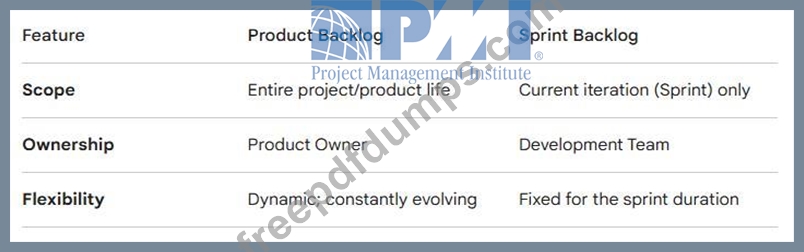
Per PMI standards and Scrum principles, the Sprint Backlog serves as a visible, real-time picture of the work that the Developers plan to accomplish during the Sprint to achieve the Sprint Goal.
The Sprint Backlog: This is a set of Product Backlog items selected for the Sprint, plus a plan for delivering the product Increment and realizing the Sprint Goal. It is highly specific to the current iteration (Sprint). Only the items the team commits to finishing within the timebox are included here.
Ownership: While the Product Owner prioritizes the Product Backlog, the Developers (the Team) own the Sprint Backlog. They decide how much work they can realistically pull into the sprint and how that work will be accomplished.
Analysis of other options:
Option A: This is incorrect. The Product Backlog is, by definition, an ordered (prioritized) list of everything that is known to be needed in the product.
Option C: This is a common distractor. The Product Owner prioritizes the Product Backlog. However, the Sprint Backlog is created by the team during Sprint Planning. While it contains items the Product Owner has prioritized, it is defined by its focus on the " current sprint, " making Option B a more precise definition of the artifact ' s purpose.
Option D: This is backwards. The Sprint Backlog is a subset of the Product Backlog, not the other way around. The Product Backlog represents the " Big Picture, " while the Sprint Backlog is the " Immediate Work. " Key Differences at a Glance:
Per PMI standards and Scrum principles, the Sprint Backlog serves as a visible, real-time picture of the work that the Developers plan to accomplish during the Sprint to achieve the Sprint Goal.
CAPM Exam Question 85
A tool and technique used during the Perform Qualitative Risk Analysis process is:
Correct Answer: A
According to the PMBOKGuide, specifically within the Perform Qualitative Risk Analysis process, Risk Data Quality Assessment is a critical tool and technique used to evaluate the degree to which the data about individual project risks is accurate and reliable.
* Core Objective: Qualitative analysis is subjective by nature. To ensure the results are credible, the project manager must evaluate the quality of the data used to identify and assess the risks. If the data is of low quality (e.g., biased, outdated, or incomplete), the entire risk prioritization process may be flawed.
* Assessment Criteria: This technique involves examining:
* The extent of the understanding of the risk.
* The accuracy, quality, reliability, and integrity of the data.
* The availability of data about the risk.
* The " GIGO " Principle: This assessment helps avoid the " Garbage In, Garbage Out " scenario. If the data quality is unacceptable, it may be necessary to gather better data before proceeding with the analysis or moving into Perform Quantitative Risk Analysis.
Comparison with Other Options:
* Variance and trend analysis (B): This is a tool and technique used in Monitor and Control Risks and Control Costs to compare planned results to actual results. It is not used for the initial qualitative prioritization of risks.
* Data gathering and representation techniques (C): While " Data Gathering " (like interviewing) is used,
" Data Representation " (like probability distributions) is specifically a tool and technique for Perform Quantitative Risk Analysis, not qualitative.
* Risk audits (D): This is a tool and technique for Monitor and Control Risks. It is used to examine and document the effectiveness of risk responses and the risk management process itself.
- Other Version
- 1139PMI.CAPM.v2026-10-15.q575
- 5188PMI.CAPM.v2026-07-17.q643
- 5623PMI.CAPM.v2023-02-14.q281
- 12257PMI.CAPM.v2022-05-24.q570
- 59PMI.Pass4guide.CAPM.v2022-05-12.by.shirley.570q.pdf
- 15147PMI.CAPM.v2022-01-02.q768
- 89PMI.Exams4sures.CAPM.v2021-08-25.by.odelette.722q.pdf
- Latest Upload
- 173HP.HPE7-A01.v2026-10-28.q69
- 152CompTIA.SY0-701.v2026-10-28.q386
- 145CuramSoftware.CS0-004.v2026-10-28.q41
- 257Anthropic.CCAO-F.v2026-10-27.q51
- 206AAPSCM.ACSCP.v2026-10-26.q45
- 281Anthropic.CCAR-F.v2026-10-26.q65
- 185Microsoft.AB-620.v2026-10-26.q55
- 392PMI.CPMAI.v2026-10-26.q152
- 215Microsoft.AI-103.v2026-10-26.q47
- 240Microsoft.AI-300.v2026-10-26.q89