

CAPM Exam Question 476
In Project Cost Management, which input is exclusive to the Determine Budget process?
Correct Answer: D
According to the PMBOKGuide, specifically within the Determine Budget process, the inputs are categorized to help aggregate the estimated costs of individual activities or work packages to establish an authorized cost baseline.
While many processes share similar inputs, Resource Calendars hold a unique position in this specific context:
Resource Calendars: These identify the working days and shifts on which each specific resource is available.
In the Determine Budget process, they are necessary to know when costs will be incurred. For example, if a specialized piece of equipment is only available for two weeks, the budget must account for that specific expenditure during that window.
* The Nuance of " Exclusive " : In the context of the Cost Management knowledge area (Plan Cost Management, Estimate Costs, Determine Budget, and Control Costs), Resource Calendars do not appear as an input to Estimate Costs or Control Costs, but they are critical for Determine Budget to map the cost baseline against the project timeline.
Comparison with Other Options:
Scope baseline (A): This is a common input used in Estimate Costs (to understand the deliverables) and Determine Budget (to ensure all work packages are accounted for). Because it is used in multiple processes within the knowledge area, it is not " exclusive. "
* Organizational process assets (B): OPAs are standard inputs to almost every project management process, providing templates, historical information, and lessons learned.
* Project schedule (C): The schedule is an input to both Estimate Costs (to determine duration-based costs) and Determine Budget (to aggregate those costs over time).
While many processes share similar inputs, Resource Calendars hold a unique position in this specific context:
Resource Calendars: These identify the working days and shifts on which each specific resource is available.
In the Determine Budget process, they are necessary to know when costs will be incurred. For example, if a specialized piece of equipment is only available for two weeks, the budget must account for that specific expenditure during that window.
* The Nuance of " Exclusive " : In the context of the Cost Management knowledge area (Plan Cost Management, Estimate Costs, Determine Budget, and Control Costs), Resource Calendars do not appear as an input to Estimate Costs or Control Costs, but they are critical for Determine Budget to map the cost baseline against the project timeline.
Comparison with Other Options:
Scope baseline (A): This is a common input used in Estimate Costs (to understand the deliverables) and Determine Budget (to ensure all work packages are accounted for). Because it is used in multiple processes within the knowledge area, it is not " exclusive. "
* Organizational process assets (B): OPAs are standard inputs to almost every project management process, providing templates, historical information, and lessons learned.
* Project schedule (C): The schedule is an input to both Estimate Costs (to determine duration-based costs) and Determine Budget (to aggregate those costs over time).
CAPM Exam Question 477
The following is a network diagram for a project.
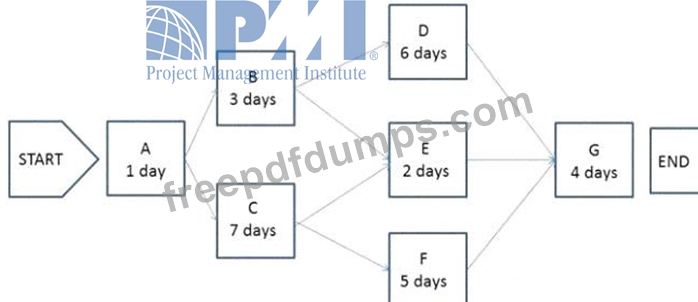
The shortest non-critical path for the project is how many days in duration?
The shortest non-critical path for the project is how many days in duration?
Correct Answer: D
According to the PMBOKGuide (Project Management Body of Knowledge), specifically the Project Schedule Management knowledge area and the Critical Path Method (CPM), we must calculate the duration of every possible path from " Start " to " End " to distinguish between the critical and non-critical paths.
Based on the network diagram provided in the previous sequence (Questions 163-164):
Analyze all Network Paths:
* Path 1: A (1) # B (4) # C (6) # F (5) # G (7) # I (2) = 25 days (Critical Path)
* Path 2: A (1) # B (4) # C (6) # F (5) # H (3) # I (2) = 21 days (Non-critical)
* Path 3: A (1) # D (2) # E (3) # F (5) # G (7) # I (2) = 20 days (Non-critical)
* Path 4: A (1) # D (2) # E (3) # F (5) # H (3) # I (2) = 16 days (Non-critical)
* Identify the Shortest Non-Critical Path:
* The Critical Path is the longest path (25 days).
* Any path with a duration less than the Critical Path is a Non-Critical Path.
* Comparing the non-critical durations (21, 20, and 16), the path with the minimum value is Path 4, which totals 16 days.
In the PMI framework, identifying the shortest path helps the Project Manager understand which sequences of activities have the most Total Float. In this specific network, the path A-D-E-F-H-I has the most flexibility, with a total float of $25 - 16 = 9$ days.
Based on the network diagram provided in the previous sequence (Questions 163-164):
Analyze all Network Paths:
* Path 1: A (1) # B (4) # C (6) # F (5) # G (7) # I (2) = 25 days (Critical Path)
* Path 2: A (1) # B (4) # C (6) # F (5) # H (3) # I (2) = 21 days (Non-critical)
* Path 3: A (1) # D (2) # E (3) # F (5) # G (7) # I (2) = 20 days (Non-critical)
* Path 4: A (1) # D (2) # E (3) # F (5) # H (3) # I (2) = 16 days (Non-critical)
* Identify the Shortest Non-Critical Path:
* The Critical Path is the longest path (25 days).
* Any path with a duration less than the Critical Path is a Non-Critical Path.
* Comparing the non-critical durations (21, 20, and 16), the path with the minimum value is Path 4, which totals 16 days.
In the PMI framework, identifying the shortest path helps the Project Manager understand which sequences of activities have the most Total Float. In this specific network, the path A-D-E-F-H-I has the most flexibility, with a total float of $25 - 16 = 9$ days.
CAPM Exam Question 478
An input to the Control Quality process is:
Correct Answer: D
According to the PMBOK Guide (Project Management Body of Knowledge), specifically within the Project Quality Management knowledge area, the Control Quality process is the process of monitoring and recording results of executing the quality management activities to assess performance and ensure the project outputs are complete, correct, and meet customer expectations.
* Deliverables (Option D): This is a critical input to the Control Quality process. Deliverables are the unique and verifiable products, results, or capabilities that are produced to complete a process, phase, or project. In this process, these " raw " deliverables (from the Direct and Manage Project Work process) are inspected and measured against the quality standards defined in the Quality Management Plan. If they pass, they become Verified Deliverables, which then serve as an input to the Validate Scope process for formal customer acceptance.
* Quality Control Measurements (Option B): These are an output of the Control Quality process, not an input. They represent the documented results of the control quality activities in the format specified during quality planning.
* Activity Attributes (Option A): These are typically an input to schedule-related processes (like Estimate Activity Durations or Develop Schedule) as they provide additional information about each individual activity.
* Enterprise Environmental Factors (Option C): While EEFs influence many processes, the PMBOK Guide specifically identifies Organizational Process Assets (OPAs) and the Project Management Plan as the primary environmental/organizational inputs for Control Quality, rather than EEFs.
In the PMI framework, the Control Quality process ensures that the project team is " doing things right " by verifying that the Deliverables meet the technical requirements and quality standards before they are presented to the customer.
* Deliverables (Option D): This is a critical input to the Control Quality process. Deliverables are the unique and verifiable products, results, or capabilities that are produced to complete a process, phase, or project. In this process, these " raw " deliverables (from the Direct and Manage Project Work process) are inspected and measured against the quality standards defined in the Quality Management Plan. If they pass, they become Verified Deliverables, which then serve as an input to the Validate Scope process for formal customer acceptance.
* Quality Control Measurements (Option B): These are an output of the Control Quality process, not an input. They represent the documented results of the control quality activities in the format specified during quality planning.
* Activity Attributes (Option A): These are typically an input to schedule-related processes (like Estimate Activity Durations or Develop Schedule) as they provide additional information about each individual activity.
* Enterprise Environmental Factors (Option C): While EEFs influence many processes, the PMBOK Guide specifically identifies Organizational Process Assets (OPAs) and the Project Management Plan as the primary environmental/organizational inputs for Control Quality, rather than EEFs.
In the PMI framework, the Control Quality process ensures that the project team is " doing things right " by verifying that the Deliverables meet the technical requirements and quality standards before they are presented to the customer.
CAPM Exam Question 479
A project is in its final stages when a competitor releases a similar product. This could make the project redundant. What should the project manager do next?
Correct Answer: C
According to the PMBOK Guide, specifically regarding the Project Manager ' s Role and Project Integration Management, issues involving the project's continued viability are business-level concerns.
Business Value and Viability: The project manager is responsible for delivering the project ' s outputs, but the Project Sponsor is the owner of the Business Case. When a competitor releases a product that potentially makes the current project redundant, it threatens the project ' s strategic alignment and expected return on investment (ROI).
The Role of the Sponsor: Because the sponsor provides the financial resources and is accountable for the project's business benefits, they are the only ones with the authority to decide whether to continue, pivot, or terminate the project based on the new market reality.
Escalation: This is not a technical project issue that can be handled via a standard change request or risk mitigation plan within the project ' s boundaries. It is a high-level strategic risk that must be escalated immediately so the organization can perform a cost-benefit analysis of finishing the project versus stopping it.
Analysis of other options:
Initiate change control (Option A): Change control is used for modifications to the project scope, schedule, or budget. It is not the appropriate mechanism for deciding the existential fate of a project due to external market shifts.
Address risk mitigation (Option B): Mitigation is done to reduce the impact of a risk. Once the competitor has already released the product, the threat has realized into an issue. You cannot " mitigate " the fact that a competitor ' s product now exists; you must decide if your product still has value.
Initiate project closure (Option D): A project manager does not have the authority to unilaterally close a project because of a competitor ' s move. Closure only happens after the sponsor or a steering committee formally decides to terminate the project.
Per PMI standards, the project manager must ensure the project remains aligned with organizational goals.
When an external event significantly alters the business value, the Project Sponsor must be engaged to re- evaluate the project ' s justification.
Business Value and Viability: The project manager is responsible for delivering the project ' s outputs, but the Project Sponsor is the owner of the Business Case. When a competitor releases a product that potentially makes the current project redundant, it threatens the project ' s strategic alignment and expected return on investment (ROI).
The Role of the Sponsor: Because the sponsor provides the financial resources and is accountable for the project's business benefits, they are the only ones with the authority to decide whether to continue, pivot, or terminate the project based on the new market reality.
Escalation: This is not a technical project issue that can be handled via a standard change request or risk mitigation plan within the project ' s boundaries. It is a high-level strategic risk that must be escalated immediately so the organization can perform a cost-benefit analysis of finishing the project versus stopping it.
Analysis of other options:
Initiate change control (Option A): Change control is used for modifications to the project scope, schedule, or budget. It is not the appropriate mechanism for deciding the existential fate of a project due to external market shifts.
Address risk mitigation (Option B): Mitigation is done to reduce the impact of a risk. Once the competitor has already released the product, the threat has realized into an issue. You cannot " mitigate " the fact that a competitor ' s product now exists; you must decide if your product still has value.
Initiate project closure (Option D): A project manager does not have the authority to unilaterally close a project because of a competitor ' s move. Closure only happens after the sponsor or a steering committee formally decides to terminate the project.
Per PMI standards, the project manager must ensure the project remains aligned with organizational goals.
When an external event significantly alters the business value, the Project Sponsor must be engaged to re- evaluate the project ' s justification.
CAPM Exam Question 480
A project manager is in the process of onboarding resources to start work on a project. Which of the following components of a project management plan will the project manager update after completing this activity?
Correct Answer: B
According to the PMBOKGuide, specifically the Acquire Resources process, onboarding specific team members is a critical transition from planning to execution that impacts several management artifacts.
Resource Management Plan: While the plan initially outlines how resources will be acquired, it must be updated to reflect the actual resources assigned to the project. This includes their specific roles, responsibilities, and the timing of their involvement. Onboarding also triggers updates to the Project Team Assignments and Resource Calendars, which are sub-components or closely related to the Resource Management Plan.
Cost Baseline: In many organizations, resources are planned using " average " or " standard " rates. Once the project manager completes the actual onboarding, the specific costs (actual salaries, contractor rates, or specialized equipment costs) become known. If there is a significant difference between the estimated costs and the actual costs of the onboarded resources, the Cost Baseline must be updated to reflect the true financial commitment of the project.
The Transition: Onboarding is the point where " Generic Resource A " becomes " John Doe at $\$150$/hour.
" This precision is what necessitates the baseline update.
Analysis of other options:
Option A: The Lessons Learned Register is typically updated after a process is completed to capture what went well or poorly. While you might update it eventually, it is a project document, not a component of the Project Management Plan.
Option C: The Procurement Management Plan governs the process of how you buy goods or services. Once resources are onboarded, you are executing that plan, not necessarily updating it (unless the procurement strategy itself changed).
Option D: Preassignment is a tool and technique (or an input) of the Acquire Resources process, not a component of the Project Management Plan that is updated after the activity. You cannot " update " a preassignment once the person is already onboarded.
Per PMI standards, when moving from resource planning to actual acquisition and onboarding, the project manager must ensure that the Resource Management Plan reflects the current team structure and the Cost Baseline remains accurate based on actual resource expenditures.
Resource Management Plan: While the plan initially outlines how resources will be acquired, it must be updated to reflect the actual resources assigned to the project. This includes their specific roles, responsibilities, and the timing of their involvement. Onboarding also triggers updates to the Project Team Assignments and Resource Calendars, which are sub-components or closely related to the Resource Management Plan.
Cost Baseline: In many organizations, resources are planned using " average " or " standard " rates. Once the project manager completes the actual onboarding, the specific costs (actual salaries, contractor rates, or specialized equipment costs) become known. If there is a significant difference between the estimated costs and the actual costs of the onboarded resources, the Cost Baseline must be updated to reflect the true financial commitment of the project.
The Transition: Onboarding is the point where " Generic Resource A " becomes " John Doe at $\$150$/hour.
" This precision is what necessitates the baseline update.
Analysis of other options:
Option A: The Lessons Learned Register is typically updated after a process is completed to capture what went well or poorly. While you might update it eventually, it is a project document, not a component of the Project Management Plan.
Option C: The Procurement Management Plan governs the process of how you buy goods or services. Once resources are onboarded, you are executing that plan, not necessarily updating it (unless the procurement strategy itself changed).
Option D: Preassignment is a tool and technique (or an input) of the Acquire Resources process, not a component of the Project Management Plan that is updated after the activity. You cannot " update " a preassignment once the person is already onboarded.
Per PMI standards, when moving from resource planning to actual acquisition and onboarding, the project manager must ensure that the Resource Management Plan reflects the current team structure and the Cost Baseline remains accurate based on actual resource expenditures.
- Other Version
- 2657PMI.CAPM.v2026-09-05.q632
- 4726PMI.CAPM.v2026-07-17.q643
- 5401PMI.CAPM.v2023-02-14.q281
- 12104PMI.CAPM.v2022-05-24.q570
- 59PMI.Pass4guide.CAPM.v2022-05-12.by.shirley.570q.pdf
- 14823PMI.CAPM.v2022-01-02.q768
- 89PMI.Exams4sures.CAPM.v2021-08-25.by.odelette.722q.pdf
- Latest Upload
- 149Microsoft.AI-103.v2026-10-16.q46
- 181InsuranceLicensing.NY-Independent-General-Adjuster.v2026-10-15.q45
- 218Anthropic.CCAR-F.v2026-10-15.q76
- 207Salesforce.Marketing-Cloud-Consultant.v2026-10-15.q68
- 554PMI.CAPM.v2026-10-15.q575
- 172ServiceNow.CIS-DF.v2026-10-15.q61
- 399IIA.IIA-CIA-Part2-CN.v2026-10-14.q323
- 228Cisco.300-215.v2026-10-14.q84
- 183Fortinet.NSE6_FNC_AD-7.6.v2026-10-13.q26
- 716Snowflake.COF-C03.v2026-10-13.q472