PRINCE2-Practitioner Exam Question 111
Scenario:
Techniques, processes and procedures
1. Any threat that may result in a loss of MFH data must be escalated immediately.
Joint agreements
2. Work is to start at the beginning of week 2 (Stage 4).
3. The project will take two years to complete, at an estimated cost of £2.5m.
Tolerances
4. None.
Constraints
5. MFH staff must not be involved in any heavy lifting during the removal of existing IT equipment.
6. Installation work must take place during MFH normal working hours.
7. +£10,000 / -£25,000.
Reporting arrangements
8. Highlight Report every Monday by 10.00 am.
9. The report must contain a summary of all products worked on during the previous week.
10. Project Manager must be notified of any issues immediately by telephone.
Problem handling and escalation
11. Impact analysis of all issues must be completed within 24 hours.
Extracts or references
12. The Stage Plan for stage 4 is available from Project Support.
Approval method
13. Project Assurance will review the completed Work Package and confirm completion At the end of stage 3, the service provider will be selected and the contract awarded. During stage 4, the Account Manager for the selected service provider will work with the Project Manager to complete the transition of the services to the selected service provider.
Techniques, processes and procedures
1. Any threat that may result in a loss of MFH data must be escalated immediately.
Joint agreements
2. Work is to start at the beginning of week 2 (Stage 4).
3. The project will take two years to complete, at an estimated cost of £2.5m.
Tolerances
4. None.
Constraints
5. MFH staff must not be involved in any heavy lifting during the removal of existing IT equipment.
6. Installation work must take place during MFH normal working hours.
7. +£10,000 / -£25,000.
Reporting arrangements
8. Highlight Report every Monday by 10.00 am.
9. The report must contain a summary of all products worked on during the previous week.
10. Project Manager must be notified of any issues immediately by telephone.
Problem handling and escalation
11. Impact analysis of all issues must be completed within 24 hours.
Extracts or references
12. The Stage Plan for stage 4 is available from Project Support.
Approval method
13. Project Assurance will review the completed Work Package and confirm completion At the end of stage 3, the service provider will be selected and the contract awarded. During stage 4, the Account Manager for the selected service provider will work with the Project Manager to complete the transition of the services to the selected service provider.
PRINCE2-Practitioner Exam Question 112
Project Scenario
Calendar Project (Note: The companies and people within the scenario are fictional.) There has been a reduction in fie number of orders at the MNO Manufacturing Company due in part to the increased marketing activities of its competitors. To help counter this, the company has decided to create a promotional calendar for next year for all its current and prospective customers. The end product of this project will be a prepared calendar pack, ready for printing. The design of the calendar will be similar to one sent out previously, and must reflect the company image as described in the existing corporate branding standards. Another project is currently producing a new company logo when is to be printed on each page of the promotional calendar. The prepared calendar pack will consist of:
* Design for each month - correctly showing at public holidays and new company logo
* Selected photographs- 12 professionally-produced photographs, showing different members of staff
* Selected paper and selected envelope - for printing and mailing the calendar
* Chosen label design - a competition to design a label will be held as part of this project
* List of customers - names and addresses of customers to whom the calendar will be sent.
The project is currently in initiation and will have two further stages:
Stage 2 will include tie activities to:
* Create the customer fast using information from the Accounts and Marketing departments
* Confirm compliance with the Data Protection Legislation
* Create a design for each month - this will be done by the internal creative team
* Select and appoint a professional photographer
* Gather photograph design ideas from previous project and agree photographic session schedule
* Prepare a production cost forecast
* Select paper and envelope.
Stage 3 will include the activities to:
* Produce and select tie professionally-taken photographs
* Hold the label design competition and choose the label design
* Assemble the prepared calendar pack.
A production cost forecast, based on the options and costs for the paper, envelope, printing and marketing of the calendar is to be produced in stage 2. However, the actual production and distribution of the calendars is not within the scope of the project. The product cost forecast will be reviewed by the Project Board to determine whether tie project should continue.
It is now 05 October and the prepared calendar pack must be delivered to the print company by 30 November, to enable printing and distribution of the calendar in time for Christmas. The cost of the activities to develop the specialist products and the cost of the project management activities are estimated to be £20,000. There is a project time tolerance of +1 week /-2 weeks and a project cost tolerance of +£6,000 / -£6,000. A change budget of £500 has been allocated but there is no risk budget.
Whilst identifying the mailing costs for the calendars the Project Manager was surprised to find the costs could vary considerably depending on the size of the package and the delivery service used. For the purpose of this project, the Project Manager has selected an appropriate service but feels that a corporate standard for postage would have reduced the time and effort invested. It could reduce the company's overheads by up to
£20k per year. How should the Project Manager record this observation within the project?
Calendar Project (Note: The companies and people within the scenario are fictional.) There has been a reduction in fie number of orders at the MNO Manufacturing Company due in part to the increased marketing activities of its competitors. To help counter this, the company has decided to create a promotional calendar for next year for all its current and prospective customers. The end product of this project will be a prepared calendar pack, ready for printing. The design of the calendar will be similar to one sent out previously, and must reflect the company image as described in the existing corporate branding standards. Another project is currently producing a new company logo when is to be printed on each page of the promotional calendar. The prepared calendar pack will consist of:
* Design for each month - correctly showing at public holidays and new company logo
* Selected photographs- 12 professionally-produced photographs, showing different members of staff
* Selected paper and selected envelope - for printing and mailing the calendar
* Chosen label design - a competition to design a label will be held as part of this project
* List of customers - names and addresses of customers to whom the calendar will be sent.
The project is currently in initiation and will have two further stages:
Stage 2 will include tie activities to:
* Create the customer fast using information from the Accounts and Marketing departments
* Confirm compliance with the Data Protection Legislation
* Create a design for each month - this will be done by the internal creative team
* Select and appoint a professional photographer
* Gather photograph design ideas from previous project and agree photographic session schedule
* Prepare a production cost forecast
* Select paper and envelope.
Stage 3 will include the activities to:
* Produce and select tie professionally-taken photographs
* Hold the label design competition and choose the label design
* Assemble the prepared calendar pack.
A production cost forecast, based on the options and costs for the paper, envelope, printing and marketing of the calendar is to be produced in stage 2. However, the actual production and distribution of the calendars is not within the scope of the project. The product cost forecast will be reviewed by the Project Board to determine whether tie project should continue.
It is now 05 October and the prepared calendar pack must be delivered to the print company by 30 November, to enable printing and distribution of the calendar in time for Christmas. The cost of the activities to develop the specialist products and the cost of the project management activities are estimated to be £20,000. There is a project time tolerance of +1 week /-2 weeks and a project cost tolerance of +£6,000 / -£6,000. A change budget of £500 has been allocated but there is no risk budget.
Whilst identifying the mailing costs for the calendars the Project Manager was surprised to find the costs could vary considerably depending on the size of the package and the delivery service used. For the purpose of this project, the Project Manager has selected an appropriate service but feels that a corporate standard for postage would have reduced the time and effort invested. It could reduce the company's overheads by up to
£20k per year. How should the Project Manager record this observation within the project?
PRINCE2-Practitioner Exam Question 113
There are four steps in the Risk Management procedure, what are they?
PRINCE2-Practitioner Exam Question 114
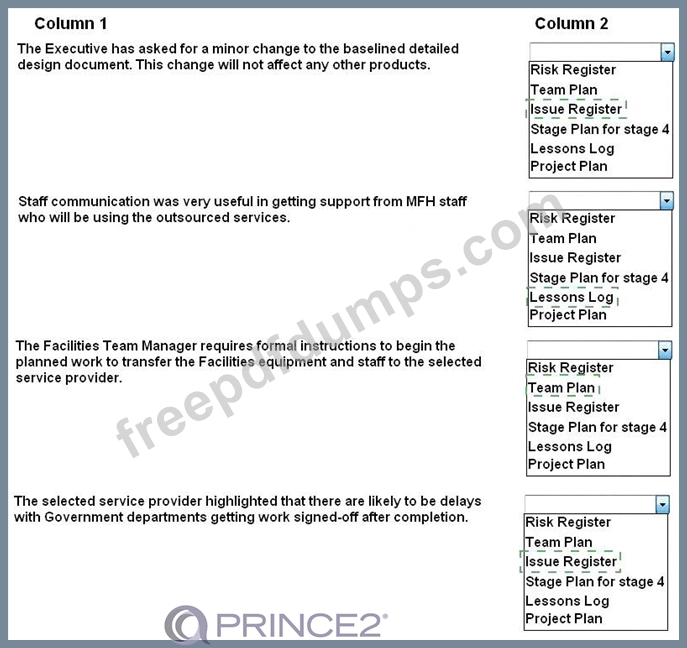
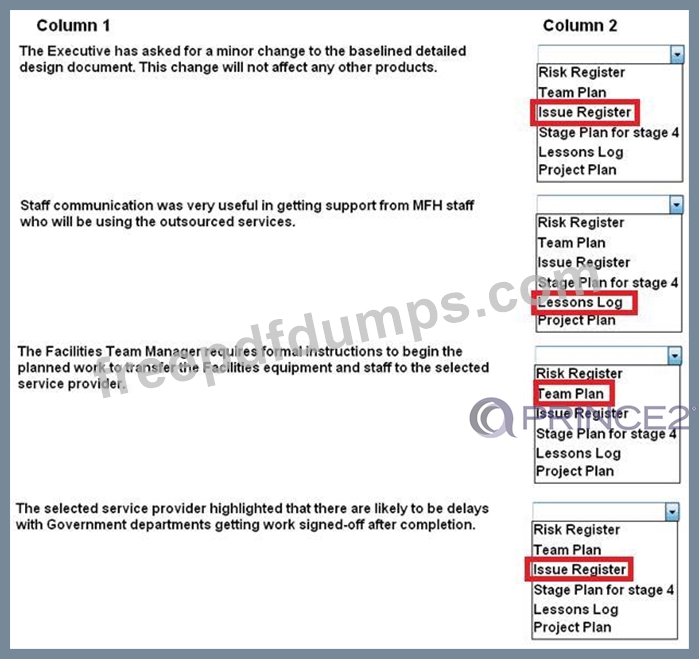
Column 1 is a list of entries from the Daily Log that occurred during stage 4 in the Controlling a Stage process. For each entry in Column 1, select the first management product from Column 2 that should have been updated, or created, as a result of the entry. Each selection from Column 2 can be used once, more than once or not at all.
Drop down the right answer from column 1 to column 2.
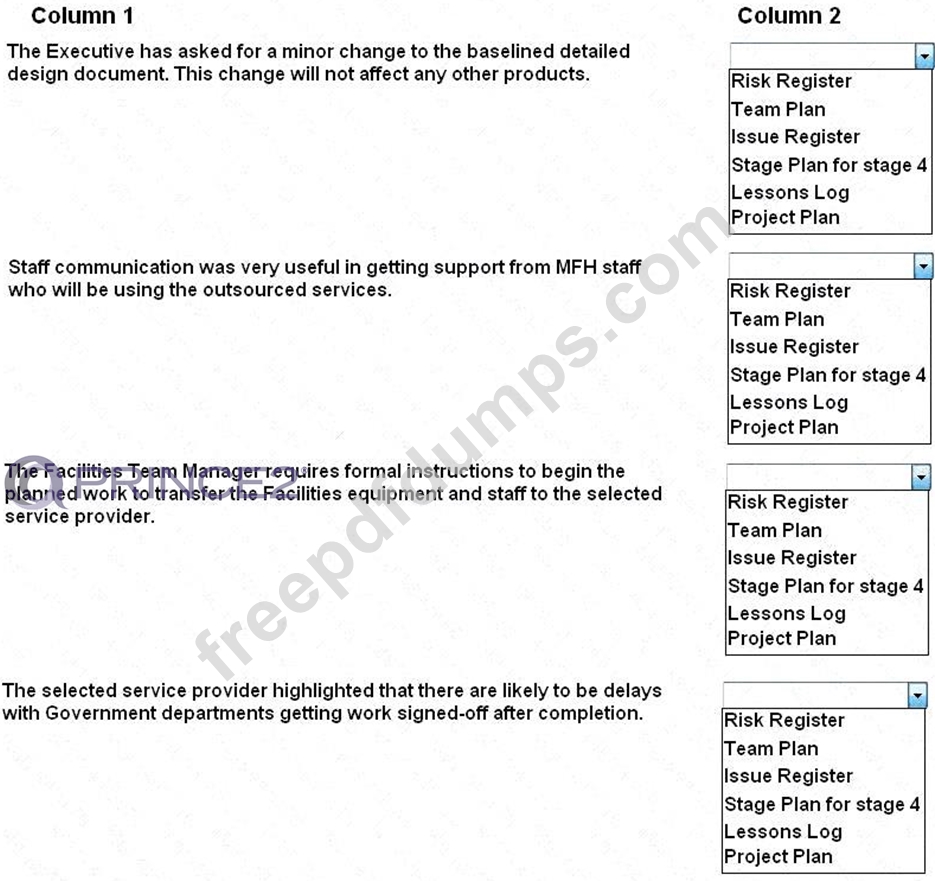
Drop down the right answer from column 1 to column 2.
PRINCE2-Practitioner Exam Question 115
Scenario
A central government department, the Ministry of Food Hygiene (MFH), faces increasing pressure to cut costs, better manage suppliers' performance and reduce the confusion caused by inadequate internal controls, outdated standards and outdated technology. External consultants were employed to conduct a feasibility study to identify options to address the problems, and the likely costs and benefits. The following options were considered:
# Do nothing.
# Re-engineer selected business functions.
# Outsource selected business functions.
The feasibility study concluded that there was a case for outsourcing the MFH Information Technology Division and the Facilities Division (maintenance of buildings and grounds). The recommendations were:
# One service provider should be contracted to provide the services currently provided by the Information Technology Division and the Facilities Division.
# A 10-year service contract should be agreed with the selected service provider.
The feasibility study developed high-level designs of the current organization, processes, systems and operating models, plus an outline Business Case for the required project. The external consultants also made the following recommendations for the management of the project:
# Use PRINCE2.
# Set up the project with 4 management stages:
Stage 1. Standard PRINCE2 initiation activities.
Stage 2. Create detailed designs (future organization, processes, systems and operating models) and the service level agreement between MFH and the future service provider.
Stage 3. Request and evaluate proposals, select service provider and agree contract.
Stage 4. Transfer equipment and staff, transfer responsibility for service provision and run trial period.
Initial estimates indicated that the project would cost £2.5m and take two years to complete.
MFH senior management agreed that there was a case for outsourcing, and accepted the recommendations as a basis for the project. There is an expected saving of £20m over 10 years.
The Outsourcing project has completed the Starting up a Project process and is now in the initiation stage.
Because of the strategic importance of the project, the MFH Chief Executive Officer has taken the role of Executive. A PRINCE2-experienced Project Manager has been appointed from within MFH. Staff within the business functions being outsourced will work with the external consultants who conducted the feasibility study to define the detailed designs.
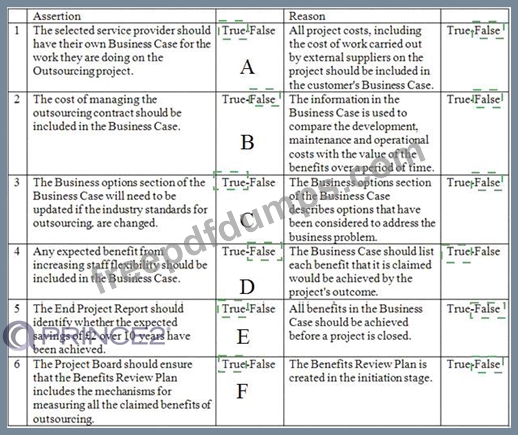
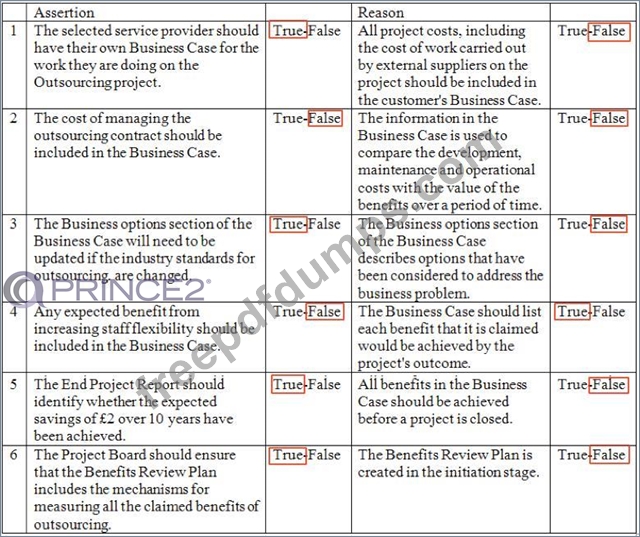
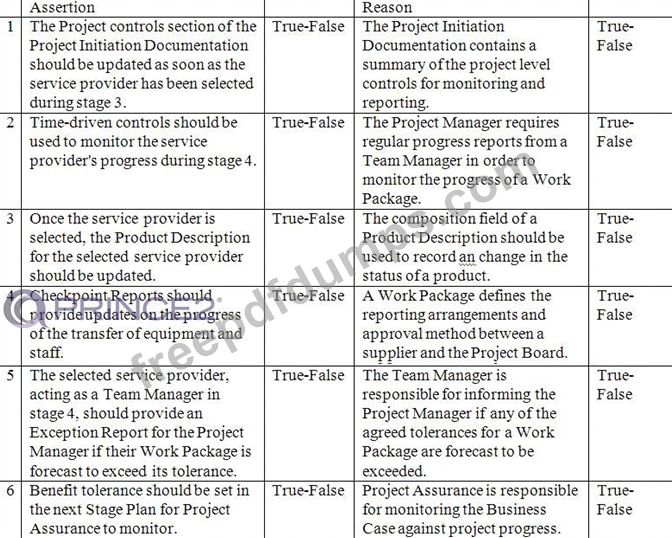
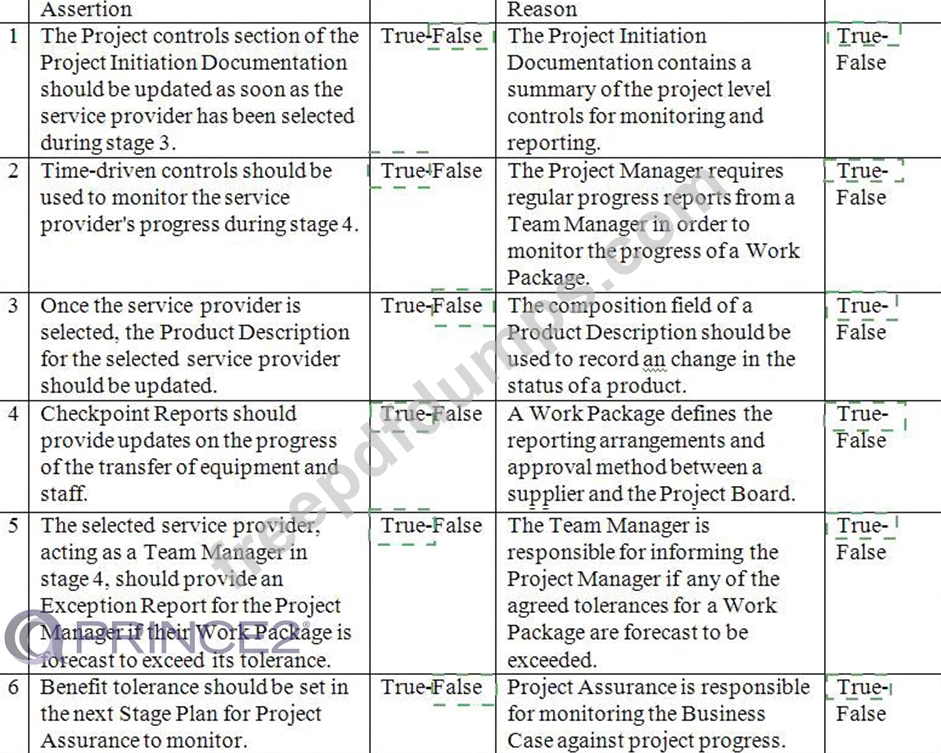
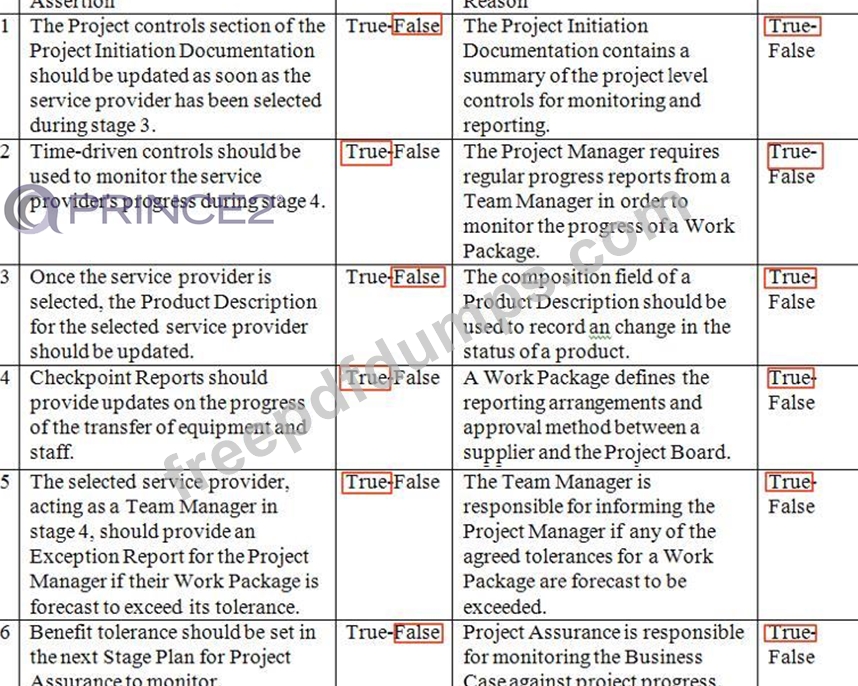
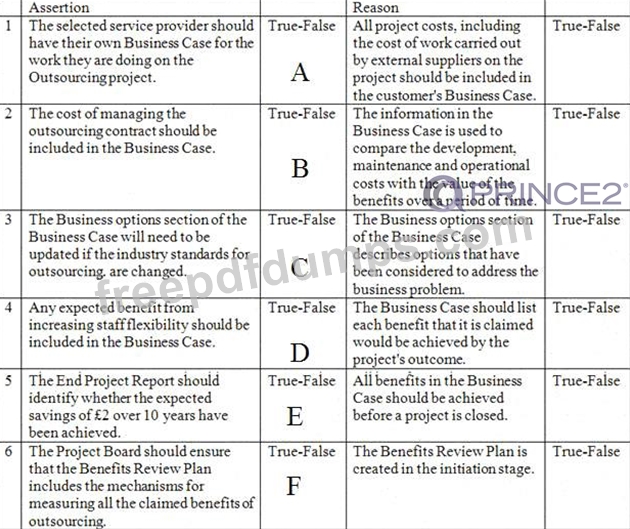
Lines 1 to 6 in the table below consist of an assertion statement and a reason statement. For each line identify the appropriate option, from options A to E, that applies. Each option can be used once, more than once or not at all.
A central government department, the Ministry of Food Hygiene (MFH), faces increasing pressure to cut costs, better manage suppliers' performance and reduce the confusion caused by inadequate internal controls, outdated standards and outdated technology. External consultants were employed to conduct a feasibility study to identify options to address the problems, and the likely costs and benefits. The following options were considered:
# Do nothing.
# Re-engineer selected business functions.
# Outsource selected business functions.
The feasibility study concluded that there was a case for outsourcing the MFH Information Technology Division and the Facilities Division (maintenance of buildings and grounds). The recommendations were:
# One service provider should be contracted to provide the services currently provided by the Information Technology Division and the Facilities Division.
# A 10-year service contract should be agreed with the selected service provider.
The feasibility study developed high-level designs of the current organization, processes, systems and operating models, plus an outline Business Case for the required project. The external consultants also made the following recommendations for the management of the project:
# Use PRINCE2.
# Set up the project with 4 management stages:
Stage 1. Standard PRINCE2 initiation activities.
Stage 2. Create detailed designs (future organization, processes, systems and operating models) and the service level agreement between MFH and the future service provider.
Stage 3. Request and evaluate proposals, select service provider and agree contract.
Stage 4. Transfer equipment and staff, transfer responsibility for service provision and run trial period.
Initial estimates indicated that the project would cost £2.5m and take two years to complete.
MFH senior management agreed that there was a case for outsourcing, and accepted the recommendations as a basis for the project. There is an expected saving of £20m over 10 years.
The Outsourcing project has completed the Starting up a Project process and is now in the initiation stage.
Because of the strategic importance of the project, the MFH Chief Executive Officer has taken the role of Executive. A PRINCE2-experienced Project Manager has been appointed from within MFH. Staff within the business functions being outsourced will work with the external consultants who conducted the feasibility study to define the detailed designs.
Lines 1 to 6 in the table below consist of an assertion statement and a reason statement. For each line identify the appropriate option, from options A to E, that applies. Each option can be used once, more than once or not at all.