

PCNSE Exam Question 16
The following objects and policies are defined in a device group hierarchy


A)
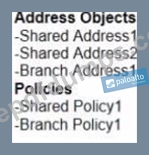
B)

C)
Address Objects
-Shared Address 1
-Branch Address2
Policies -Shared Polic1
l -Branch Policyl
D)
Address Objects -Shared Addressl -Shared Address2 -Branch Addressl Policies -Shared Policyl -Shared Policy2 -Branch Policyl
A)
B)
C)
Address Objects
-Shared Address 1
-Branch Address2
Policies -Shared Polic1
l -Branch Policyl
D)
Address Objects -Shared Addressl -Shared Address2 -Branch Addressl Policies -Shared Policyl -Shared Policy2 -Branch Policyl
PCNSE Exam Question 17
A global corporate office has a large-scale network with only one User-ID agent, which creates a bottleneck near the User-ID agent server. Which solution in PAN-OS software would help in this case?
PCNSE Exam Question 18
The administrator has enabled BGP on a virtual router on the Palo Alto Networks NGFW, but new routes do not seem to be populating the virtual router.
Which two options would help the administrator troubleshoot this issue? (Choose two.)
Which two options would help the administrator troubleshoot this issue? (Choose two.)
PCNSE Exam Question 19
Which User-ID mapping method should be used in a high-security environment where all IP address-to-user mappings should always be explicitly known?
PCNSE Exam Question 20
Refer to Exhibit:


A firewall has three PDF rules and a default route with a next hop of 172.29.19.1 that is configured in the default VR. A user named XX-bes a PC with a 192.168.101.10 IP address.
He makes an HTTPS connection to 172.16.10.29.
What is the next hop IP address for the HTTPS traffic from Wills PC.
A firewall has three PDF rules and a default route with a next hop of 172.29.19.1 that is configured in the default VR. A user named XX-bes a PC with a 192.168.101.10 IP address.
He makes an HTTPS connection to 172.16.10.29.
What is the next hop IP address for the HTTPS traffic from Wills PC.