Green Elk & Company is the world s leading manufacturer of agricultural and forestry machinery. The former company slogan "Elk always runs has recently been changed to Elk feeds the world". One of Green Elk's strategic goals is to increase its revenue in the emerging markets of China, India, and other parts of Asia by 80 % within three years. This requires a new business model that caters to significantly smaller farms with limited budgets. You are the Chief Enterprise Architect and the CIO asks you to assess the new business model for smaller farms with smaller budgets. Given the principle and statement, which of the following combinations of rationale and implication do you consider well-defined?
Correct Answer: D
Explanation The rationale and implication in this combination are well-defined because they both support the principle of using packaged solutions in a standard way. The rationale explains the benefits of using packaged solutions, while the implication outlines the steps that need to be taken to ensure that packaged solutions are used in a standard way. According to the SAP Enterprise Architecture Framework, which is a methodology and toolset by the German multinational software company SAP that helps enterprise architects define and implement an architecture strategy for their organizations, a principle is a general rule or guideline that expresses a fundamental value or belief, and that guides the design and implementation of the architecture. A principle consists of four elements: a name, a statement, a rationale, and an implication. The name is a short and memorable label that summarizes the principle. The statement is a concise and precise description of the principle. The rationale is an explanation of why the principle is important and beneficial for the organization. The implication is a description of the consequences or impacts of applying or not applying the principle. The principle in option D is: Name: Use packaged solutions, in a standard way. Statement: Buy packaged solutions that support our business requirements and use them in a standard way. Rationale: Process and solution will be simplified by using packaged software in a standard way. Adherence to standard will allow better maintenance and lower the total cost of ownership. Increase the capability to adopt technology innovation. Implication: In case custom developments are required, adhere to defined best practices, standards, and guidelines (extensibility concept, side-by-side extensions). Reuse before buy, before build. Enable easier transition to the cloud in the future. This combination of rationale and implication is well-defined because it clearly and logically explains the benefits and consequences of following or not following the principle. The rationale shows how using packaged solutions in a standard way can simplify the process and solution, reduce the cost and effort of maintenance, and increase the ability to adopt new technologies. The implication shows how custom developments should be minimized and standardized, how reuse should be preferred over buying or building new solutions, and how cloud readiness should be considered for future scalability. The other options (A, B, C) are not correct for the combination of rationale and implication that is well-defined because they either mix up or confuse some of the elements of the principle. For example: Option A is not correct because it mixes up the rationale and implication elements. The first sentence of the rationale ("Process and solution will be simplified by using packaged software in a standard way") is actually an implication of following the principle, not a reason for following it. The first sentence of the implication ("Reuse vendor and industry best practices, reference architectures and pre-delivered content") is actually a rationale for following the principle, not a consequence of following it. Option B is not correct because it confuses the rationale and implication elements. The first sentence of the rationale ("In case custom developments are required, adhere to defined best practices, standards, and guidelines (extensibility concept, side-by-side extensions)") is actually an implication of following the principle, not a reason for following it. The first sentence of the implication ("Process and solution will be simplified by using packaged software in a standard way") is actually a rationale for following the principle, not a consequence of following it. Option C is not correct because it confuses the rationale and implication elements. The second sentence of the rationale ("Adherence to standard will allow better maintenance and lower the total cost of ownership") is actually an implication of following the principle, not a reason for following it. The second sentence of the implication ("Reuse before buy, before build") is actually a rationale for following the principle, not a consequence of following it.
P_SAPEA_2023 Exam Question 7
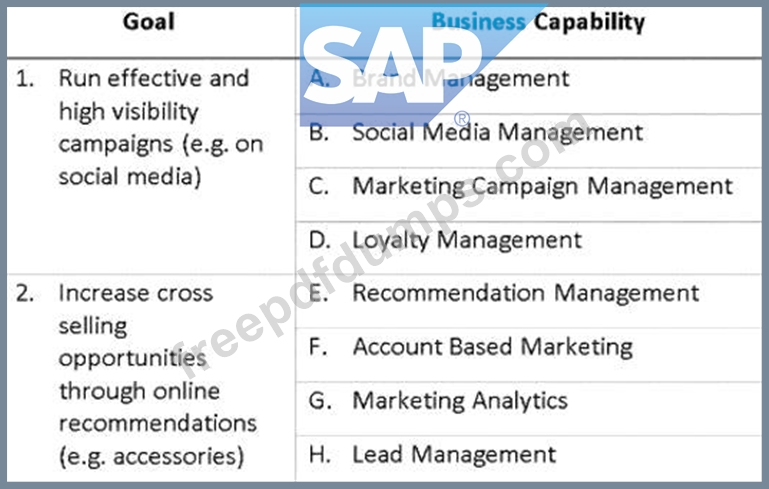
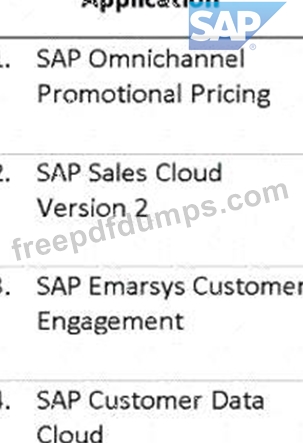
The Wanderlust CIO, along with you, the Chief Enterprise Architect, are in the process of deciding on the application that can potentially replace your existing online marketing application, and you are trying to create the artifact Business Footprint Diagram for decision support ( See table below) Which of the following combinations of goals, business capabilities, and applications would you recommend? Note: There are 2 correct answers to this question,
Correct Answer: B,C
P_SAPEA_2023 Exam Question 8
As part of the mapping of a Business Architecture to the Solution Architecture, an Environment & Location Diagram must be developed in the Technology Architecture phase. In this context, numerous architecture decisions have to be made. Among other things, you must check which SAP BTP services and which SAP SaaS solutions are available as part of the Solution Architecture in which data center of the desired hyperscaler. How do you go about this validation?
Correct Answer: B
Explanation According to the SAP Discovery Center 1 and the SAP Trust Center 2, the steps involved in this validation are: Use the SAP Discovery Center to check which of the selected SAP BTP services are offered by which hyperscaler. The SAP Discovery Center is a platform that provides access to SAP BTP services, events, and related resources, and helps you to implement your use cases on SAP BTP with step-by-step guidance and support from topic experts and SAP Community. In the Service Catalog section of the SAP Discovery Center, you can browse and filter the available SAP BTP services by category, region, or hyperscaler. You can also compare the features and pricing of different services, and learn how to use them in your projects. Use the SAP Trust Center to check in which data center the involved SAP SaaS solutions are available. The SAP Trust Center is a platform that provides information on cloud performance, security, privacy, and compliance. In the Certification and Compliance section of the SAP Trust Center, you can find certificates, reports, and attestations that show how SAP meets various industry standards and regulatory requirements. You can also filter the documents by solution, region, or hyperscaler, and download them for your reference. The other options (A and C) are not correct for how to validate the availability of SAP BTP services and SAP SaaS solutions in the desired hyperscaler's data center, because they either do not exist or do not provide the required information. For example: Option A is not correct because there is no such platform as SAP Business Accelerator Hub (api.sap.com) that provides all the required information regarding SAP BTP service and SAP SaaS solution availability for each hyperscaler. The correct name of the platform is SAP API Business Hub (api.sap.com), which is a platform that provides access to SAP APIs, events, and related resources, but it does not provide any information on the availability of SAP BTP services or SAP SaaS solutions for each hyperscaler or data center. Option C is not correct because the SAP Discovery Center does not provide any information on the availability of SAP SaaS solutions for each hyperscaler or data center. The SAP Discovery Center only provides information on the availability of SAP BTP services for each hyperscaler or region, but not for specific data centers. To check the availability of SAP SaaS solutions for each data center, you need to use the SAP Trust Center instead.
P_SAPEA_2023 Exam Question 9
Why would you recommend building SAP Side-by-Side Extensions to an S/4HANA system based on SAP BTP?
Correct Answer: B
Explanation There are a few reasons why you would recommend building SAP Side-by-Side Extensions to an S/4HANA system based on SAP BTP. SAP BTP is a cloud-based platform, which means that extensions can be developed, deployed, and managed in the cloud. This makes it easy to scale and manage extensions, and it also makes it easier to collaborate with other developers. SAP BTP provides a number of services that can be used to build extensions, such as SAP Cloud Platform Integration and SAP Cloud Platform Event Mesh. These services can help to make extensions more scalable, reliable, and secure. SAP BTP supports a variety of programming languages, which means that developers can use the language they are most comfortable with. This can help to make the development process more efficient and productive. In addition to these reasons, SAP BTP also allows extensions to maintain SAP user and security context and allow the use of S/4HANA eventing. This is important because it ensures that users are only able to access the data and functionality that they are authorized to access, and it also allows extensions to react to events that occur in S/4HANA. Therefore, SAP BTP is a good choice for building SAP Side-by-Side Extensions to an S/4HANA system. Extensions on SAP BTP can maintain SAP user and security context, which means that the extensions can use the same authentication and authorization mechanisms as the S/4HANA system and respect the user roles and permissions defined in the S/4HANA system. Extensions on SAP BTP can use S/4HANA eventing, which means that the extensions can subscribe to business events that are triggered by the S/4HANA system and react to them accordingly. For example, an extension can listen to a sales order creation event and perform some additional logic or integration based on the event data. Extensions on SAP BTP can leverage the SAP Cloud Platform Integration Suite and the SAP HANA Data Management Suite, which provide a comprehensive set of services and tools for different integration scenarios, such as process integration, data integration, analytics integration, user integration, and thing integration. Extensions on SAP BTP can benefit from the cloud-native capabilities of SAP BTP, such as scalability, elasticity, availability, and security. Extensions on SAP BTP can also take advantage of the various programming languages, frameworks, and technologies supported by SAP BTP, such as Java, Node.js, Python, Go, PHP, CAP, or serverless functions. Verified References: 6: https://help.sap.com/viewer/9d1db9835307451daa8c930fbd9ab264/2020.002/en-US/6f7b0c5a5e0d4f8a8b7c0e9c
P_SAPEA_2023 Exam Question 10
Which of the following roles are missing from Wanderlust's current Enterprise Architecture practice structure? Note: There are 2 correct answers to this question.
Correct Answer: A,B
Explanation Wanderlust's current Enterprise Architecture practice structure includes the following roles: Business Architect: This role is responsible for understanding the business requirements and translating them into technical requirements. Application Architect: This role is responsible for designing and implementing applications that meet the business requirements. Technical Architect: This role is responsible for designing and implementing the underlying infrastructure that supports the applications. However, the structure is missing the following roles: Data Architect: This role is responsible for designing and managing the data architecture. This includes defining the data models, data warehouses, and data lakes. Architecture Board: This role is responsible for overseeing the Enterprise Architecture practice and ensuring that it is aligned with the business goals. The Architecture Board is responsible for setting the overall direction of the Enterprise Architecture practice and ensuring that it is aligned with the business goals. The Board also provides oversight and guidance to the other roles in the practice. The Data Architect is responsible for designing and managing the data architecture. This includes defining the data models, data warehouses, and data lakes. The Data Architect also works with the Business Architect to ensure that the data architecture meets the business requirements. The absence of these two roles in Wanderlust's current Enterprise Architecture practice structure suggests that the practice is not fully mature. The addition of these roles would help to ensure that the practice is more effective and aligned with the business goals.