A company that is a leading provider of courses and training delivers courses using third-party trainers. The trainer for the company has to be verified by 10 different training accreditation verification agencies before providing training for the company. Each training accreditation agency has its own response time, which means it could take days to confirm a trainer. The company decided to automate the trainer accreditation verification process by integrating it with the agency's web service1s. What is the recommended approach to automa2te this process?3456
Correct Answer: A
In this scenario, the primary architectural challenge is managing high-latency, multi-step orchestration involving 10 disparate external systems. Each agency has a varying response time that can span several days, making a synchronous "Request-Reply" pattern within Salesforce technically impossible due to transaction timeout limits (maximum 120 seconds). The recommended approach is to leverage Middleware as the orchestration and state-management layer. Middleware (such as an ESB or iPaaS) is specifically designed for Process Choreography. Salesforce initiates a single "Fire and Forget" request to the middleware. The middleware then takes responsibility for: Sequential or Parallel Callouts: Initiating the requests to all 10 verification agencies. Callback Management: Handling the asynchronous responses from each agency as they arrive over a period of days. Aggregation Logic: Consolidating the results and determining when the "Business Process" is complete (e.g., all 10 agencies have approved). Once the consolidation logic is satisfied, the middleware performs a Remote Call-In to the Salesforce REST API to update the trainer's record. This pattern keeps Salesforce "clean" by moving complex, long-running orchestration logic off-platform, preventing the consumption of excessive Apex CPU time and ensuring that Salesforce only receives a single, final status update. Option B (External Services) is unsuitable for a multi-day asynchronous process as it is designed for real-time, synchronous Flow actions. Option C (@future) is restricted by the same 120-second timeout and cannot handle the "waiting" state required for days of verification. Using middleware provides the necessary Quality of Service (QoS), durability, and error handling required for such a critical enterprise compliance process.
Plat-Arch-204 Exam Question 22
Northern Trail Outfitters (NTO) has recently changed its Corporate Security Guidelines requiring all cloud applications to pass through a secure firewall before accessing on-premise resources. NTO is evaluating middleware solutions. Which consideration should an integration architect evaluate before choosing a middleware solution?
Correct Answer: C
When corporate guidelines mandate a firewall-protected entry point for cloud traffic, the middleware architecture must include a component capable of residing in a Demilitarized Zone (DMZ) or perimeter network. The architect must evaluate the solution's API Gateway capabilities. A secure API Gateway acts as the intermediary that terminates external (cloud) TLS connections and inspects incoming traffic before proxying it to internal systems. It allows the security team to implement: IP Whitelisting: Ensuring only Salesforce's IP ranges can access the gateway. Mutual Authentication: Using certificates to verify that the request is genuinely coming from the Salesforce org. Rate Limiting: Protecting on-premise resources from being overwhelmed by cloud requests. Option A (OAuth) is an authorization framework and does not satisfy the network-level firewall requirement on its own. Option B (ODBC) is an internal database protocol that should generally never be exposed to a cloud-facing firewall due to security risks. By prioritizing a solution with a hardened API Gateway, the architect ensures that NTO meets its new security mandates while providing a scalable and secure bridge for Salesforce to access back-office services.
Plat-Arch-204 Exam Question 23
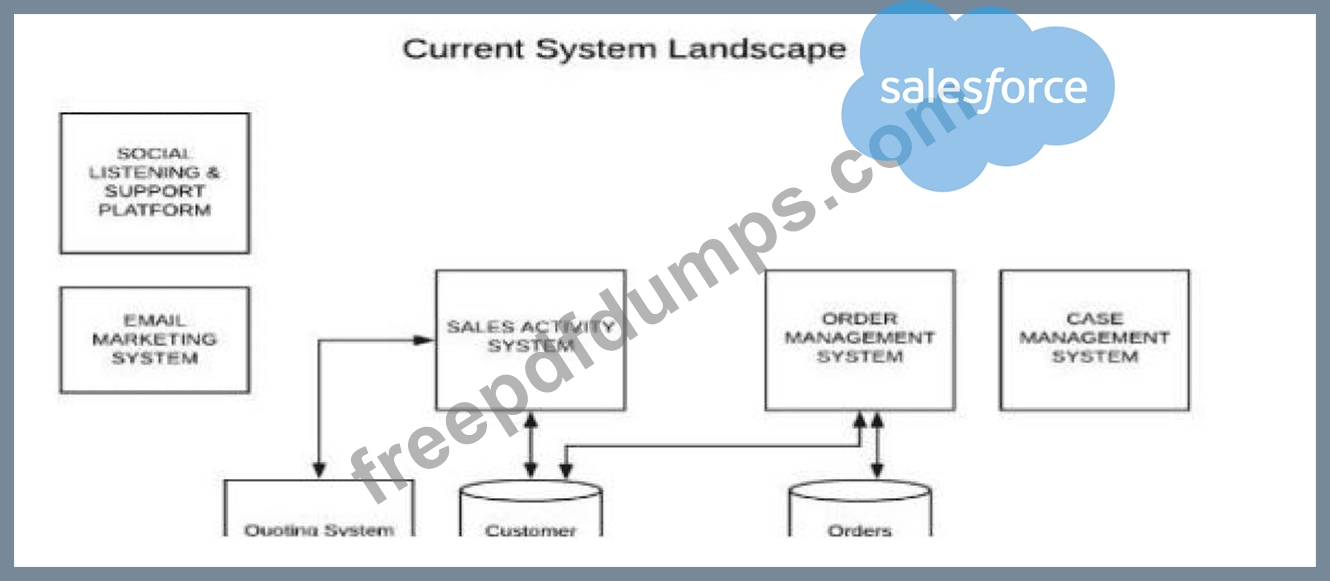
A large business-to-consumer (B2C) customer is planning to implement Salesforce CRM to become a customer-centric enterprise. Below is the B2C customer's current system landscape diagram. The goals for implementing Salesforce include: Develop a 360-degree view of the customer. Leverage Salesforce capabilities for marketing, sales, and service processes. Reuse Enterprise capabilities built for quoting and order management processes. Which three systems from the current system landscape can be retired with the implementation of Salesforce?
Correct Answer: C
Comprehensive and Detailed 250 to 350 words of Explanation From Salesforce Pl14atform Integration Architect documents: In the rol15e of a Salesforce Platform Integration Architect, evaluating a legacy landscape requires a clinical mapping of current system functions against Salesforce's native capabilities, while strictly adhering to the "Constraints and Goals" provided by the business. The objective here is to maximize the ROI of the Salesforce implementation by consolidating redundant systems into the core platform. According to Goal 2, the business intends to utilize Salesforce for Marketing, Sales, and Service processes. Salesforce is architected to handle these three domains through its core clouds: Marketing Cloud (replacing the legacy Email Marketing System), Sales Cloud (replacing the Sales Activity System), and Service Cloud (replacing the Case Management System). By consolidating these three specific functions into Salesforce, the organization achieves Goal 1, which is the creation of a 360-degree view of the customer. When these activities occur on a single platform, the data is unified, eliminating the silos that existed in the previous landscape. However, the architect must also respect the technical constraints defined in Goal 3, which explicitly states the need to reuse enterprise capabilities built for quoting and order management. In architectural design, this designates the "Quoting System" and the "Order Management System" as systems of record that must remain in the future-state landscape. These systems likely contain complex, proprietary logic or are tightly coupled with back-end ERP systems like SAP Business Suite, making them "non-negotiable" for retirement at this stage. Therefore, because Email Marketing, Sales Activity, and Case Management map directly to Salesforce's primary strengths and are not excluded by the "reuse" requirement, they are the three systems that should be retired. This strategic retirement simplifies the integration architecture, allowing the architect to focus on building robust integration patterns (such as Request-Reply or Fire-and-Forget) between Salesforce and the remaining Quoting and Order Management systems.
Plat-Arch-204 Exam Question 24
Northern Trail Outfitters (NTO) is planning to create a native employee-facing mobile app with the look and feel of Salesforce Lighting Experience. The mobile app needs to integrate with NTO's Salesforce org. Which Salesforce API should be used to implement this integration?
Correct Answer: B
When building custom mobile or web applications that aim to replicate the look and feel of Salesforce Lightning Experience, the User Interface (UI) API is the architecturally recommended choice. The UI API is specifically designed to provide the metadata and data needed to build high-fidelity user interfaces. Unlike the standard REST API (Option B), which returns raw record data, the UI API returns both data and metadata in a single response. This includes information about page layouts, field-level security, picklist values, and localized labels. By using the UI API, the mobile app can dynamically render fields according to the user's permissions and the organization's layout configurations, ensuring that the custom app stays in sync with changes made in Salesforce Setup without requiring code updates in the mobile app. Connect REST API (Option A) is primarily used for Chatter, Communities (Experience Cloud), and CMS content, and while it is useful for those specific social features, it does not provide the layout and record-level metadata required for a full CRM interface. The UI API is the same underlying technology that powers the Salesforce mobile app and Lightning Experience itself. Therefore, utilizing this API allows NTO's developers to build a native app that perfectly mimics the Lightning Experience while reducing the amount of custom logic needed to handle complex Salesforce UI requirements.
Plat-Arch-204 Exam Question 25
Northern Trail Outfitters needs a synchronous callout from Salesforce to an Order Management System (OMS) when an opportunity is "Closed/Won" with products attached. What should an integration architect do to satisfy these requirements?
Correct Answer: A
To satisfy a requirement for a synchronous callout triggered by a user action, the architect should use a UI-driven approach, such as a Lightning component and a button. In Salesforce, triggers (Option B) are primarily used for asynchronous logic in integration contexts. Because a trigger executes as part of the database save operation, making a synchronous callout directly from a trigger is prohibited as it would block the database transaction until the external system responds, leading to performance degradation and "uncommitted work pending" errors. If a trigger must initiate an integration, it must do so asynchronously (using @future or Queueable Apex), which violates the requirement for a synchronous call. By using a Lightning component, the architect can initiate a synchronous Request-and-Reply pattern. When the sales rep clicks the "7Submit to OMS" button, the componen8t invokes an Apex method that makes the REST callout to the OMS in real-time. The user remains on the page while the system waits for the OMS to respond, allowing for immediate feedback-such as an order confirmation number or an error message-to be displayed in the UI. A Batch Apex job (Option C) is inherently asynchronous and delayed, making it unsuitable for a synchronous, real-time fulfillment requirement.