Which of the following eval commands will provide a new value for host from src if it exists?
Correct Answer: D
The eval command is a Splunk command that allows you to create or modify fields using expressions . The if function is an expression that evaluates a condition and returns a value based on whether the condition is true or false. The syntax of the if function is if(X,Y,Z), where X is the condition, Y is the value to return if X is true, and Z is the value to return if X is false. The isnotnull function is an expression that returns true if the argument is not null, and false otherwise. The syntax of the isnotnull function is isnotnull(X), where X is the argument to check. Therefore, the expression if (isnotnull (src), src, host) returns the value of src if it is not null, and the value of host otherwise. This means that it will provide a new value for host from src if it exists, and keep the original value of host otherwise.
SPLK-1002 Exam Question 2
A data model consists of which three types of datasets?
Correct Answer: B
The building block of a data model. Each data model is composed of one or more data model datasets. Each dataset within a data model defines a subset of the dataset represented by the data model as a whole. Data model datasets have a hierarchical relationship with each other, meaning they have parent-child relationships. Data models can contain multiple dataset hierarchies. There are three types of dataset hierarchies: event, search, and transaction. https://docs.splunk.com/Splexicon:Datamodeldataset
SPLK-1002 Exam Question 3
A user runs the following search: index-X sourcetype=Y I chart count (domain) as count, sum (price) as sum by product, action usenull=f useother-f Which of the following table headers match the order this command creates?
Correct Answer: C
The correct answer is C. Product, count: addtocart, count: remove, count: purchase, sum: addtocart, sum: remove, sum: purchase1. In Splunk, the chart command is used to create a table or a chart visualization from your data2. The chart command takes at least one function and one field, and optionally another field to group by2. In the given search, the chart command is used with two functions (count and sum), two fields (domain and price), and two fields to group by (product and action). The usenull=f and useother=f options are used to exclude null values and other values from the chart2. The chart command creates a table with headers that match the order of the fields and functions in the command1. The headers for the count function are prefixed with count:, and the headers for the sum function are prefixed with sum:1. The values of the product and action fields are used as the suffixes for the headers1. Therefore, the table headers created by this command are Product, count: addtocart, count: remove, count: purchase, sum: addtocart, sum: remove, and sum: purchase1.
SPLK-1002 Exam Question 4
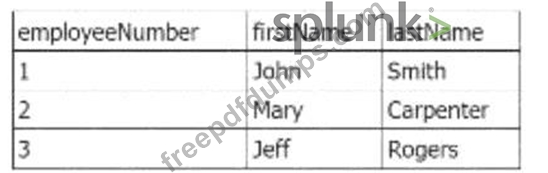
Two separate results tables are being combined using the join command. The outer table has the following values: The inner table has the following values: The line of SPL used to join the tables is: join employeeNumber type=outer How many rows are returned in the new table?
Correct Answer: C
In this case, the outer join is applied, which means that all rows from the outer (left) table will be included, even if there are no matching rows in the inner (right) table. The result will include all five rows from the outer table, with the matched data from the inner table where employeeNumber matches. Rows without matching employeeNumber values will have null values for the fields from the inner table. References: Splunk Documentation - Join Command
SPLK-1002 Exam Question 5
Which of the following searches show a valid use of a macro? (Choose all that apply.)
Correct Answer: A,C
The searches A and C show a valid use of a macro. A macro is a reusable piece of SPL code that can be called by using single quotes (''). A macro can take arguments, which are passed inside parentheses after the macro name. For example, 'makeMyField(oldField)' calls a macro named makeMyField with an argument oldField. The searches B and D are not valid because they use double quotes ("") instead of single quotes ('').