Which of the following is one of the pre-configured data models included in the Splunk Common Information Model (CIM) add-on?
Correct Answer: B
SPLK-1002 Exam Question 107
The gauge command:
Correct Answer: A
SPLK-1002 Exam Question 108
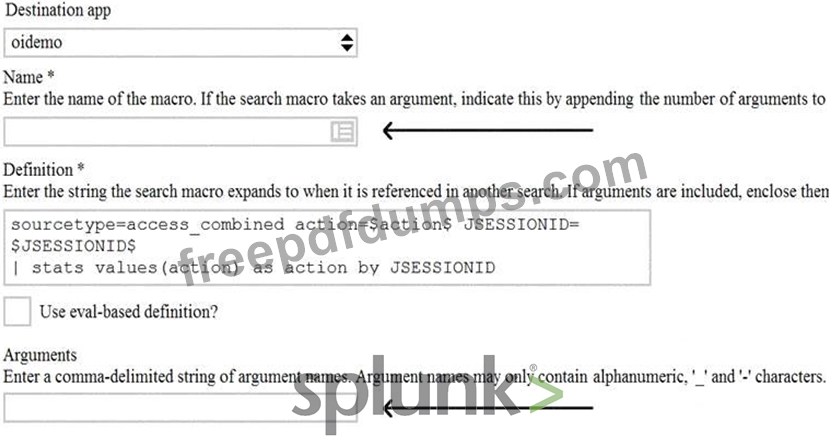
Given the macro definition below, what should be entered into the Name and Arguments fileds to correctly configured the macro?
Correct Answer: B
Reference: https://docs.splunk.com/Documentation/Splunk/8.0.3/Knowledge/Definesearchmacros The macro definition below shows a macro that tracks user sessions based on two arguments: action and JSESSIONID. sessiontracker(2) The macro definition does the following: It specifies the name of the macro as sessiontracker. This is the name that will be used to execute the macro in a search string. It specifies the number of arguments for the macro as 2. This indicates that the macro takes two arguments when it is executed. It specifies the code for the macro as index=main sourcetype=access_combined_wcookie action=$action$ JSESSIONID=$JSESSIONID$ | stats count by JSESSIONID. This is the search string that will be run when the macro is executed. The search string can contain any part of a search, such as search terms, commands, arguments, etc. The search string can also include variables for the arguments using dollar signs around them. In this case, action and JSESSIONID are variables for the arguments that will be replaced by their values when the macro is executed. Therefore, to correctly configure the macro, you should enter sessiontracker as the name and action, JSESSIONID as the arguments. Alternatively, you can use sessiontracker(2) as the name and leave the arguments blank.
SPLK-1002 Exam Question 109
Which of the following describes the I transaction command?
Correct Answer: C
The transaction command is a Splunk command that finds transactions based on events that meet various constraints . Transactions are made up of the raw text (the _raw field) of each member, the time and date fields of the earliest member, as well as the union of all other fields of each member . The transaction command groups events together by matching one or more fields that have the same value across the events . For example, | transaction clientip will group events that have the same value in the clientip field.
SPLK-1002 Exam Question 110
Select this in the fields sidebar to automatically pipe you search results to the rare command
Correct Answer: B
The fields sidebar is a panel that shows the fields that are present in your search results2. The fields sidebar has two sections: selected fields and interesting fields2. Selected fields are fields that you choose to display in your search results by clicking on them in the fields sidebar or by using the fields command2. Interesting fields are fields that appear in at least 20 percent of events or have high variability among values2. For each field in the fields sidebar, you can select one of the following options: events with this field, rare values, top values by time or top values2. If you select rare values, Splunk will automatically pipe your search results to the rare command, which shows the least common values of a field2. Therefore, option B is correct, while options A, C and D are incorrect because they do not pipe your search results to the rare command.