What process turns a set of business capabilities into a structure that communicates the right amount of detail to different stakeholder groups?
Correct Answer: D
Mapping is the process that turns a set of business capabilities into a structure that communicates the right amount of detail to different stakeholder groups. Here's a detailed explanation: * Definition of Mapping: * Mapping: In the context of business architecture, mapping refers to the process of visually representing the relationships between business capabilities and other elements such as processes, value streams, and organizational units. This helps in communicating the structure and interactions within the business. * Purpose: * Communication: Mapping provides a clear and structured way to communicate the details of business capabilities to different stakeholder groups. It ensures that each group receives the appropriate level of detail needed for their role and decision-making. * Alignment: Helps in aligning business capabilities with strategic goals, processes, and * organizational structure, ensuring that the architecture supports the overall business strategy. * TOGAF References: * Phase B: Business Architecture: During this phase, mapping is used to represent business capabilities and their relationships with other business elements. This helps in creating a coherent and comprehensive business architecture. * Capability Mapping: TOGAF emphasizes the use of capability mapping to understand and analyze how different capabilities support business processes and value streams. * Benefits: * Clarity and Understanding: Mapping provides a visual representation that enhances clarity and understanding of the business architecture. It helps stakeholders see the big picture and understand how different parts of the business fit together. * Stakeholder Engagement: By providing the right amount of detail to different stakeholders, mapping ensures effective engagement and collaboration across the organization. In summary, mapping is the process that turns a set of business capabilities into a structure that communicates the right amount of detail to different stakeholder groups, facilitating clarity, understanding, and alignment.
OGBA-101 Exam Question 32
Consider the following representation of a business model: Which of the following business models is this an example of?
Correct Answer: B
The provided representation of a business model appears to be a variant of the Business Model Canvas, which is a strategic management template for developing new or documenting existing business models. It is a visual chart with elements describing a firm's value proposition, infrastructure, customers, and finances. The model assists firms in aligning their activities by illustrating potential trade-offs. Since none of the options precisely match the Business Model Canvas and the Four Box Framework is conceptually closest to the Business Model Canvas, option B is the best available answer, albeit not a perfect match.
OGBA-101 Exam Question 33
Which of the following is a benefit of Value Stream Mapping?
Correct Answer: B
Value Stream Mapping (VSM) is a powerful tool used to assess an organization's effectiveness at creating, capturing, and delivering value for different stakeholders. It involves mapping out the entire process of value creation from end to end, identifying each step involved, and analyzing how value is added at each stage. VSM helps in identifying bottlenecks, inefficiencies, and opportunities for improvement, ultimately aiming to optimize the value delivery process to better meet stakeholder needs.
OGBA-101 Exam Question 34
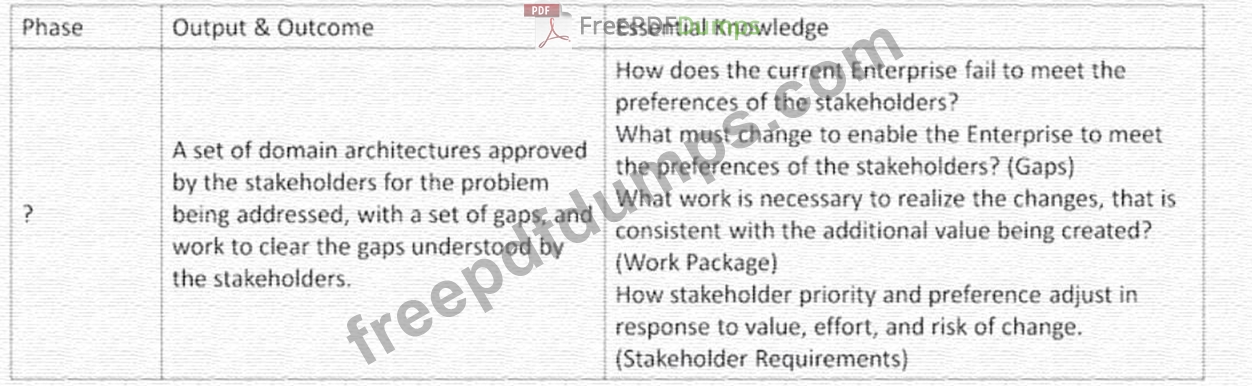
Refer to the table below: Which ADM Phase(s) does this describe?
Correct Answer: C
The table describes the steps involved in Phase B (Business Architecture), Phase C (Information Systems Architectures), and Phase D (Technology Architecture) of the TOGAF ADM5. These phases are responsible for developing the target architectures for each domain and identifying the gaps between the baseline and target architectures. The table shows the outputs and outcomes of each phase, as well as the essential knowledge required for each phase.
OGBA-101 Exam Question 35
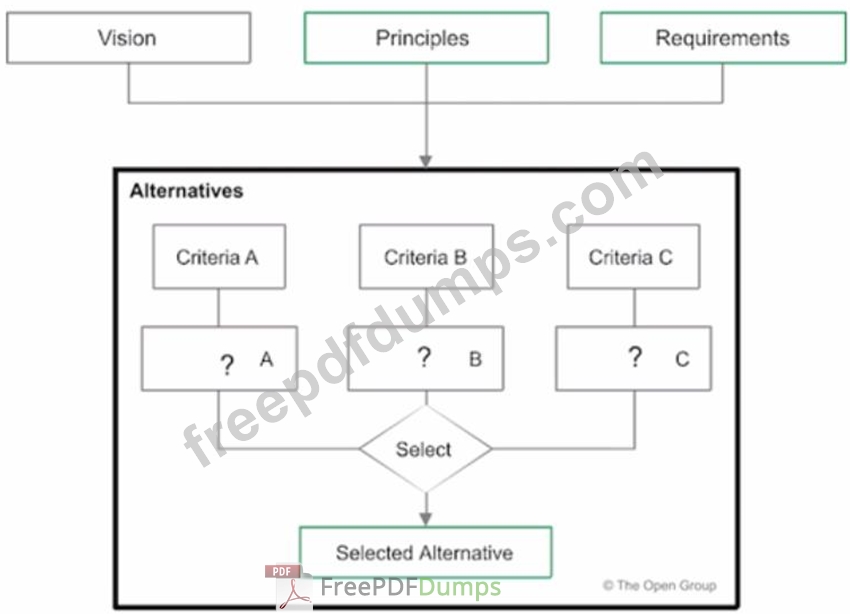
Consider the following graphic illustrating a method supporting the TOGAF ADM. What does the method help identify?
Correct Answer: C
The graphic illustrates a method for developing alternative target architectures in Phase E of the TOGAF ADM1. The method involves identifying and evaluating candidate architectures based on criteria such as business value, cost, risk, and feasibility1. The method helps to identify the most suitable architecture solution for the enterprise. The graphic illustrates a method that supports the TOGAF ADM by identifying and evaluating alternative target architectures. The process begins with a vision, influenced by principles and requirements, leading to the consideration of alternatives. Each alternative is assessed based on different criteria, leading to the selection of the most suitable target architecture. This is consistent with the TOGAF approach of developing a set of potential architectures and then selecting the one that best meets the enterprise's needs.