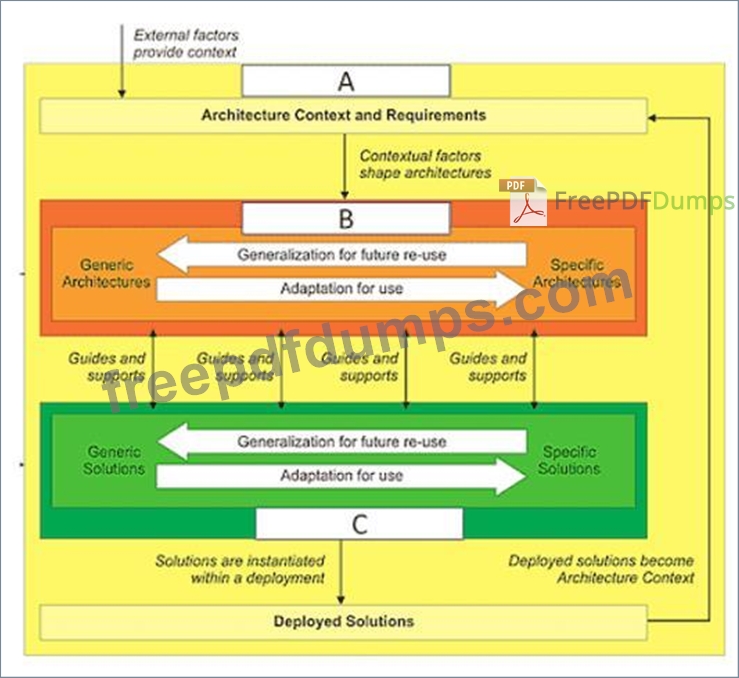
Consider the illustration. What are the items labelled A, B and C?
Correct Answer: A
The illustration shows the relationship between the Enterprise Continuum, the Architecture Continuum, and the Solutions Continuum, which are key concepts in the TOGAF framework. The Enterprise Continuum is a view of the Architecture Repository that shows how generic foundation architectures can be leveraged and specialized to support the requirements of an individual organization. The Architecture Continuum specifies a structured classification for architectural artifacts, such as models, patterns, and descriptions, that can be reused and adapted across different domains and levels of abstraction. The Solutions Continuum identifies implemented solutions that support various stages of business and IT capability evolution, such as common systems, industry solutions, and organization-specific solutions. The illustration also shows how the architecture context and requirements are influenced by external factors, such as business drivers, stakeholders, and standards, and how they shape the generic and specific architectures and solutions. The illustration also shows how the deployed solutions become part of the architecture context for future iterations of the architecture development cycle. References: *TOGAF Standard, 10th Edition, Part II: Architecture Development Method, Chapter 6: Architecture Repository, Section 6.2 Enterprise Continuum. *TOGAF Standard, 10th Edition, Part IV: Architecture Content Framework, Chapter 35: Enterprise Continuum and Tools, Section 35.1 Introduction.
OGEA-101 Exam Question 2
Consider the following statement: According to the TOGAF Standard a governed approach of a particular deliverable will ensure a system of continuous monitoring to check integrity changes decision-making and audit of all architecture-related activities Which deliverable is being referred to?
Correct Answer: A
An Architecture Contract is a deliverable that specifies the responsibilities and obligations of the parties involved in the implementation and governance of an architecture. It ensures a system of continuous monitoring to check integrity changes decision-making and audit of all architecture-related activities. Reference: The TOGAF Standard | The Open Group Website, Section 3.3.4 Architecture Contracts.
OGEA-101 Exam Question 3
What component of the Architecture Repository represents architecture requirements agreed with the Architecture Board?
Correct Answer: C
The Architecture Requirements Repository stores all the requirements that are output of the architecture development cycle, as well as the requirements that are input to the architecture development cycle1. The Architecture Requirements Repository includes the following types of requirements1: *Stakeholder Requirements: These are the high-level requirements and expectations of the stakeholders, derived from the business drivers, goals, and objectives. They are captured and refined in the Architecture Vision phase and the Requirements Management phase. *Architecture Requirements: These are the detailed requirements that specify what the architecture must do or deliver to meet the stakeholder requirements. They are derived and refined in the Business, Information Systems, and Technology Architecture phases. *Implementation and Migration Requirements: These are the detailed requirements that specify what the implementation and migration projects must do or deliver to realize the architecture. They are derived and refined in the Opportunities and Solutions and Migration Planning phases. The Architecture Requirements Repository is used to manage the architecture requirements throughout the architecture lifecycle, ensuring their traceability, consistency, and compliance1. The Architecture Board is the authority that reviews and approves the architecture requirements, as well as the architecture deliverables and artifacts, as part of the architecture governance process2. References: 1: Architecture Requirements Repository 2: Architecture Board
OGEA-101 Exam Question 4
Which of the following is the ability to develop use and sustain the architecture of a particular enterprise using architecture to govern change?
Correct Answer: A
The ability to develop, use, and sustain the architecture of a particular enterprise using architecture to govern change is an EA Capability. An EA Capability is a set of skills, processes, roles, responsibilities, tools, and techniques that enable an enterprise to successfully develop and maintain its Enterprise Architecture and achieve its desired outcomes. An EA Capability is part of an enterprise's overall capability portfolio and should be aligned with its strategy and objectives. Reference: The TOGAF Standard | The Open Group Website, Section 3.2 Preliminary Phase.
OGEA-101 Exam Question 5
Which ADM phase focuses on defining the problem to be solved, identifying the stakeholders, their concerns, and requirements?
Correct Answer: D
Phase A: Architecture Vision is the first phase of the Architecture Development Method (ADM) cycle, which is the core of the TOGAF standard. The main purpose of this phase is to define the scope and approach of the architecture development, and to create the Architecture Vision, which is a high-level description of the desired outcomes and benefits of the proposed architecture. To achieve this purpose, this phase focuses on defining the problem to be solved, identifying the stakeholders, their concerns, and requirements, and establishing the business goals and drivers that motivate the architecture work. This phase also involves obtaining the approval and commitment of the sponsors and other key stakeholders, and initiating the Architecture Governance process. The TOGAF Standard, Version 9.2, Part II: Architecture Development Method (ADM), Chapter 5: Introduction to the ADM : The TOGAF Standard, Version 9.2, Part II: Architecture Development Method (ADM), Chapter 18: Phase A: Architecture Vision : The TOGAF Standard, Version 9.2, Part II: Architecture Development Method (ADM), Chapter 18.3: Inputs : The TOGAF Standard, Version 9.2, Part II: Architecture Development Method (ADM), Chapter 18.4: Steps