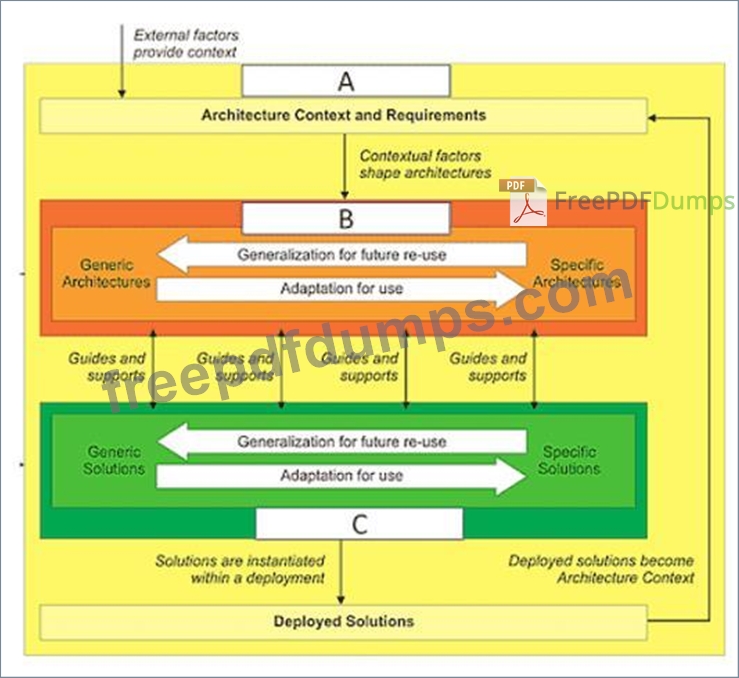
Consider the illustration. What are the items labelled A, B and C?
Correct Answer: A
The illustration shows the relationship between the Enterprise Continuum, the Architecture Continuum, and the Solutions Continuum, which are key concepts in the TOGAF framework. The Enterprise Continuum is a view of the Architecture Repository that shows how generic foundation architectures can be leveraged and specialized to support the requirements of an individual organization. The Architecture Continuum specifies a structured classification for architectural artifacts, such as models, patterns, and descriptions, that can be reused and adapted across different domains and levels of abstraction. The Solutions Continuum identifies implemented solutions that support various stages of business and IT capability evolution, such as common systems, industry solutions, and organization-specific solutions. The illustration also shows how the architecture context and requirements are influenced by external factors, such as business drivers, stakeholders, and standards, and how they shape the generic and specific architectures and solutions. The illustration also shows how the deployed solutions become part of the architecture context for future iterations of the architecture development cycle. References: *TOGAF Standard, 10th Edition, Part II: Architecture Development Method, Chapter 6: Architecture Repository, Section 6.2 Enterprise Continuum. *TOGAF Standard, 10th Edition, Part IV: Architecture Content Framework, Chapter 35: Enterprise Continuum and Tools, Section 35.1 Introduction.
OGEA-101 Exam Question 32
Complete the following sentence. In the ADM, documents which are under development and have not undergone any formal review and approval process are called______ Documents which have been reviewed and approved are called ______
Correct Answer: B
According to the TOGAF Standard, 10th Edition, documents which are under development and have not undergone any formal review and approval process are called draft documents, while documents which have been reviewed and approved are called approved documents 1. Draft documents are typically marked with a version number of 0.x, indicating that they are incomplete or provisional. Approved documents are typically marked with a version number of 1.0 or higher, indicating that they have been finalized and authorized. The other options are not correct, as they are not the terms used by the TOGAF Standard to distinguish between documents under development and documents that have been reviewed and approved. The terms "finalized", "concept", "deliverable", and "Version 0.1" and "Version 1.0" are not specific to the TOGAF Standard, and they may have different meanings or interpretations in different contexts. References: 1: TOGAF Standard, 10th Edition, Part II: Architecture Development Method, Chapter 7: Applying Iteration to the ADM, Section 7.2.3 Document Categorization.
OGEA-101 Exam Question 33
Complete the sentence. A business scenario describes
Correct Answer: B
OGEA-101 Exam Question 34
Complete the sentence. The purpose of the Gap Analysis technique is to _____.
Correct Answer: D
Comprehensive and Detailed Explanation Gap Analysis is an ADM technique used in Phases B, C, and D of the TOGAF ADM (Business, Information Systems, and Technology Architectures). Its main purpose is to validate the target architecture by comparing the Baseline Architecture with the Target Architecture and identifying: * Gaps (building blocks or capabilities present in the target but missing in the baseline). * Overlaps (building blocks duplicated across architectures). * Conflicts (inconsistencies between baseline and target). The output of Gap Analysis provides: * A validated Target Architecture. * A set of identified gaps that must be addressed by future work packages in Phase E: Opportunities and Solutions. Therefore, the purpose of Gap Analysis is best expressed as to validate the architecture (Answer D). Why the other options are incorrect * A. Establish quality metrics for the architecture: This is part of performance management and governance, not Gap Analysis. * B. Identify non-functional requirements: Non-functional requirements are captured through requirements management and stakeholder analysis, not Gap Analysis. * C. Determine service levels: Service levels are typically defined in SLAs and operational models, not through Gap Analysis. References * The Open Group, TOGAF Standard, Version 9.2, Part III: ADM Guidelines & Techniques - Gap Analysis. * The Open Group, TOGAF 9 Certified Study Guide - explains the role of Gap Analysis in validating architectures and identifying work package inputs.
OGEA-101 Exam Question 35
Which of the following best describes a purpose of the Gap Analysis technique?
Correct Answer: D
Gap analysis is a technique that is used to validate an architecture by highlighting the shortfall between the Baseline Architecture and the Target Architecture. One of the purposes of gap analysis is to identify missing functions that are either deliberately omitted, accidentally left out, or not yet defined in the Target Architecture. Missing functions are marked as gaps that need to be filled by developing or procuring the building blocks.