Complete the sentence. The " Rationale " part of the recommended TOGAF template for Architecture Principles should:
Correct Answer: C
In TOGAF, an Architecture Principle is defined using a structured template that includes several key elements such as Name, Statement, Rationale, and Implications. Each element serves a distinct purpose to ensure clarity, usability, and governance effectiveness. The Rationale specifically explains why the principle exists and why it is important to the organization. It provides the business justification for the principle and describes the benefits of applying it. This includes outlining how adopting the principle supports business objectives, improves operations, reduces risk, or enables strategic outcomes. Therefore, the Rationale is closely tied to business impact and value , making option C the correct answer. Option B is incorrect because communicating the fundamental rule is the role of the Statement , not the Rationale. Option A refers more to implementation guidance, which belongs to the Implications section, where the consequences and actions required to follow the principle are described. Option D is not part of the standard TOGAF template for principles. By clearly stating the business impact, the Rationale helps stakeholders understand the importance of adhering to the principle and ensures alignment between architecture governance and business strategy. Therefore, the correct answer is C .
OGEA-101 Exam Question 42
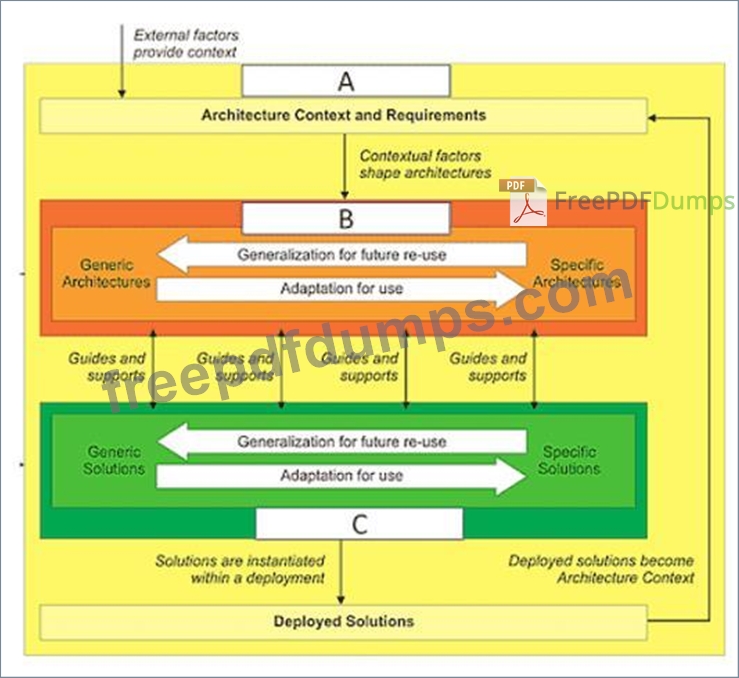
Consider the illustration. What are the items labelled A, B and C?
Correct Answer: A
The illustration shows the relationship between the Enterprise Continuum, the Architecture Continuum, and the Solutions Continuum, which are key concepts in the TOGAF framework. The Enterprise Continuum is a view of the Architecture Repository that shows how generic foundation architectures can be leveraged and specialized to support the requirements of an individual organization. The Architecture Continuum specifies a structured classification for architectural artifacts, such as models, patterns, and descriptions, that can be reused and adapted across different domains and levels of abstraction. The Solutions Continuum identifies implemented solutions that support various stages of business and IT capability evolution, such as common systems, industry solutions, and organization-specific solutions. The illustration also shows how the architecture context and requirements are influenced by external factors, such as business drivers, stakeholders, and standards, and how they shape the generic and specific architectures and solutions. The illustration also shows how the deployed solutions become part of the architecture context for future iterations of the architecture development cycle. References: *TOGAF Standard, 10th Edition, Part II: Architecture Development Method, Chapter 6: Architecture Repository, Section 6.2 Enterprise Continuum. *TOGAF Standard, 10th Edition, Part IV: Architecture Content Framework, Chapter 35: Enterprise Continuum and Tools, Section 35.1 Introduction.
OGEA-101 Exam Question 43
Complete the sentence. Architecture effort at the Logical abstraction level is about:
Correct Answer: C
(Authoritative Open Group guidance distinguishes conceptual, logical, and physical concerns; at the logical level, component types are identified independently of implementation.) For example, the Open Group's metamodel guidance emphasizes technology-agnostic structure to ensure consistency within an architecture description, which is precisely what the logical level captures before physical realization. "The Content Metamodel defines a formal structure... to ensure consistency within the architecture description and also to provide guidance for organizations that wish to implement their architecture within an architecture tool." Open Group Publications Reference: The Open Group, TOGAF 9 Conformance Requirements (Content Framework overview); Open Group Whitepaper TOGAF 9 Conformance Requirements-Content Metamodel description. Note: TOGAF Series Guides (member library) explicitly define the four abstraction levels; the logical level focuses on the "what (structure) independent of technology." The cited Content Metamodel text underpins this by mandating technology-agnostic structure for consistency.
OGEA-101 Exam Question 44
Complete the sentence. The four purposes that typically frame the planning horizon, depth and breadth of an Architecture Project, and the contents of the EA Repository are Strategy, Portfolio,
Correct Answer: D
The planning horizon, depth, and breadth of an Architecture Project, along with the contents of the EA Repository, are typically framed by Strategy, Portfolio, Segment, and End-to-end Target Architecture. The 'Segment' refers to a part of the organization, typically addressed in a Segment Architecture, while 'End-to-end Target Architecture' encompasses the complete view of the planned architecture across the entire organization.
OGEA-101 Exam Question 45
Within the Architecture Repository, what does the class of information known as the Architecture Capability include?
Correct Answer: A
Comprehensive and Detailed Explanation From documents: The Architecture Repository in TOGAF provides a structured model for storing architectural output. It contains six classes of architectural information: * Architecture Metamodel - defines the structure of architectural content and relationships. * Architecture Capability - contains parameters, structures, and processes supporting the governance of the repository and the Architecture Board. * Architecture Landscape - architectural views at different levels (Strategic, Segment, Capability). * Standards Information Base (SIB) - standards to guide architecture development and solution building. * Reference Library - reference materials such as patterns, templates, guidelines. * Governance Log - record of governance activity, compliance assessments, waivers, and approvals. Focusing on Architecture Capability: * Defined by TOGAF as: "The parameters, structures, and processes that support governance of the Architecture Repository." * It provides the framework for ensuring that the repository is managed, controlled, and aligned with the enterprise's architecture governance practices. * It includes organizational roles, responsibilities, and processes that ensure architecture practices are sustainable and repeatable. Why the other options are incorrect: * B. This describes the Architecture Metamodel, not Architecture Capability. * C. This describes the Governance Log, which holds the record of governance activity. * D. This describes the Reference Library, which contains patterns, templates, and guidelines. References (official TOGAF materials, no links): * The Open Group, TOGAF Standard, Version 9.2, Part V: Enterprise Continuum and Tools - Architecture Repository. * The Open Group, TOGAF 9 Certified Study Guide - detailed breakdown of the six classes in the Architecture Repository and their purpose.