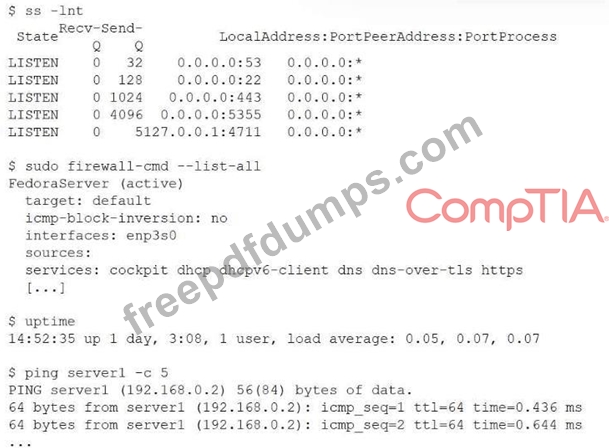
Users cannot access a server after it has been restarted. At the server console, the administrator runs the following commands; Which of the following is the cause of the issue?
Correct Answer: B
This issue is a classic example of post-reboot connectivity troubleshooting, which falls under the Troubleshooting domain of CompTIA Linux+ V8. The administrator has correctly gathered evidence using multiple diagnostic tools, allowing the root cause to be identified through correlation. The ss -lnt output confirms that the SSH daemon is running and listening on TCP port 22. This eliminates the possibility that the SSH service failed to start after reboot. Additionally, the uptime output shows a very low load average, indicating that system performance is not a limiting factor. The successful ping test confirms that the server is reachable at the network layer and that DNS resolution and basic connectivity are functioning correctly. The critical clue comes from the firewall configuration. The output of firewall-cmd --list-all shows that only specific services are allowed through the firewall, such as https, dns, and cockpit. The SSH service is notably absent. On systems using firewalld, services must be explicitly allowed, even if the daemon itself is running and listening on the correct port. As a result, incoming SSH connection attempts are being blocked by the firewall, preventing users from accessing the server remotely after reboot. This aligns precisely with option B. The other options are incorrect. DNS is functioning, as shown by successful ping responses. System load is low and not contributing to the issue. There is no indication that users are attempting to access the web server using an incorrect protocol. Linux+ V8 documentation emphasizes that administrators must verify both service status and firewall rules when diagnosing access issues. In this case, allowing SSH with a command such as firewall-cmd --add- service=ssh --permanent followed by a reload would resolve the problem.
XK0-006 Exam Question 37
A systems administrator wants to prevent the current contents of a file from being overwritten and wants to allow new additions at the end of the file. Which of the following commands should the administrator use?
Correct Answer: C
File attribute management is an important system administration skill included in Linux+ V8. In this scenario, the administrator needs to ensure that a file cannot be modified or truncated, while still allowing data to be appended. The correct solution is chattr +a file, which sets the append-only attribute on the file. When this attribute is enabled, the file's existing contents cannot be altered or deleted, but new data can be appended to the end of the file. This is commonly used for protecting log files from tampering while still allowing normal logging operations. The other options are incorrect. setenforce controls SELinux enforcement mode and does not affect file write behavior. setfacl modifies access control lists but does not enforce append-only semantics. chmod +t applies the sticky bit, which is primarily used on directories to prevent users from deleting files they do not own. Linux+ V8 documentation explicitly references chattr and immutable or append-only attributes as mechanisms for protecting critical files from accidental or malicious modification.
XK0-006 Exam Question 38
A systems administrator is configuring new Linux systems and needs to enable passwordless authentication between two of the servers. Which of the following commands should the administrator use?
Correct Answer: A
Comprehensive and Detailed 250 to 350 words of Explanation From Linux+ V8 documents: Passwordless authentication using SSH key pairs is a foundational security practice covered in the Security domain of CompTIA Linux+ V8. It allows administrators to securely authenticate between systems without transmitting passwords over the network, significantly reducing the risk of credential compromise. The correct approach involves two essential steps: generating an SSH key pair and installing the public key on the remote system. Option A correctly performs both steps using best-practice commands. The command ssh-keygen -t rsa generates an RSA public/private key pair in the user's ~/.ssh/ directory. The private key (id_rsa) remains securely on the local system, while the public key (id_rsa.pub) is intended to be shared. The second part of the command, ssh-copy-id -i ~/.ssh/id_rsa.pub john@server2, securely copies the public key to the remote server's ~/.ssh/authorized_keys file. This enables key-based authentication for the specified user. The other options are incorrect or incomplete. Option B uses ssh-keyscan, which is intended for collecting host keys to populate known_hosts, not for user authentication. Option C misuses ssh-agent, which manages keys already generated and does not create or install them. Option D is insecure and incorrect because copying the entire .ssh directory risks exposing private keys and violates security best practices. Linux+ V8 documentation emphasizes the use of ssh-keygen and ssh-copy-id as the standard, secure method for configuring passwordless SSH access. This approach ensures proper permissions, correct key placement, and minimal risk.
XK0-006 Exam Question 39
A DevOps engineer needs to create a local Git repository. Which of the following commands should the engineer use?
Correct Answer: A
Version control is a core DevOps practice, and CompTIA Linux+ V8 includes Git fundamentals as part of automation and orchestration objectives. To create a new local Git repository, the correct command is git init. The git init command initializes a new Git repository in the current directory by creating a hidden .git directory. This directory contains all the metadata required for version control, including commit history, branches, configuration settings, and object storage. After running git init, the directory becomes a fully functional local repository ready to track files and commits. The other options do not create a new repository. git clone is used to copy an existing remote repository to a local system, not to create a new one. git config is used to set Git configuration values such as username, email, or default editor. git add stages files for commit but only works after a repository has already been initialized. Linux+ V8 documentation highlights git init as the foundational command for starting version control in new projects. This command is frequently used in DevOps workflows when creating infrastructure-as-code repositories, automation scripts, or application source trees from scratch. By initializing a local repository, engineers can begin tracking changes, collaborating with others, and integrating Git into CI/CD pipelines. Therefore, the correct answer is A. git init.
XK0-006 Exam Question 40
A Linux administrator is testing a web application on a laboratory service and needs to temporarily allow DNS and HTTP/HTTPS traffic from the internal network. Which of the following commands will accomplish this task?
Correct Answer: C
Comprehensive and Detailed Explanation From Exact Extract: The correct way to temporarily allow specific services in a particular zone with firewalld is to use firewall- cmd --add-service=service --zone=zone. Multiple services can be specified in curly braces and separated by commas. The correct syntax is: bash CopyEdit firewall-cmd --add-service={dns,http,https} --zone=internal This command will allow DNS (port 53), HTTP (port 80), and HTTPS (port 443) through the firewall for the "internal" zone temporarily (for the current runtime session). Other options: * A. The command syntax is incorrect; firewalld is a service, not a command-line tool. * B. iptables does not use the --enable-service flag, nor does it have zones in this way. * D. systemctl mask disables services, and the rest of the command is invalid. Reference: CompTIA Linux+ Study Guide: Exam XK0-006, Sybex, Chapter 9: "Networking", Section: "Managing Firewalls with firewalld" CompTIA Linux+ XK0-006 Objectives, Domain 2.0: Networking