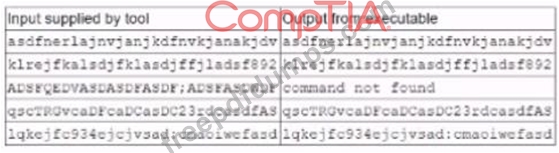
A security analyst is running a tool against an executable of an unknown source. The Input supplied by the tool to the executable program and the output from the executable are shown below: Which of the following should the analyst report after viewing this Information?
Correct Answer: C
A buffer overflow is a type of attack that exploits a vulnerability in an application or program that does not properly check the size or boundaries of an input. A buffer overflow occurs when an attacker supplies more data than the buffer can hold, causing the excess data to overwrite adjacent memory locations. This can result in unpredictable behavior, such as crashes, errors, data corruption, or execution of malicious code2 The tool that the analyst ran against the executable supplied an input that was too long for the buffer allocated by the executable. This caused a buffer overflow in the executable's memory, as indicated by the error message "Segmentation fault (core dumped)".
CS0-002 Exam Question 42
A business recently acquired a software company. The software company's security posture is unknown. However, based on an assessment, there are limited security controls. No significant security monitoring exists. Which of the following is the NEXT step that should be completed to obtain information about the software company's security posture?
Correct Answer: A
An asset inventory is a list of all the hardware, software, data, and other resources that an organization owns or uses. An asset inventory helps to identify what systems are present in an organization, where they are located, what they do, and how they are configured2 Developing an asset inventory is the next step that should be completed to obtain information about the software company's security posture, as it provides a baseline for further analysis and assessment of the systems' vulnerabilities and risks.
CS0-002 Exam Question 43
A security analyst is scanning the network to determine if a critical security patch was applied to all systems in an enterprise. The Organization has a very low tolerance for risk when it comes to resource availability. Which of the following is the BEST approach for configuring and scheduling the scan?
Correct Answer: D
A vulnerability scan is a process of identifying and assessing known vulnerabilities in a system or network using automated tools or software1 A vulnerability scan can help improve the security posture of a vulnerability management program by detecting and prioritizing potential weaknesses that could be exploited by attackers. To increase the security posture of a vulnerability scan, the following actions can be taken: Expand the ports being scanned to include all ports: This means scanning all possible ports on a system or network, not just the well-known or commonly used ones. This can help discover more vulnerabilities that may be hidden or overlooked on less frequently used ports. Increase the scan interval to a number the business will accept without causing service interruption: This means scanning more frequently or regularly, but not so often that it causes performance issues or downtime for the system or network. This can help keep up with new vulnerabilities that may emerge over time and reduce the window of opportunity for attackers. Enable authentication and perform credentialed scans: This means using login credentials or SSH keys on an asset to get deeper access to its data, processes, configurations, and vulnerabilities2 This can help discover more vulnerabilities that cannot be seen from the network, such as insecure versions of software or poor security permissions.
CS0-002 Exam Question 44
A security analyst observes a large amount of scanning activity coming from an IP address outside the organization's environment. Which of the following should the analyst do to block this activity?
Correct Answer: C
A firewall is a device or software that controls the incoming and outgoing network traffic based on predefined rules. Creating a firewall rule to block the IP address that is scanning the organization's environment is an effective way to stop this activity and prevent potential attacks. Creating an IPS rule to block the subnet, sinkholing the IP address, or closing all unnecessary open ports are other possible actions, but they are not as specific or efficient as creating a firewall rule to block the IP address. Reference: https://www.cisco.com/c/en/us/solutions/small-business/resource-center/security/firewall.html
CS0-002 Exam Question 45
A security analyst is deploying a new application in the environment. The application needs to be integrated with several existing applications that contain SPI Pnor to the deployment, the analyst should conduct:
Correct Answer: C
A PCI assessment should be conducted prior to the deployment of a new application that contains SPI (Sensitive Personal Information). A PCI assessment is an evaluation of how well an organization complies with the Payment Card Industry Data Security Standard (PCI DSS), which is a set of requirements for protecting cardholder data. PCI DSS applies to any organization that stores, processes, or transmits cardholder data, such as credit card numbers, expiration dates, or security codes4. A PCI assessment can help identify and remediate any gaps or weaknesses in the security controls of an application that handles cardholder data.