

SSCP Exam Question 116
Attributes that characterize an attack are stored for reference using which of the following Intrusion Detection System (IDS) ?
Correct Answer: A
Section: Analysis and Monitoring
Explanation/Reference:
Source: KRUTZ, Ronald L. & VINES, Russel D., The CISSP Prep Guide: Mastering the Ten Domains of Computer Security, 2001, John Wiley & Sons, Page 49.
Explanation/Reference:
Source: KRUTZ, Ronald L. & VINES, Russel D., The CISSP Prep Guide: Mastering the Ten Domains of Computer Security, 2001, John Wiley & Sons, Page 49.
SSCP Exam Question 117
Attributable data should be:
Correct Answer: A
Explanation/Reference:
As per FDA data should be attributable, original, accurate, contemporaneous and legible. In an automated system attributability could be achieved by a computer system designed to identify individuals responsible for any input.
Source: U.S. Department of Health and Human Services, Food and Drug Administration, Guidance for Industry - Computerized Systems Used in Clinical Trials, April 1999, page 1.
SSCP Exam Question 118
Which of the following is a LAN transmission method?
Correct Answer: A
LAN transmission methods refer to the way packets are sent on the network
and are either unicast, multicast or broadcast.
CSMA/CD is a common LAN media access method.
Token ring is a LAN Topology.
LAN transmission protocols are the rules for communicating between computers on a LAN.
Common LAN transmission protocols are: polling and token-passing.
A LAN topology defines the manner in which the network devices are organized to facilitate
communications.
Common LAN topologies are: bus, ring, star or meshed.
LAN transmission methods refer to the way packets are sent on the network and are either
unicast, multicast or broadcast.
LAN media access methods control the use of a network (physical and data link layers).
They can be Ethernet, ARCnet, Token ring and FDDI.
Source: KRUTZ, Ronald L. & VINES, Russel D., The CISSP Prep Guide: Mastering the
Ten Domains of Computer Security, John Wiley & Sons, 2001, Chapter 3:
Telecommunications and Network Security (page 103).
HERE IS A NICE OVERVIEW FROM CISCO:
LAN Transmission Methods
LAN data transmissions fall into three classifications: unicast, multicast, and broadcast. In each type of transmission, a single packet is sent to one or more nodes.
In a unicast transmission, a single packet is sent from the source to a destination on a network. First, the source node addresses the packet by using the address of the destination node. The package is then sent onto the network, and finally, the network passes the packet to its destination.
A multicast transmission consists of a single data packet that is copied and sent to a specific subset of nodes on the network. First, the source node addresses the packet by using a multicast address. The packet is then sent into the network, which makes copies of the packet and sends a copy to each node that is part of the multicast address.
A broadcast transmission consists of a single data packet that is copied and sent to all nodes on the network. In these types of transmissions, the source node addresses the packet by using the broadcast address. The packet is then sent on to the network, which makes copies of the packet and sends a copy to every node on the network. LAN Topologies LAN topologies define the manner in which network devices are organized. Four common LAN topologies exist: bus, ring, star, and tree. These topologies are logical architectures, but the actual devices need not be physically organized in these configurations. Logical bus and ring topologies, for example, are commonly organized physically as a star. A bus topology is a linear LAN architecture in which transmissions from network stations propagate the length of the medium and are received by all other stations. Of the three most widely used LAN implementations, Ethernet/IEEE 802.3 networks-including 100BaseT-implement a bus topology
Sources:
KRUTZ, Ronald L. & VINES, Russel D., The CISSP Prep Guide: Mastering the Ten Domains of Computer Security, John Wiley & Sons, 2001, Chapter 3: Telecommunications and Network Security (page 104). http://www.cisco.com/univercd/cc/td/doc/cisintwk/ito_doc/introlan.htm
SSCP Exam Question 119
Which authentication technique best protects against hijacking?
Correct Answer: B
A continuous authentication provides protection against impostors who can see, alter, and insert information passed between the claimant and verifier even after the claimant/verifier authentication is complete. This is the best protection against hijacking. Static authentication is the type of authentication provided by traditional password schemes and the strength of the authentication is highly dependent on the difficulty of guessing passwords. The robust authentication mechanism relies on dynamic authentication data that changes with each authenticated session between a claimant and a verifier, and it does not protect against hijacking. Strong authentication refers to a two-factor authentication (like something a user knows and something a user is). Source: TIPTON, Harold F. & KRAUSE, Micki, Information Security Management Handbook, 4th edition (volume 1), 2000, CRC Press, Chapter 3: Secured Connections to External Networks (page 51).
SSCP Exam Question 120
During which phase of an IT system life cycle are security requirements developed?
Correct Answer: C
The software development life cycle (SDLC) (sometimes referred to as the System Development Life Cycle) is the process of creating or altering software systems, and the models and methodologies that people use to develop these systems.
The NIST SP 800-64 revision 2 has within the description section of para 3.2.1:
This section addresses security considerations unique to the second SDLC phase. Key security activities for this phase include:
Conduct the risk assessment and use the results to supplement the baseline security controls;
Analyze security requirements;
Perform functional and security testing;
Prepare initial documents for system certification and accreditation; and
Design security architecture.
Reviewing this publication you may want to pick development/acquisition. Although initiation would be a decent choice, it is correct to say during this phase you would only brainstorm the idea of security requirements. Once you start to develop and acquire hardware/software components then you would also develop the security controls for these. The Shon Harris reference below is correct as well.
Shon Harris' Book (All-in-One CISSP Certification Exam Guide) divides the SDLC differently:
Project initiation Functional design analysis and planning System design specifications Software development Installation Maintenance support Revision and replacement
According to the author (Shon Harris), security requirements should be developed during the functional design analysis and planning phase.
SDLC POSITIONING FROM NIST 800-64
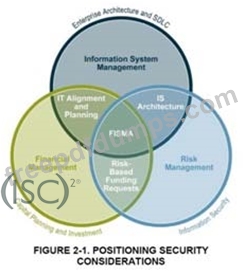
SDLC Positioning in the enterprise Information system security processes and activities provide valuable input into managing IT systems and their development, enabling risk identification, planning and mitigation. A risk management approach involves continually balancing the protection of agency information and assets with the cost of security controls and mitigation strategies throughout the complete information system development life cycle (see Figure 2-1 above). The most effective way to implement risk management is to identify critical assets and operations, as well as systemic vulnerabilities across the agency. Risks are shared and not bound by organization, revenue source, or topologies. Identification and verification of critical assets and operations and their interconnections can be achieved through the system security planning process, as well as through the compilation of information from the Capital Planning and Investment Control (CPIC) and Enterprise Architecture (EA) processes to establish insight into the agency's vital business operations, their supporting assets, and existing interdependencies and relationships.
With critical assets and operations identified, the organization can and should perform a business impact analysis (BIA). The purpose of the BIA is to relate systems and assets with the critical services they provide and assess the consequences of their disruption. By identifying these systems, an agency can manage security effectively by establishing priorities. This positions the security office to facilitate the IT program's cost-effective performance as well as articulate its business impact and value to the agency.
SDLC OVERVIEW FROM NIST 800-64 SDLC Overview from NIST 800-64 Revision 2
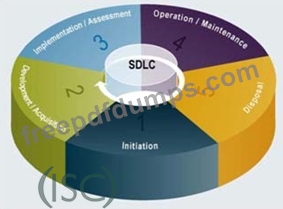
NIST 800-64 Revision 2 is one publication within the NISTstandards that I would
recommend you look at for more details about the SDLC. It describe in great details what
activities would take place and they have a nice diagram for each of the phases of the
SDLC. You will find a copy at:
http://csrc.nist.gov/publications/nistpubs/800-64-Rev2/SP800-64-Revision2.pdf
DISCUSSION:
Different sources present slightly different info as far as the phases names are concerned.
People sometimes gets confused with some of the NIST standards. For example NIST
800-64 Security Considerations in the Information System Development Life Cycle has
slightly different names, the activities mostly remains the same.
NIST clearly specifies that Security requirements would be considered throughout ALL of
the phases. The keyword here is considered, if a question is about which phase they would
be developed than Functional Design Analysis would be the correct choice.
Within the NIST standard they use different phase, howeverr under the second phase you
will see that they talk specifically about Security Functional requirements analysis which
confirms it is not at the initiation stage so it become easier to come out with the answer to
this question. Here is what is stated:
The security functional requirements analysis considers the system security environment, including the enterprise information security policy and the enterprise security architecture. The analysis should address all requirements for confidentiality, integrity, and availability of information, and should include a review of all legal, functional, and other security requirements contained in applicable laws, regulations, and guidance.
At the initiation step you would NOT have enough detailed yet to produce the Security Requirements. You are mostly brainstorming on all of the issues listed but you do not develop them all at that stage.
By considering security early in the information system development life cycle (SDLC), you may be able to avoid higher costs later on and develop a more secure system from the start.
NIST says: NIST`s Information Technology Laboratory recently issued Special Publication (SP) 80064, Security Considerations in the Information System Development Life Cycle, by Tim Grance, Joan Hash, and Marc Stevens, to help organizations include security requirements in their planning for every phase of the system life cycle, and to select, acquire, and use appropriate and cost-effective security controls.
I must admit this is all very tricky but reading skills and paying attention to KEY WORDS is a must for this exam.
References:
HARRIS, Shon, All-In-One CISSP Certification Exam Guide, McGraw-Hill/Osborne, Fifth Edition, Page 956 and NIST S-64 Revision 2 at http://csrc.nist.gov/publications/nistpubs/800-64-Rev2/SP800-64Revision2.pdf and http://www.mks.com/resources/resource-pages/software-development-life-cycle-sdlcsystem-development
The NIST SP 800-64 revision 2 has within the description section of para 3.2.1:
This section addresses security considerations unique to the second SDLC phase. Key security activities for this phase include:
Conduct the risk assessment and use the results to supplement the baseline security controls;
Analyze security requirements;
Perform functional and security testing;
Prepare initial documents for system certification and accreditation; and
Design security architecture.
Reviewing this publication you may want to pick development/acquisition. Although initiation would be a decent choice, it is correct to say during this phase you would only brainstorm the idea of security requirements. Once you start to develop and acquire hardware/software components then you would also develop the security controls for these. The Shon Harris reference below is correct as well.
Shon Harris' Book (All-in-One CISSP Certification Exam Guide) divides the SDLC differently:
Project initiation Functional design analysis and planning System design specifications Software development Installation Maintenance support Revision and replacement
According to the author (Shon Harris), security requirements should be developed during the functional design analysis and planning phase.
SDLC POSITIONING FROM NIST 800-64
SDLC Positioning in the enterprise Information system security processes and activities provide valuable input into managing IT systems and their development, enabling risk identification, planning and mitigation. A risk management approach involves continually balancing the protection of agency information and assets with the cost of security controls and mitigation strategies throughout the complete information system development life cycle (see Figure 2-1 above). The most effective way to implement risk management is to identify critical assets and operations, as well as systemic vulnerabilities across the agency. Risks are shared and not bound by organization, revenue source, or topologies. Identification and verification of critical assets and operations and their interconnections can be achieved through the system security planning process, as well as through the compilation of information from the Capital Planning and Investment Control (CPIC) and Enterprise Architecture (EA) processes to establish insight into the agency's vital business operations, their supporting assets, and existing interdependencies and relationships.
With critical assets and operations identified, the organization can and should perform a business impact analysis (BIA). The purpose of the BIA is to relate systems and assets with the critical services they provide and assess the consequences of their disruption. By identifying these systems, an agency can manage security effectively by establishing priorities. This positions the security office to facilitate the IT program's cost-effective performance as well as articulate its business impact and value to the agency.
SDLC OVERVIEW FROM NIST 800-64 SDLC Overview from NIST 800-64 Revision 2
NIST 800-64 Revision 2 is one publication within the NISTstandards that I would
recommend you look at for more details about the SDLC. It describe in great details what
activities would take place and they have a nice diagram for each of the phases of the
SDLC. You will find a copy at:
http://csrc.nist.gov/publications/nistpubs/800-64-Rev2/SP800-64-Revision2.pdf
DISCUSSION:
Different sources present slightly different info as far as the phases names are concerned.
People sometimes gets confused with some of the NIST standards. For example NIST
800-64 Security Considerations in the Information System Development Life Cycle has
slightly different names, the activities mostly remains the same.
NIST clearly specifies that Security requirements would be considered throughout ALL of
the phases. The keyword here is considered, if a question is about which phase they would
be developed than Functional Design Analysis would be the correct choice.
Within the NIST standard they use different phase, howeverr under the second phase you
will see that they talk specifically about Security Functional requirements analysis which
confirms it is not at the initiation stage so it become easier to come out with the answer to
this question. Here is what is stated:
The security functional requirements analysis considers the system security environment, including the enterprise information security policy and the enterprise security architecture. The analysis should address all requirements for confidentiality, integrity, and availability of information, and should include a review of all legal, functional, and other security requirements contained in applicable laws, regulations, and guidance.
At the initiation step you would NOT have enough detailed yet to produce the Security Requirements. You are mostly brainstorming on all of the issues listed but you do not develop them all at that stage.
By considering security early in the information system development life cycle (SDLC), you may be able to avoid higher costs later on and develop a more secure system from the start.
NIST says: NIST`s Information Technology Laboratory recently issued Special Publication (SP) 80064, Security Considerations in the Information System Development Life Cycle, by Tim Grance, Joan Hash, and Marc Stevens, to help organizations include security requirements in their planning for every phase of the system life cycle, and to select, acquire, and use appropriate and cost-effective security controls.
I must admit this is all very tricky but reading skills and paying attention to KEY WORDS is a must for this exam.
References:
HARRIS, Shon, All-In-One CISSP Certification Exam Guide, McGraw-Hill/Osborne, Fifth Edition, Page 956 and NIST S-64 Revision 2 at http://csrc.nist.gov/publications/nistpubs/800-64-Rev2/SP800-64Revision2.pdf and http://www.mks.com/resources/resource-pages/software-development-life-cycle-sdlcsystem-development
Premium Bundle
Newest SSCP Exam PDF Dumps shared by Actual4test.com for Helping Passing SSCP Exam! Actual4test.com now offer the updated SSCP exam dumps, the Actual4test.com SSCP exam questions have been updated and answers have been corrected get the latest Actual4test.com SSCP pdf dumps with Exam Engine here:
(1338 Q&As Dumps, 30%OFF Special Discount: Freepdfdumps)
- Other Version
- 77ISC.Vceprep.SSCP.v2022-05-30.by.mildred.592q.pdf
- 12734ISC.SSCP.v2022-05-14.q592
- 20058ISC.SSCP.v2022-01-26.q859
- 112ISC.Exam4labs.SSCP.v2021-08-27.by.janice.837q.pdf
- Latest Upload
- 204Microsoft.DP-900.v2026-11-23.q149
- 154Anthropic.CCAR-F.v2026-11-23.q30
- 237CISI.IFC.v2026-11-23.q238
- 159Salesforce.AP-208.v2026-11-23.q45
- 148Microsoft.AB-730.v2026-11-23.q38
- 204Microsoft.DP-300.v2026-11-23.q209
- 146Huawei.H13-811_V3.5.v2026-11-23.q26
- 264Microsoft.AZ-400.v2026-11-21.q249
- 413Microsoft.PL-900.v2026-11-20.q196
- 178Oracle.1z0-1085-26.v2026-11-19.q25