Organizations should consider which of the following first before allowing external access to their LANs via the Internet?
Correct Answer: D
Before a LAN is connected to the Internet, you need to determine what the access controls mechanisms are to be used, this would include how you are going to authenticate individuals that may access your network externally through access control. The following answers are incorrect: plan for implementing workstation locking mechanisms. This is incorrect because locking the workstations have no impact on the LAN or Internet access. plan for protecting the modem pool. This is incorrect because protecting the modem pool has no impact on the LAN or Internet access, it just protects the modem. plan for providing the user with his account usage information. This is incorrect because the question asks what should be done first. While important your primary concern should be focused on security.
SSCP Exam Question 132
A proxy is considered a:
Correct Answer: C
Explanation/Reference: The proxy (application layer firewall, circuit level proxy, or application proxy ) is a second generation firewall "First generation firewall" incorrect. A packet filtering firewall is a first generation firewall. "Third generation firewall" is incorrect. Stateful Firewall are considered third generation firewalls "Fourth generation firewall" is incorrect. Dynamic packet filtering firewalls are fourth generation firewalls References: CBK, p. 464 AIO3, pp. 482 - 484 Neither CBK or AIO3 use the generation terminology for firewall types but you will encounter it frequently as a practicing security professional. See http://www.cisco.com/univercd/cc/td/doc/product/iaabu/centri4/ user/scf4ch3.htm for a general discussion of the different generations.
SSCP Exam Question 133
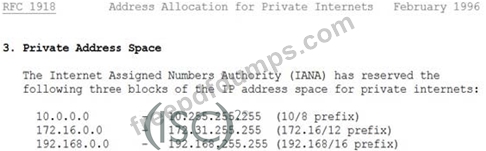
Which of the following is an IP address that is private (i.e. reserved for internal networks, and not a valid address to use on the Internet)?
Correct Answer: A
This is a valid Class A reserved address. For Class A, the reserved addresses are 10.0.0.0 - 10.255.255.255. The following answers are incorrect: 11.0.42.5 Is incorrect because it is not a Class A reserved address. 12.0.42.5 Is incorrect because it is not a Class A reserved address. 13.0.42.5 Is incorrect because it is not a Class A reserved address. The private IP address ranges are defined within RFC 1918: RFC 1918 private ip address range References: 3Com http://www.3com.com/other/pdfs/infra/corpinfo/en_US/501302.pdf AIOv3 Telecommunications and Networking Security (page 438)
SSCP Exam Question 134
In the process of gathering evidence from a computer attack, a system administrator took a series of actions which are listed below. Can you identify which one of these actions has compromised the whole evidence collection process?
Correct Answer: D
Explanation/Reference: Displaying the directory contents of a folder can alter the last access time on each listed file. Using a write blocker is wrong because using a write blocker ensure that you cannot modify the data on the host and it prevent the host from writing to its hard drives. Made a full-disk image is wrong because making a full-disk image can preserve all data on a hard disk, including deleted files and file fragments. Created a message digest for log files is wrong because creating a message digest for log files. A message digest is a cryptographic checksum that can demonstrate that the integrity of a file has not been compromised (e.g. changes to the content of a log file) Domain: LEGAL, REGULATIONS, COMPLIANCE AND INVESTIGATIONS References: AIO 3rd Edition, page 783-784 NIST 800-61 Computer Security Incident Handling guide page 3-18 to 3-20
SSCP Exam Question 135
When referring to a computer crime investigation, which of the following would be the MOST important step required in order to preserve and maintain a proper chain of custody of evidence:
Correct Answer: C
Explanation/Reference: Two concepts that are at the heart of dealing effectively with digital/electronic evidence, or any evidence for that matter, are the chain of custody and authenticity/integrity. The chain of custody refers to the who, what, when, where, and how the evidence was handled-from its identification through its entire life cycle, which ends with destruction or permanent archiving. Any break in this chain can cast doubt on the integrity of the evidence and on the professionalism of those directly involved in either the investigation or the collection and handling of the evidence. The chain of custody requires following a formal process that is well documented and forms part of a standard operating procedure that is used in all cases, no exceptions. The following are incorrect answers: Evidence has to be collected in accordance with all laws and legal regulations. Evidence would have to be collected in accordance with applicable laws and regulations but not necessarily with ALL laws and regulations. Only laws and regulations that applies would be followed. Law enforcement officials should be contacted for advice on how and when to collect critical information. It seems you failed to do your homework, once you have an incident it is a bit late to do this. Proper crime investigation as well as incident response is all about being prepared ahead of time. Obviously, you are improvising if you need to call law enforcement to find out what to do. It is a great way of contaminating your evidence by mistake if you don't have a well documented processs with clear procedures that needs to be followed. Log files containing information regarding an intrusion are retained for at least as long as normal business records, and longer in the case of an ongoing investigation. Specific legal requirements exists for log retention and they are not the same as normal business records. Laws such as Basel, HIPPAA, SOX, and others has specific requirements. Reference(s) used for this question: Hernandez CISSP, Steven (2012-12-21). Official (ISC)2 Guide to the CISSP CBK, Third Edition ((ISC)2 Press) (Kindle Locations 23465-23470). Auerbach Publications. Kindle Edition. and ALLEN, Julia H., The CERT Guide to System and Network Security Practices, Addison-Wesley, 2001, Chapter 7: Responding to Intrusions (pages 282-285).