

CTAL-TM_Syll2012 Exam Question 56
Test Management
You are managing the system testing for a SOA based system. The integrated system consists of several subsystems:
- a SOA middleware
- a CRM (Customer Relationship Management) system
- a BRM (Billing and Revenue Management) system
- a SMS (Subscriber Management System) system
and you performed a risk analysis based on these subsystems.
At the end of the scheduled period for test execution you produce a first classical report based on the traditional metrics of testing. Test pass/fail status and bug status (open/resolved) That table provides you a distorted picture of the quality risk, because there is no indication of the risk level of the failed tests, the tests not run, or the open bugs. Thus, you produce the following table to solve this distortion issue:
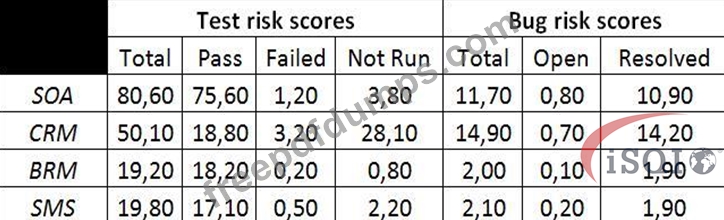
In the table above, where you have introduced the concept of risk weighting, the highest risk test or bug report has a score of 1, while the lowest risk test or bug report has a score of 0.04.
Which of the following subsystems, based on the risk scores of the table, is most risky?
Number of correct responses: 1
K4 3 credits
You are managing the system testing for a SOA based system. The integrated system consists of several subsystems:
- a SOA middleware
- a CRM (Customer Relationship Management) system
- a BRM (Billing and Revenue Management) system
- a SMS (Subscriber Management System) system
and you performed a risk analysis based on these subsystems.
At the end of the scheduled period for test execution you produce a first classical report based on the traditional metrics of testing. Test pass/fail status and bug status (open/resolved) That table provides you a distorted picture of the quality risk, because there is no indication of the risk level of the failed tests, the tests not run, or the open bugs. Thus, you produce the following table to solve this distortion issue:
In the table above, where you have introduced the concept of risk weighting, the highest risk test or bug report has a score of 1, while the lowest risk test or bug report has a score of 0.04.
Which of the following subsystems, based on the risk scores of the table, is most risky?
Number of correct responses: 1
K4 3 credits
CTAL-TM_Syll2012 Exam Question 57
During the follow-up phase the following conditions are checked:
X1. The code has been completely reviewed
X2. All the identified defects have been correctly fixed and the modified code has been compiled successfully and run through all the static analyzers used by the project without warnings and errors X3. The modified code is available under the configuration management system with a new version number for the specified CI If these conditions are fulfilled then the review process terminates.
Which of the following characteristics of a formal review is missing in this description?
Number of correct responses: 1
K2 1 credit
X1. The code has been completely reviewed
X2. All the identified defects have been correctly fixed and the modified code has been compiled successfully and run through all the static analyzers used by the project without warnings and errors X3. The modified code is available under the configuration management system with a new version number for the specified CI If these conditions are fulfilled then the review process terminates.
Which of the following characteristics of a formal review is missing in this description?
Number of correct responses: 1
K2 1 credit
CTAL-TM_Syll2012 Exam Question 58
A chart showing the trend in the lag time from defect reporting to resolution during system testing is also available. The chart shows that the daily closure period is consistently and significantly above the rolling closure period for a long period of the system testing phase.
Almost all defects found during system testing have been related to the system as a whole, not related to single units or integrations issues. Almost all quality risks have been addressed during the unit and integration testing phase and no residual quality risks were present in the integrated system. This has been confirmed by exploratory testing sessions performed during system testing, targeted at finding defects in these quality risk areas.
Based on the given information only, which one of the following areas would you expect to be considered more in the retrospective meeting in order to be improved?
Number of correct responses: 1
K3 3 credits
Almost all defects found during system testing have been related to the system as a whole, not related to single units or integrations issues. Almost all quality risks have been addressed during the unit and integration testing phase and no residual quality risks were present in the integrated system. This has been confirmed by exploratory testing sessions performed during system testing, targeted at finding defects in these quality risk areas.
Based on the given information only, which one of the following areas would you expect to be considered more in the retrospective meeting in order to be improved?
Number of correct responses: 1
K3 3 credits
CTAL-TM_Syll2012 Exam Question 59
People Skills - Team Composition
Assume you are managing the system testing execution phase of a project.
The system test execution period for that project is scheduled for eighteen weeks and the release date is scheduled at the end of system testing.
During the sixth week of system test execution, at the staff meeting, the project manager informs you that the project deadlines are changed and the release date that is only three weeks ahead.
This new release will not allow the completion of the system tests. Suppose also that you have followed a risk-driven test approach for this project.
Which of the following statements represents the worst way to lead your test team in the next three weeks?
Assume you are managing the system testing execution phase of a project.
The system test execution period for that project is scheduled for eighteen weeks and the release date is scheduled at the end of system testing.
During the sixth week of system test execution, at the staff meeting, the project manager informs you that the project deadlines are changed and the release date that is only three weeks ahead.
This new release will not allow the completion of the system tests. Suppose also that you have followed a risk-driven test approach for this project.
Which of the following statements represents the worst way to lead your test team in the next three weeks?
CTAL-TM_Syll2012 Exam Question 60
After the presentation, you are asked to explain the chart.
Assume you have applied a full risk-based testing strategy.
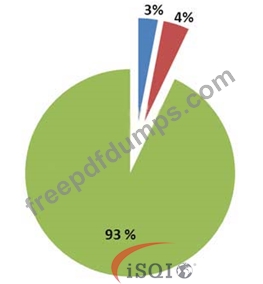
Which of the following answers would you expect to best describe the pie chart?
K4 3 credits
Assume you have applied a full risk-based testing strategy.
Which of the following answers would you expect to best describe the pie chart?
K4 3 credits